Washington will no longer impose tariffs on those who supply crude oil to Cuba in compliance with a ruling by the United States Supreme Court; But experts warn that the White House still has tools to prolong the energy siege, despite recently authorizing the sale of fuel to private Cubans as an opening gesture.
The decision, signed by President Donald Trump last week, eliminates one of the pillars of the January 29 executive order, but leaves in place the declaration of “national emergency” against Cuba, noted a dispatch from the Spanish agency EFE.
The ruling of the Supreme Court and the presidential order
The US Supreme Court ruled that it was not legal to impose punitive tariffs on oil suppliers under the International Emergency Economic Powers Act (IEEPA). In response, Trump signed a presidential order withdrawing that measure.
For John Kavulich, president of the US-Cuba Trade and Economic Council, the decision should not be interpreted as a shield for the island. “If it has teeth, it is still a tiger, it can still be scary,” he told the Spanish agency. EFE.
For his part, Cuban-American lawyer Pedro Freyre, partner at the Akerman law firm, agreed that the White House left the door open to other sanctions: “Knowing how they do things in this administration, I think I can assure that they are going to use other tools.”
Impact of energy blockage
The energy blockade, which the UN Human Rights Office considers contrary to international law, is already wreaking havoc in Cuba.
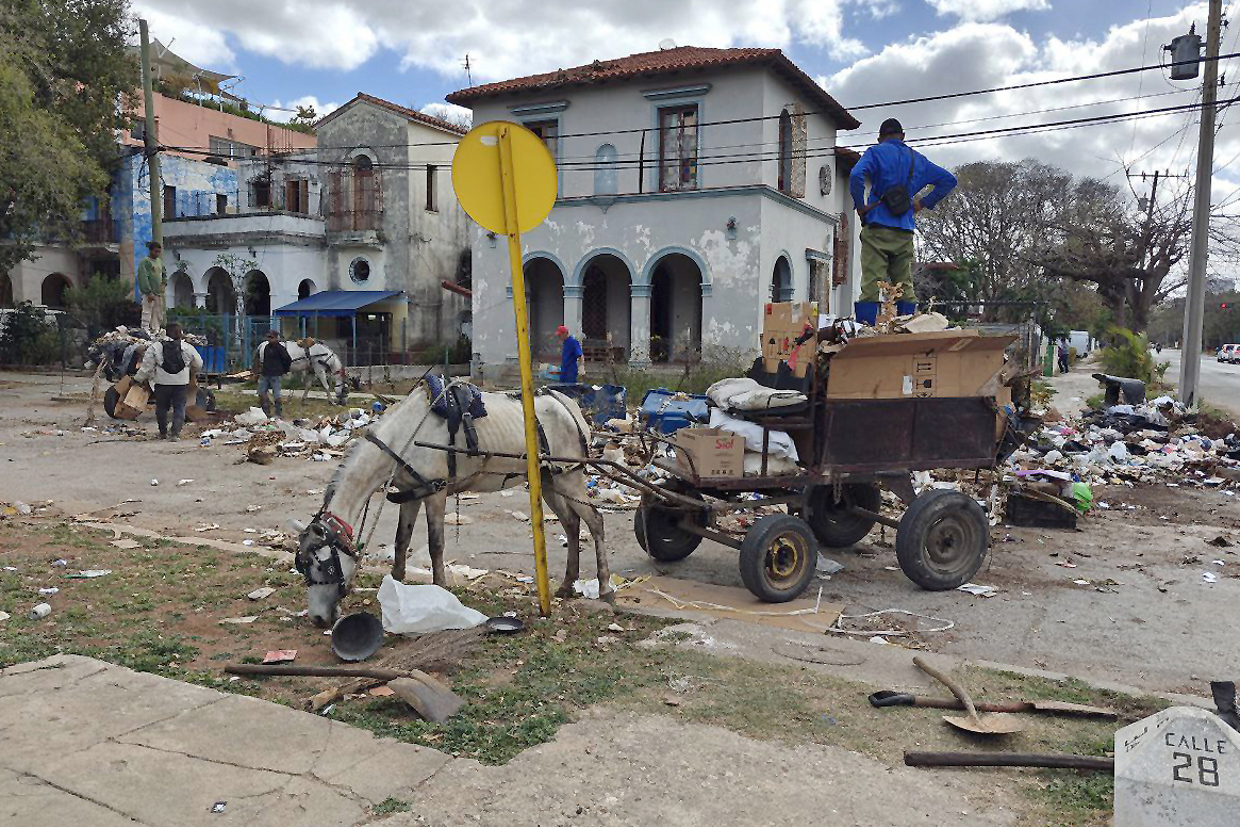
Hospitals and public transportation operate with minimal services, garbage accumulates in the streets due to lack of fuel for collection, and blackouts reach up to 20 hours a day in large areas of the country.
The economy is practically paralyzed, with the tourism sector in clear contraction, in a context of six years of deep crisis that forces two-thirds of energy needs to be imported.
The “fear tactic”
For Kavulich, Trump’s strategy is based on issuing threats in the hope that their deterrent effect will be sufficient. “It’s the fear tactic,” he explained.
The expert posed hypothetical scenarios: what would happen if Cuba bought oil from a country free of sanctions and transported it on a ship with all its papers in order, or if Russia sent an oil tanker escorted by a military ship. Although he considers it unlikely to happen, he warns that it would reveal the limits of American pressure.
Kavulich recognizes that there is “a minority” in Washington that would be willing to allow Russia or China to supply some oil to avoid a humanitarian crisis, but without lifting the energy fence.
Freyre, meanwhile, emphasizes that the US administration demands a policy change in Cuba, not necessarily a regime change. “We will accept the same people staying if they make better decisions,” Kavulich summarized.
The US arranges the sale of oil to private Cubans, according to Bloomberg
Partial opening: sale of energy to private parties
In this context, the Cuban government authorized the private sector to directly import fuel, often from Miami, as a way to partially save the oil siege. Washington seems to tolerate this measure, considering it an economic opening.
The decision marks a significant change: for the first time, private actors on the island can access energy without depending exclusively on the State, which opens a loophole in the maximum pressure policy.
This Tuesday, a US official cited by BloombergNews revealed that the Trump Administration is preparing new guidelines to clarify that energy companies can sell oil and fuel to private companies and Cuban individuals, without the need for a specific license and within the current legal framework.
The central fact is that the Departments of Commerce and the Treasury will issue formal guidelines for exporters and re-exporters, emphasizing that the current energy ban applies exclusively to sales to the Cuban government, not to the private sector or ordinary citizens.
Remembrance of Brothers to the Rescue
Bilateral tension intensified on the 30th anniversary, this Tuesday, February 24, of the downing of two Hermanos al Rescate planes by the Cuban Armed Forces, in which four pilots died. The State Department recalled the attack as a “barbaric act of terror” and promised to continue putting pressure on the “illegitimate Cuban regime.”
The fact maintains two conflicting narratives. According to Havana, the civilian ships were neutralized within Cuban airspace, but relatives of the victims and the United States government have maintained that the attack occurred in international airspace.
Exiles in Florida asked that Raúl Castro, then Minister of the Armed Forces, be charged with murder, while congressmen of Cuban origin such as María Elvira Salazar and Mario Díaz-Balart demanded accountability.
The Cuban community in Florida held vigils in honor of the fallen, convinced that the end of the regime is closer than ever due to Trump’s measures. “Thirty years later, our commitment to freedom burns stronger than ever,” said Salazar.