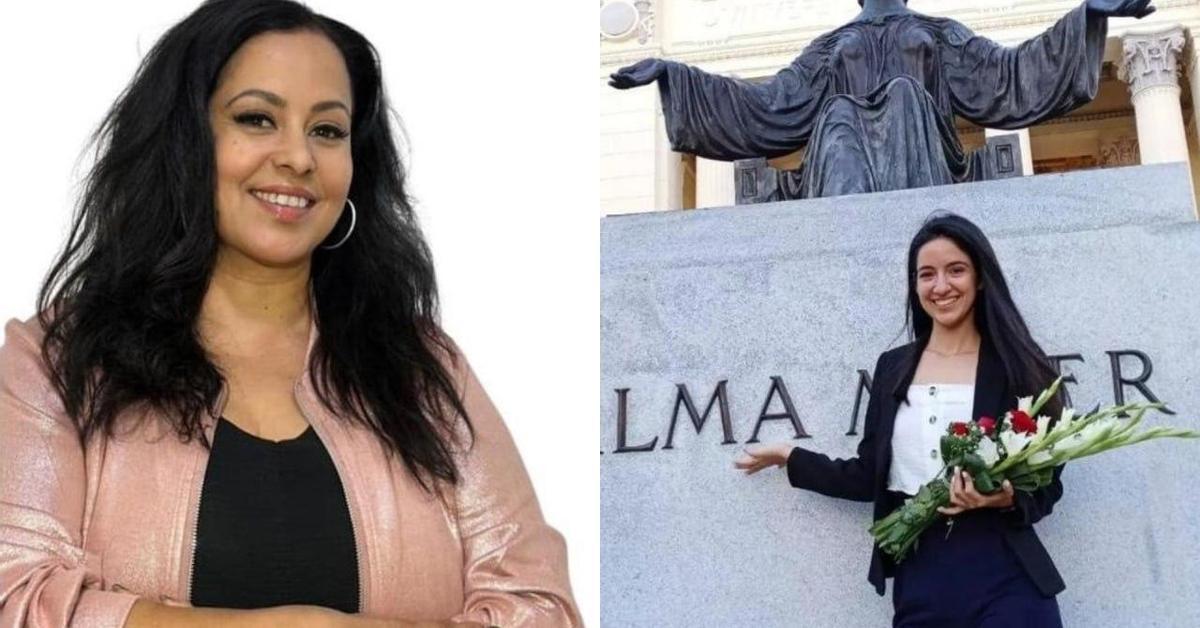
Madrid/There is no news about Tamara Valdés, the 39-year-old Cuban who disappeared after the train accident that occurred this Sunday night in Spain when two high-speed trains collided due to the derailment of one of them. The accident has claimed the lives of 41 people so far, although the toll could increase dramatically, since two cars have not yet been able to be lifted from one of the trains.
Tamara Valdés had lived in Huelva for several years. In that Andalusian province, the final destination of one of the trains, she lived with her husband Ramón Montón, who spoke to the local press this Monday while trying to locate her. “I’m very nervous, I still haven’t been able to locate her, it took me three hours from Huelva, I stepped on her a little bit. My wife was on the Alvia, I spoke to her 20 minutes before the accident. She almost missed the train,” he said yesterday while waiting at the municipal booth in Adamuz (Córdoba), the town closest to the point of the accident.
So far, the identity of another Cuban who was traveling on the same train, Daniela Arteaga, is known, whose luck has been much greater, as confirmed by her own mother through X early on Monday, when she said she was out of danger. The young woman, 28 years old and graduated from the Higher Institute of Design, had received a scholarship from the International University of Andalusia (UNIA) and had just arrived in Madrid, where she took the train to Huelva. “Within gravity, it is stable,” María de la O Barroso, director of the Ibero-American Headquarters of the Rábida of the UNIA, told the Spanish press.
The young woman, 28 years old and graduated from the Higher Institute of Design, had received a scholarship from the International University of Andalusia (UNIA) and had just arrived in Madrid, where she took the train to Huelva.
“She was traveling on the train that covered the Madrid-Huelva route and suffered fractures in several ribs and bruises on her head,” a friend of the young woman told OnCuba News. According to his version, Arteaga was very happy to have achieved the place for the postgraduate degree in Communication and Audiovisual Education, as well as to go to Spain, where he has no family.
The course director informed the students of the situation via email. “Today has been a very sad day for Huelva and for our master’s degree. The Adamuz train accident has filled all of Spain and especially our province with sadness,” wrote Ignacio Aguaded. “Our student Daniela Arteaga, who arrived yesterday in our land from her native Cuba, with the great hope of beginning the academic project of her life, found herself trapped in a mass of iron. Now, she continues fighting for her life in a hospital in Córdoba,” he added.
The rector of the institution, José Ignacio García Pérez, traveled to the Reina Sofía hospital in Córdoba to visit it along with other UNIA directors. “Hopefully we will have her soon in Huelva, here she will be cared for like her family.”
The visit of the kings, Felipe and Letizia, who have recently arrived from Greece to attend the funeral of an aunt of the head of state, is expected at the hospital center this Tuesday. There they will meet with survivors, relatives of the victims and teams of psychologists and rescue, together with the first vice president of the Government, María Jesús Montero, and the president of the Junta de Andalucía, Juanma Moreno.
On the ground, work continues to lift the wagons. This morning new large-tonnage cranes were received with which it is hoped that progress can be made in the complicated access to the wagons. In addition, there are 27 forensic experts from six Andalusian provinces involved in identifying the bodies, many of them based on the DNA of the families.
The accident has left an extensive emergency operation underway, the suspension of several railway connections and an open investigation to clarify its causes. The number of deaths in the train derailment reaches at least 41 people, with a total of 122 people treated by the accident, with 117 adults and five children. At this moment, there are 39 people admitted.
The accident occurred at 7:50 p.m. when the last two carriages of a train from the Italian company Iryo, which was traveling from Madrid to Malaga, left the track. At that time, an Alvia train from the state-owned Renfe, which was going from Madrid to Huelva, was traveling on the adjacent road and was hit.
The accident occurred at a speed lower than normal (both vehicles were traveling at just over 200 kilometers per hour compared to the 350 they can reach) and on a straight line. In addition, the Iryo had passed an inspection just four days before the incident, so the investigation focuses on the infrastructure to rule out any possibility.
In addition, the Iryo had passed an inspection just four days before the incident, so the investigation focuses on the infrastructure, ruling out any possibility.
The Railway Accident Investigation Commission (CIAF) has determined that it will be necessary to analyze “the rails at the starting point of the derailment” in the laboratory and will inspect the running of the Iryo train in the workshop, after the railway accident. They will also “extract data from the legal recorders on board of both trains” and “information on the circulation records through Adamuz in the two days prior to the event”, as well as inspections “of the running of other trains that previously circulated through that point.”
Condolences have come from all over the world, including Cuba. The Minister of Foreign Affairs sent a message through his X account this Monday in which he did not mention the national victims. “We deeply regret the train accident that occurred in Spain, which has caused numerous deaths and injuries. We express our heartfelt condolences to the Spanish Government and people, especially to the families and friends of the victims,” he said.
Miguel Díaz-Canel did the same a few hours later. “Heartfelt condolences to the Government and people of Spain, for the victims and injuries caused by the derailment of two trains. All our solidarity at this sad moment.”