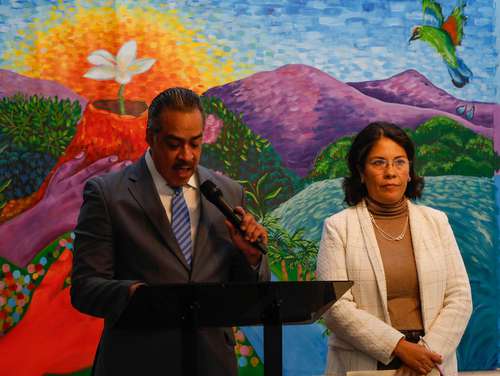
▲ Former local Mexican deputies Nancy Cárdenas and Luis Arias announced the formation of the Mexican Committee for Democracy and Freedoms in Nicaragua.Photo Jorge Ángel Pablo García
Blanche Petrich
La Jornada Newspaper
Sunday, December 7, 2025, p. 5
Having a nationality for someone who has been stripped of their own means not only having a passport or identification to manage life normally. “It means existing in the world,” as defined by one of the many people from Nicaragua who live in that condition in Mexico. “It means not being stateless.”
There are two types of exiles by the Daniel Ortega-Rosario Murillo dictatorship: the “stateless” Nicaraguans de jure“, who have some document, for example, the passport with which they left the day they were expelled from Nicaragua “forever.” If it expires they cannot renew it. And the “stateless people de facto“, whose life is even more complicated. They live outside their country – which is still their country – but without any document and without the possibility of returning to their homeland.
If they search any Nicaraguan digital platform or official archive, for example, the civil registry to obtain their birth certificate or social security, the system returns a legend: ““not found”. “It’s like a civil death,” says someone who is in that limbo.
In Mexico it is not possible to determine how many there are. Some played important roles during Nicaragua’s revolutionary years and were targets of Ortega persecution for dissenting from the authoritarian and dynastic drift that official Sandinism took since 2018.
Slow procedures
When the mass exile of political prisoners took place in 2023 – among whom were relevant figures such as Dora María Téllez, Ana Margarita Vijil, the journalist Félix Madariaga, Cristiana and Pedro Joaquín Chamorro (children of former president Violeta Barrios) – the instruction from former president Andrés Manuel López Obrador was: “Everyone who wants to be in our country has its doors open and is well received: asylum, nationality, whatever. they want.”
There are no precise figures or names of the Nicaraguan exile in Mexico because many prefer anonymity; They still have family and close ties in their country and harassment by the Sandinista police against them has been frequent. More than twenty have requested asylum from the Mexican government. Among them are opposition politicians, social leaders, human rights defenders and informants. In the recent year, the level of dialogue with the Foreign Ministry has been reduced, the procedures are slow and the only response they get is that they “take note” of their request.
On December 3, the formation of the Mexican Committee for Democracy and Freedoms was announced and the start of the campaign For a Christmas without Political Prisoners in Nicaragua, a measure that was greeted and thanked with digital messages by the poet Gioconda Belli, who expressed that after these hard years that this nomadic population has experienced, “we need solidarity more than ever, which is the tenderness of people.”
The coordinators of the committee, former local Mexican deputies Nancy Cárdenas and Luis Arias, assured that they will take steps and “strain” their dialogue with the authorities in our country, in particular with Jorge Velasco, in charge of the Foreign Ministry’s office, and with the undersecretary for Latin America and the Caribbean, Raquel Serur, “to accelerate the granting of refuge” to the Nicaraguans who have requested it.
According to the report of the UN Group of Human Rights Experts on Nicaragua, the Ortega-Murillo regime has repressed hundreds of citizens with the “arbitrary deprivation of nationality”, the prohibition of entering their country, the refusal to issue passports or any official document, in addition to the installation of a strong digital espionage apparatus that monitors these exiles and their families.
The Managua regime has confiscated the assets and possessions of those politically persecuted, including their pensions and savings, so most of them live abroad without means of support. Banishment and loss of citizenship is a weapon used by the Ortega-Murillo duo to suppress any dissidence, primarily against former Sandinista militants, militiamen and officials who came to represent the left-wing opposition to the regime. “There is a special anger with us,” acknowledge those who in the revolutionary years were comrades in struggle of those who now hold power.
The panorama of the dictatorship
In the Nicaragua of Ortega-Murillism, from 2018 to date, 355 people have been murdered for political reasons, according to the UN group of experts. More than 5 thousand have been imprisoned. Six prisoners have died in the custody of the regime, among them retired general Hugo Torres, former member of the leadership of the Sandinista National Liberation Front, and Humberto Ortega, brother of the president and kept by himself in house arrest until his death. In the last four months, three other political prisoners also died in prison.
In the middle of this year, a new repressive pattern was detected, a tightening that has led to the murder of three opponents abroad (including Roberto Samcam), the arrest of political prisoners who had already been released, and murders inside the prisons.
Of more than 200,000 Nicaraguans who have left the country due to political persecution, hundreds have requested asylum or refuge, mainly in Costa Rica. But also to Spain, the United States and Guatemala.
In Nicaragua, until August of this year, there were 73 political prisoners, 33 of them missing because their families do not know where they are or in what conditions. Among these are three Miskito indigenous leaders who in the past were part of the contras, but in the last decade they allied themselves with the government, which ended up making them disappear when they denounced predatory projects in their territories on the Atlantic coast: Brooklyn Rivera, Steadman Fagoth and Nancy Enríquez. Before the 2021 elections, the seven presidential candidates were imprisoned, as were all opposition mayors and leaders of all non-related political parties. Two years later they were exiled.
Daniel Ortega has held power for 27 years. In the revolutionary period he governed 19 years in a row (1979-1990). After 17 years away, he returned to the presidency in 2007, already with the Sandinista National Liberation Front divided, and since then, in five electoral processes, he has maneuvered to remain for 18 years and counting. At the beginning of the year they ordered constitutional changes so that in the event that Daniel Ortega (80 years old) is missing, his wife, today “co-governor”, assumes the Presidency without further formality.
He is the only commander of the historic National Directorate who remains free and alive. The last of his allies, Bayardo Arce, who remained close to the government (and his businesses), was arrested and remains under house arrest, as does another of the historical figures, Henry Ruiz.