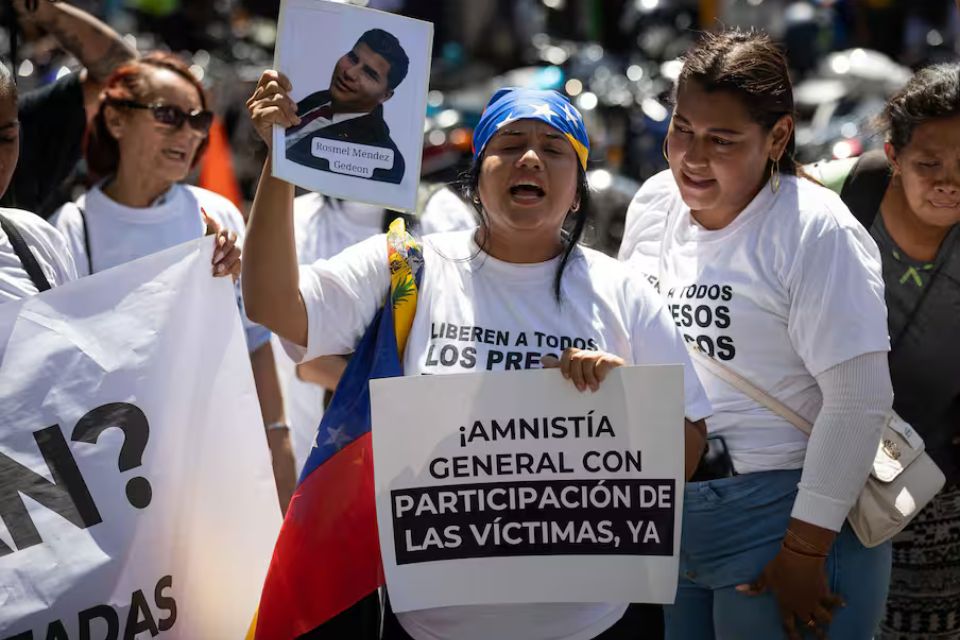
Alí Daniels, Ligia Bolívar and Antonio González Plessman agreed that the amnesty bill approved in the first discussion has fundamental flaws. They questioned the “clemency” approach, the closed list of facts and a procedure that forces people to go to courts without guarantees
In the edition of this Monday, February 9, Night D, the digital space of SuchWhich broadcast on YouTubeVíctor Amaya spoke with Alí Daniels (Access to Justice), Ligia Bolívar (Alerta Venezuela) and Antonio González Plessman (Committee of Mothers in Defense of Truth) about the draft Amnesty Law for Democratic Coexistence, approved in the first discussion with 13 articles and a statement of reasons released the next day.
Ligia Bolívar questioned the approach of the explanatory statement, considering that it is based on a logic in which those who have committed crimes are “forgiven.” He cited as an example the approach of an “act of sovereign clemency” and maintained that this formulation can be humiliating for those who consider themselves victims of persecution, by suggesting that they should “come and ask for forgiveness” in court.
Bolívar also criticized the planned procedure, warning that the law would not be automatic and that it forces people to submit requests to judicial bodies, even in a context in which there are Venezuelans abroad who could not act due to lack of consular services or due to their status as refugees or asylum seekers. In addition, he focused on article 6, which in the project lists specific facts, and warned that there are entire years that would be left out. Regarding excluded crimes, he pointed out that in Venezuela there have been “armed” files with accusations such as homicide or corruption to remove adversaries from circulation.
Bolívar added an operational criticism: the project states that it does not require additional budgetary resources, something he considered unrealistic in a judicial system with material deficiencies.
Alí Daniels reported that Acceso a la Justicia participated in a consultation meeting with the deputies called a few hours in advance. He said that, despite the urgency of the call, the organizations were able to present without time limitations and without thematic restrictions, something that he described as “unprecedented” in his experience.
However, he stated that the observations made by the NGOs were not minor adjustments, but rather structural objections that would force the text to be redone if it is to fulfill its declared purpose of “reconciliation.” Daniels insisted that the statement of reasons is not a protocol procedure, but rather an interpretation guide for judges when there are doubts, so the language of forgiveness or clemency can condition the application: “A true amnesty law is about facts, not about guilt,” he maintained.
He also warned that the volume of procedures could overwhelm the system: requests for dismissal, review of cases and updating of records. In the discussion, it was mentioned that the project does not provide for automatic application and that each case must be requested, which would open bottlenecks.
Regarding possible changes, Daniels said that the possibility of incorporating repeals of norms used for persecution was raised in the National Assembly and defended that Parliament can repeal laws, including the category of “constitutional laws”, whose existence he questioned in terms of the order.
Antonio González Plessman spoke on behalf of the Committee of Mothers in Defense of the Truth and explained that he lends his voice to Martha Lía Grajales, his wife, activist and victim of detention and judicialization. He noted that the committee summarizes its criticism in six elements: the language of “extremism” and “lemency” in the statement of reasons; the exhaustive list of facts; the weaknesses of the procedure; the lack of clarity regarding administrative sanctions (disqualifications, passports); the absence of a verification commission; and the need for guarantees of non-repetition and comprehensive repair.
Regarding article 6, he said that although part of the post-electoral cases could be covered, the closed list leaves out other sectors: peasants prosecuted for land conflicts, workers prosecuted for protesting or denouncing corruption, and soldiers accused of crimes of a political nature. He proposed that the judge should act ex officio, but also allow requests from victims and relatives, and proposed a verification commission that includes relatives, human rights organizations, deputies and the Office of the United Nations High Commissioner for Human Rights in Venezuela, among others.
The committee also placed emphasis on comprehensive reparation: return of assets, attention to physical and mental consequences, and restitution of labor rights.
An open debate and an alert about “political will”
In the final section, the guests debated whether there is anything “salvageable” about the project as it is. Bolívar said that, with a statement of reasons that starts from “clemency” and the notion of criminal, the basis is weak. Daniels preferred to highlight the political moment: he maintained that the debate on amnesty was established as a central issue and that the discussion, although “chucuta”, coincides with recent releases, which has reduced fear in his family environment.
Regarding “political will,” Bolívar measured it in recent events and warned that the approach seems to require “submission.” Daniels mentioned that there are ways other than a law to make immediate decisions, and González Plessman said that rather than speculating on elite decisions, the focus should be on citizen mobilization and the recovery of participation as democratic pressure.
The program closed with the commitment to continue reviewing the documents and proposals presented by different sectors before the second discussion of the amnesty scheduled in the National Assembly.
*Read also: Juan Pablo Guanipa is under house arrest in his home in Maracaibo
*Journalism in Venezuela is carried out in a hostile environment for the press with dozens of legal instruments in place to punish the word, especially the laws “against hate”, “against fascism” and “against the blockade.” This content was written taking into consideration the threats and limits that, consequently, have been imposed on the dissemination of information from within the country.
Post Views: 13