Officially recognized by Guinness World Records as the bigger New Year’s Eve of the world, the New Year’s Eve party in Copacabana brought together 2.6 million people. The number surpassed that of the year 2025, when the event brought together 2.5 million Rio residents and tourists. The calculations are from Rio’s city hall. The highlight of the party was the historic fireworks display, which used 19 rafts distributed along the waterfront, almost double the number used the previous year and which lit up the city’s sky for 12 minutes. According to the city hall, it is the largest ever held in Rio.
The audience spread out across the beach, where there were three stages. Rio, considered the main one, was set up in front of Copacabana Palace. If you add up the other celebrations organized by the municipality, the total reaches 5.1 million people who had fun with the arrival of 2026. In total, 13 stages were spread across the capital.
“The New Year of 2026 brought together more than 5.1 million people, including locals and tourists, on 13 stages spread across the city, once again consolidating the capital of Rio de Janeiro as the main New Year’s Eve destination on the planet”, highlights the city hall in a note.
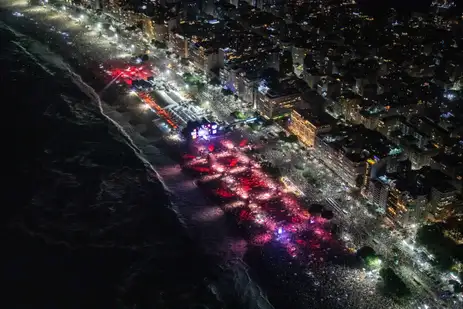
Fireworks display on New Year’s Eve in Copacabana – Photo: Fernando Maia/Rio City Hall
In Copacabana, the public was enchanted after the turn with the show that used 1,200 dronesconsidered the largest presentation of this equipment held at large events in Latin America.
Everything took place to the sound of DJ Alok, while in the sky the drones formed images in honor of the city, such as Christ the Redeemer and Sugarloaf Mountain, synchronized with the burning of fireworks. One image that surprised was the projection of a human face that interacted with the public through messages displayed on the air.
You shows on stage they really excited the Copacabana audience. Gilberto Gil had the participation of Ney Matogrosso, the singer Belo welcomed Alcione and the two sang great hits from their careers. João Gomes’ presentation was attended by singer Iza. Very emotional, the singer thanked the public for the reception in Rio, remembering that his origin is Pernambuco, according to him, very far from there.
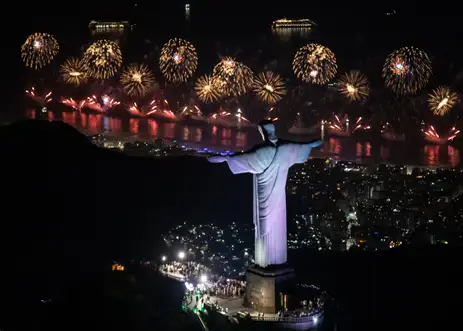
View of Christ the Redeemer during fireworks on New Year’s Eve in Copacabana – Photo: Fernando Maia/Rio City Hall
On the Samba Stage the highlights were Roberta Sá, Mart’nália, Diogo Nogueira and Feijão and Bloco da Preta. As it couldn’t be missed, the samba schools closed their shows on the Rio and Samba stages with performances by Beija-Flor de Nilópolis and Grande Rio, keeping up the excitement of those who refused to leave the place.
The night also had a space dedicated to gospel music. On the Leme Stage, singers Midian Lima, Samuel Messias and Thalles Roberto performed, with Grupo Marcados closing.
Outside of Copacabana, on the other ten stages, the public had fun at Praia do Flamengo, in the south zone; in Parque Madureira, Piscinão de Ramos, Praia da Bica and Penha, in the north; in Parque Realengo, in Parque Oeste, in Sepetiba, in Pedra de Guaratiba, in the west zone and Praia da Moreninha, in Paquetá.
According to the city of Rio, around 7,500 agents, from 11 municipal bodies, worked on transport, traffic inspection, urban planning, cleaning, reception, prevention of violence against women, social assistance and emergency care.. “Public monitoring included 700 cameras, 307 of which were in Copacabana alone, including 14 new devices with superzoom, reinforcing security actions throughout the night,” informed the municipal administration.