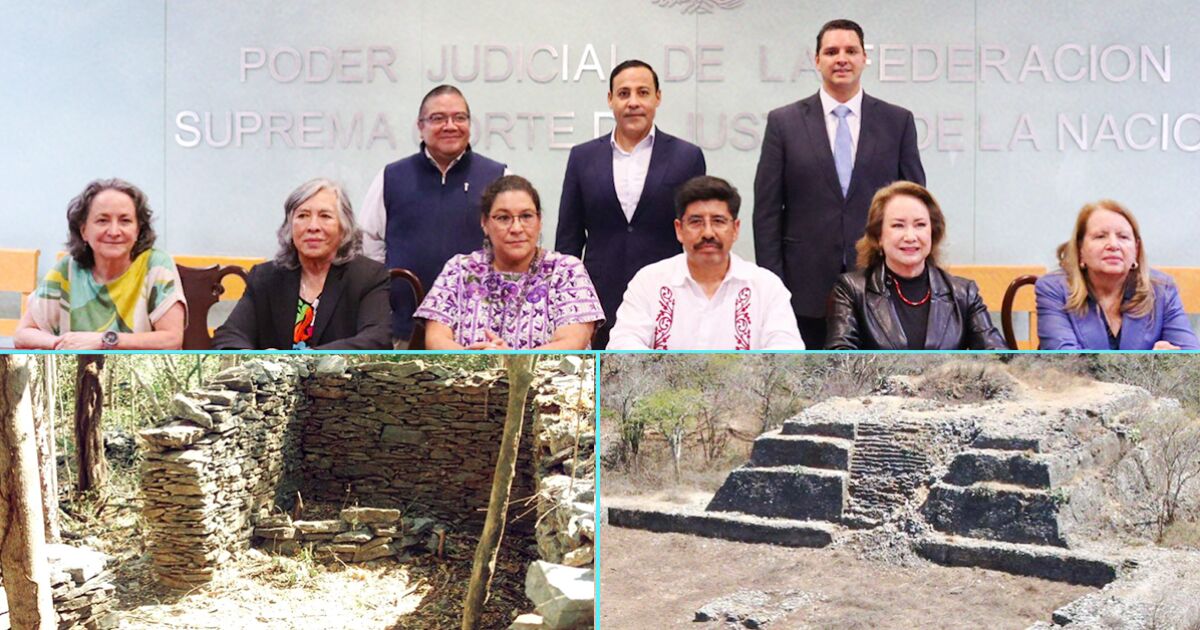
Although the arrival of Minister Aguilar, of indigenous origin, is relevant to meet the demand for justice of indigenous and Afromexican peoples and communities, experts agree, much more will be required than the issuance of sentences in favor of those communities.
They emphasize that the issuance of legal criteria, the establishment of new public policies, continuity when Aguilar concludes its presidency, within two years, and will on the part of the authorities, often omitted in respecting judicial orders, will be indispensable.
For Tomás López SarabiaPresident of the Civil Association Indigenous Professional Center for Advice, Defense and Translation (Cepiadet), it is necessary to take care of the expectation – or the speech – that there will be an immediate structural transformation due to the fact that an indigenous lawyer presides over the Court.
That is step by step. The time it has (Aguilar) because it is short, is little, the expectation is very high and hopefully they can meet it ”.
Tomás López Sarabia, indigenous defender.
López Sarabia argues that the task of guaranteeing justice to indigenous communities is also difficult because there is a structural invisibility of their rights and, to sample, remember that judicial reform did not specifically include said population.
However, he trusts that the presidency of Aguilar in the Court derives in policies and actions that revert the “historical process” of discrimination and exclusion of indigenous peoples in the justice system.
“But of 100% issues that are processed nationwide, 80% have the judicial powers of the states and only 20% are processed approximately before the Federal Judiciary (PJF),” he observes.
In contrast, the number magistrate of the Superior Agrarian Court (TSA) and lawyer Nahua of the State of Puebla, Larisa Ortiz Quinteroconsiders that the new Court, with Minister Aguilar in the front, is a guarantee of a prompt transformation of justice in the country.
“I would think that for everyone, but particularly for indigenous peoples. Not because it is the change of a person, but because the protection of indigenous peoples and communities has been evolving,” he says.
The cases that litigate indigenous communities in defense of collective rights are generally of two types: against companies and against the Mexican State, through their institutions; The latter, due to non -compliance with services, for example, water, health and education.
Justice of ‘paper’ and contempt
The opportunity for justice also implies making the past sentences, according to specialized jurists.
There are resolutions issued by courts, or the SCJN itself, which are favorable to indigenous communities, but authorities and governments do not comply with the decisions, so the breach is extended for years and even decades.
Hence, compliance mechanisms are required, they emphasize.
Some sentences order to protect their environmental damage environments, looting and exploitation of resources, but in many cases justice remains on paper.
There is the case of river protection in communities in Oaxaca.
The indigenous strategic litigation organization, led by Carlos Morales, together with the Tuxtepec Bar Association and Lawyers for Justice and Law, won amparo judgments, but that has not changed reality for indigenous towns.
These organizations met in July with the then candidate to Minister, Hugo Aguilar, to request a mechanism that forces the fulfillment of sentences, otherwise indigenous rights may not be exercised.
They also proposed the creation of a protocol to monitor the execution of amparo sentences in environmental matters, so that its effective compliance is completed.
This is the case of the amparos won to protect the Atoyac, Salado, Guigu Guii rivers, of the dogs, Mixtec, the sand and papaloapan, in litigation promoted and won in favor of indigenous peoples to order the authorities their rescue.
López Sarabia warns that contempt at judicial orders is a general problem, but that it is accentuated when it comes to indigenous people or populations.
“That is a challenge for the Court, but it is also a case of public policy, and there it will be worth knowing what the criterion will be, what will be the positions to be able to execute these sentences,” he says.
Why are there expectations with the new SCJN?
Magistrate Ortiz Quintero, also a professor of the Law School of the UNAM, where he teaches the subject of indigenous law, recalls that Mexico records three constitutional reforms in the matter.
The first in 1992, when the fourth article of the Magna Carta was modified to establish that Mexico is a multicultural country based on the existence of indigenous peoples.
In 2001 the drafting of the Second Constitutional article was changed to accommodate the recognition of fundamental peoples and rights.
And in 2024 indigenous peoples were recognized as collective subjects of law, with legal personality, their own heritage and another series of fundamental rights such as legal pluralism.
“(Not only) the legal personality of indigenous peoples and communities was contemplated, (but) today have the attribution of being able to present amparos and other resources such as constitutional controversies,” he celebrates.
“What touches is precisely the implementation of rights and that the new Judiciary, (…) to guarantee all these rights already recognized. We are already in a moment of implementation of rights,” he emphasizes.