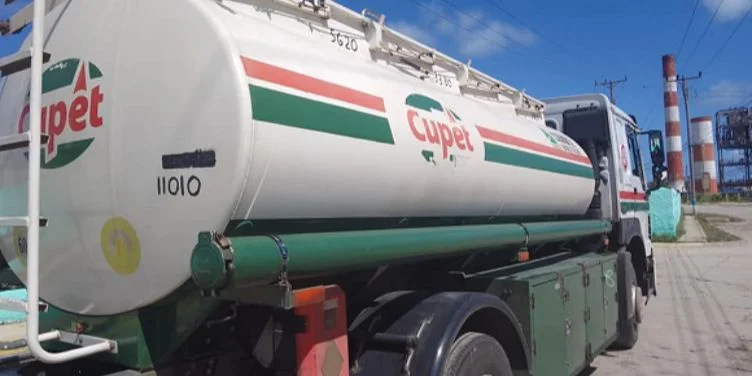
The sale of fuel in dollars has also opened a new space for resale and hoarding.
SANTIAGO DE CUBA. – Cuba is going through one of the most acute stages of its energy crisis. After losing supplies from its main supplier, Venezuelathe Government has once again supplied fuel to several service centers in the country for exclusive sale in US dollars, while basic services—especially transportation—remain practically paralyzed.
Although this is a national policy, what is happening today in Santiago de Cuba, and particularly in municipalities like Songo La Maya, clearly illustrates the unequal impact of this strategy.
The interruption of the flow of Venezuelan oil, on which the Island depended to cover a significant part of its energy demand, has had immediate effects. Estimates indicate that in 2025 this supply covered around 30% of the country’s energy needs. The abrupt “closing of the tap”, after the capture of dictator Nicolás Maduro, has left the Cuban energy system in an extreme situation.
In this context, several establishments of the Cuba Petróleos (CUPET) network in Santiago de Cuba (and other provinces) began selling regular gasoline and oil in foreign currency this week. Prices range between 1.20 and 1.30 dollars per liter, and payment can only be made using cards in freely convertible currency (Visa, MasterCard, Classic, among others).
In Songo La Maya, on January 24, the sale of about 10,000 liters of gasoline to the population began at the municipality’s service center. Each person can purchase up to 20 liters per transaction, as long as they have a currency card. However, according to local sources, the limit can be circumvented by purchasing at different times or sending to third parties with the same card.
“I bought 20 liters, but right now I’m going to buy 20 more. My goal is to save them so I can have a calm head for a while,” he told CubaNet a motorist on condition of anonymity.
At the Songo service center, oil is sold under the same requirements, although until last Wednesday morning, the sale had not been completed due to problems with the payment server.
Dollarization, public service and informal market
The contrast with the reality of the majority of the population is evident. In the informal market, a liter of gasoline exceeds 1,000 pesos and oil is even more difficult to obtain. While those with access to dollars can buy directly, state companies must expect increasingly later and limited fuel allocations.
As a result, much public transportation has last-minute cancellations or delays. Workers and students are forced to resort to private transportation, whose prices have skyrocketed since the collapse of Venezuelan supplies. On inter-municipal and inter-provincial routes, fares have doubled.
“A few days ago I was paying 100 or 200 pesos, at most, from La Maya to Santiago. But for two weeks I have had to pay up to 400. Imagine what it means for a student to spend that money only on transportation. No one can stand it,” said Daniuska, a medical student.
In this regard, the experts’ predictions seem to be correct. The economist Miguel Alejandro Hayes, for example, recently warned that the loss of Venezuelan supply could cause a 27% drop in gross domestic product, a 75% increase in transportation costs and an increase in food prices of up to 60%.
It’s not from today
Since the 1st. February 2025, special gasoline began to be sold in a network of service centers that accepted payments in USD, either in cash or through national and international cards. Until October of last year, cash payment was allowed, but in more recently enabled establishments, such as those in La Maya, that option has been eliminated: only cards in foreign currency are accepted.
Payment in national currency or MLC is not contemplated in this “alternative”, an exclusion that directly hits those who depend on salaries in Cuban pesos, in the midst of an economic crisis marked by inflation and the loss of purchasing power.
At the beginning of October 2025, at least 63 CIMEX service centers They sold fuel in dollars. By January 2026, that number was already higher, although an official figure is not known. According to the Government’s version, this network seeks to facilitate access to fuel for tourists, economic actors, foreign branches and joint ventures. In practice, it benefits a small group of the population, to the detriment of the majority.
The impact is felt especially strongly in sectors such as education. “I am a teacher and I travel every day to Patrocinio, where I teach at the La 14 semi-boarding school. We had a bus available, but now it runs intermittently, one day on and 20 days off. Either I don’t go or I pay 400 pesos a day for transportation, which there isn’t any, because I myself charge a pittance,” said Matilde de La O, while trying to get to her workplace.
The situation is not limited to Santiago de Cuba. In Havana, users of the state Ticket application have reported waiting times of up to two months to access fuel in Cuban pesos. Likewise, according to several drivers, sales in CUP are almost paralyzed.
In the capital, while some stations that operate in foreign currency display rows of several blocksothers that sell in national currency remain empty or closed due to lack of supply.
A new space for resale
This scenario has generated a domino effect: chaos in transportation, longer blackoutshigher prices of services and consolidation of the informal market as the main means of access to fuel.
“Although I have raised the prices, no one can stand having to buy gasoline at 1,100 or 1,200 pesos per liter. The business simply does not work,” explained a private transporter identified as Raúl. “When I found out that gasoline had arrived at the cupet I was one of the first, thinking there would be endless lines. There were few people, and I immediately understood why: you had to have dollars, and not even in cash, but on a currency card. Now that is mandatory.”
The sale in dollars has also opened a new space for resale and hoarding. “A liter of gasoline costs 1.20 dollars, about 500 pesos at the current exchange rate. By selling it at 800 you still make money and get out before those who sell it at 1,000,” explained a motorist known as “El Menor.”
However, this business is not available to everyone. Those who do not have foreign currency cards depend on loans or rentals, which reduces profits. Furthermore, the scarcity of small bills in the informal market forces many to buy dollars in large amounts, inaccessible to a large part of the population. For them, the only alternative is to purchase second-hand fuel, at prices ranging between 800 and 1,000 pesos per liter.
Today, the fuel crisis in Cuba is no longer just a mobility problem. It is a clear sign of an energy collapse with effects on the entire economy, which deepens inequality and places Cubans before an increasingly marked reality: access to essential goods depends, today more than ever, on the possession of dollars.