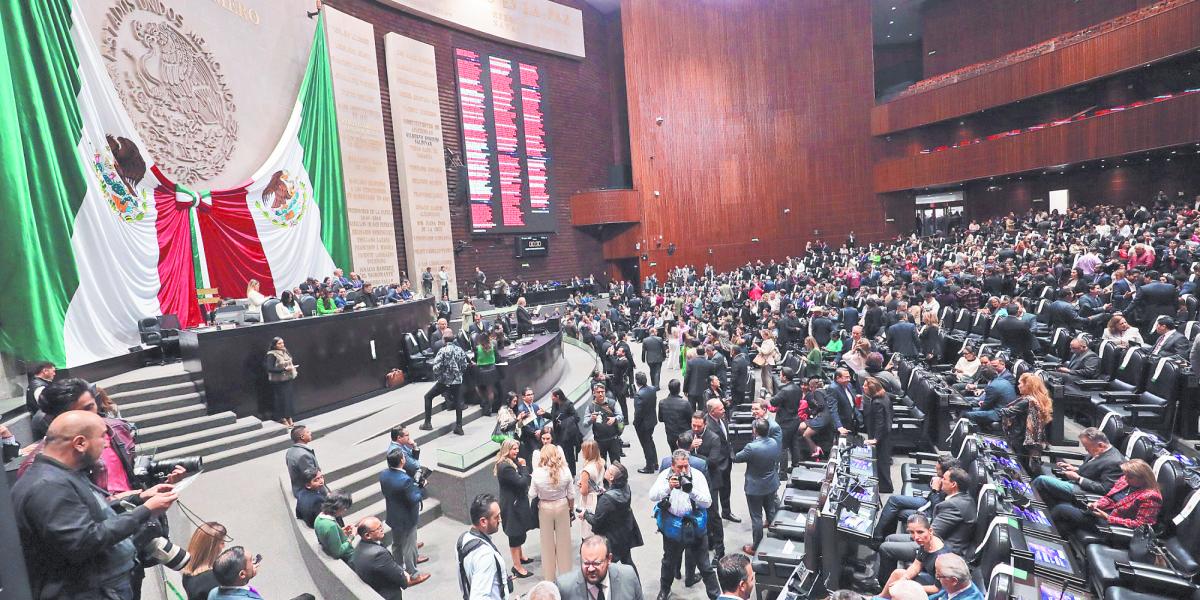
The electoral reform announced by President Claudia Sheinbaum Pardo would imply “the return to the Single Party” and would overcome the country for several decades, agreed to warn Germán Pérez Fernández del Castillo and Víctor Alarcón Olguín.
“It is very clear; it is the return to the single party, to the 40s because in reality the law of 46 is one that would resemble the current proposal because there were no multinominal (legislators) and any representation was canceled by the majority,” said Pérez Fernández del Castillo, an expert of the UNAM in politics and elections.
“From 1946 to date reforms and efforts have been made that culminated in a system of competitive parties that allowed the alternation in power and that the Executive could not do whatever he swells like a king, but had to negotiate with the different political forces.”
For Alarcón Olguín, an expert of the UAM in political parties, the changes that are expected to be promoted by the federal government would mean “returning to a system that takes us to before the design we had in 1964 (…) having pure majority deputies (federals) would really seem like a huge setback”.
“Returning to the times not only of hegemonic, almost unique party, and I even believe that that is why the concern that is not only centered on opposition parties, but even on the two members of the current government coalition, the PT and the PVEM, gives an idea of what can be an unwanted effect of now having such a lack of plurality.”
“The current system we have, which has lasted just over 30 years, has allowed outflows and coming in the representation.”
Proposals
Both specialists demonstrated against the elimination of the 200 federal deputies and 32 senators of proportional representation; to reduce the public financing of political parties, and to choose by popular vote to electoral advisors, as already done, for the first time in history last June, with the electoral magistrates.
Pérez Fernández del Castillo proposed that the Chamber of Deputies be integrated by 250 relative majority legislators, directly elected at the polls, and the same number of plurinominals in order to achieve the “real representation of the citizen will” in the Congress of the Union.
“It is not a matter of strengthening political parties, that was a fallacious argument of the 1963 reform. Representation has to be real.”
Alarcón Olguín considered that the current number and conformation of federal deputies (300 uninominal and 200 multinominals) and senators (96 uninominal and 32 multinominals) would not have to be modified with the reform at the door, but only the formula for the allocation of plurinominal legislators.
“What would have to be reviewed is the formula for the integration between the majority and the minor explained.
It is appropriate to mention that with the new integration of the Congress of the Union, in September 2024, opposition parties accused Morena and allies of having overrepresentation because the calculations for the allocation of plurinominal legislators are carried out per party and not by coalition, a reform that, the ruling, promoted the PAN in 2008.
The “party deputies”, introduced with the electoral reform of 1964, are the antecedent of federal deputies of proportional or multinominal representation, which arose with the electoral reform of 1977; From then on, the lower house was integrated by 300 majority deputies and 100 pluris. The legal changes of 1988 increased to 200 Los Pluris and since 1996 the Congress of the Union was integrated by 300 federal majority and 200 multinominal deputies, and the upper house by 96 majority senators and 32 pluris.
Face democracy
Regarding the possibility of diminishing public financing to the parties, the UNAM expert said that will leave them “practically in helplessness (…) Democracy is expensive and must be face.”
“With the electoral reform of 77 the parties become entities of public interest and this allows public financing.”
On this issue, the UAM academic warned that if public financing is limited, political parties will have a very low possibility of communicating or developing.
“That has been the value, precisely, of public financing. For that it was promoted that the process that has been opened since 1977 was giving greater conditions of equity and rather the issue would be the opposite, how we can reinforce the value of public financing but with due inspection and there it does generate the protections so that the electoral campaigns are not penetrated by organized crime or other types of actors that can be illegally financed or even the diversion of others Public space actors, that governors, legislators divert resources and that generates competition conditions with loaded dice ”.