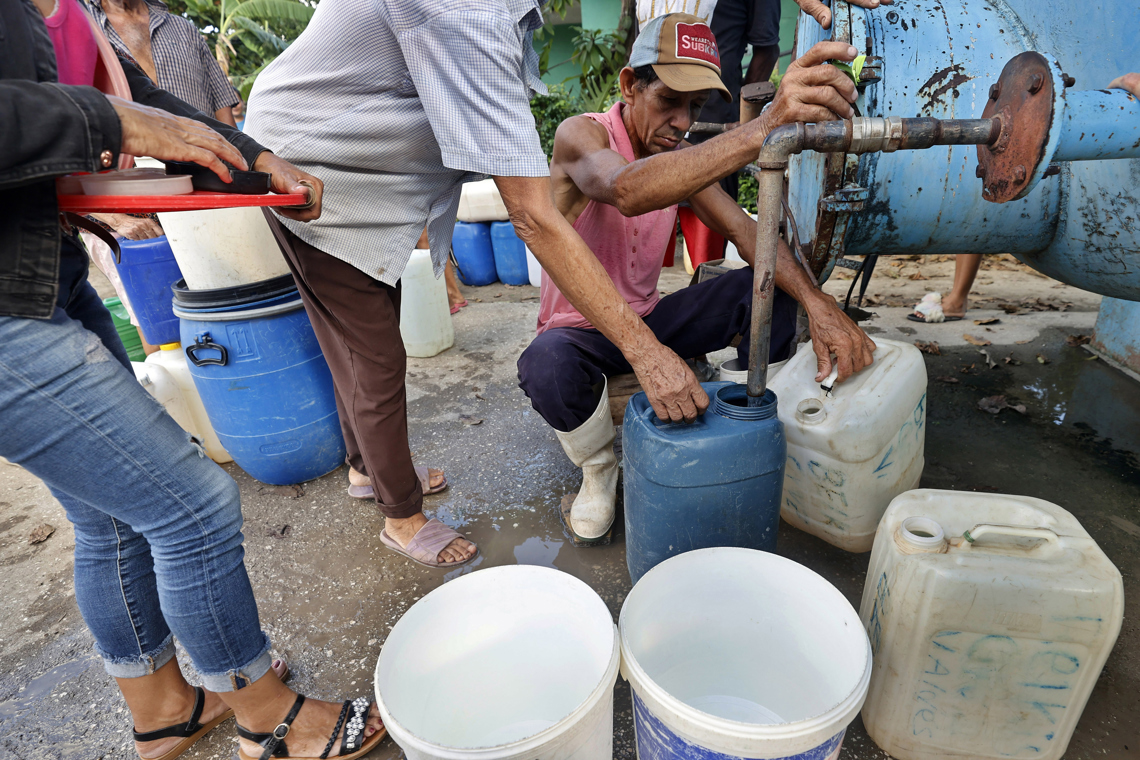
A daily average of two million people, 20.8% of Cuba’s total population (9.6 million), has some type of impact on the water service, according to a report presented this Thursday to the National Assembly of People’s Power.
The Prime Minister, Manuel Marrero, cited among the government measures applied to face the water supply deficit, the execution of kilometers of pipelines and supply networks, the rehabilitation of 10 water treatment plants and the operation of 713 pumping equipment.
He also indicated that this year 33,358 people have been connected to the sewage networks and 16,507 new connections were installed for the distribution of the liquid.
“There is no justification” for the delay in water supply in Havana, says Díaz-Canel
In the previous parliamentary meeting, last July, it had been reported that one million people lacked adequate access to water, around 10% of the population, mainly due to frequent blackouts, breakdowns in pumping equipment and hydraulic networks, and an intense drought.
The breakdown of equipment was affecting about 300,000 people and the intense drought due to lack of rain had a negative impact on the supply, especially in the eastern provinces, as explained at the time by the president of the state National Institute of Hydraulic Resources, Antonio Rodríguez.
Likewise, the authorities have recognized that the serious energy crisis and the instability of the National Electrical System (SEN) also affect water pumping, with electricity service outages exceeding 20 hours a day in large areas of the island.
Among the most affected provinces, Marrero included Havana, Pinar del Río and Artemisa (west), Villa Clara and Cienfuegos (center) and Santiago de Cuba and Granma (east) are the most affected.
Deficiencies with the water supply have been the reason in recent months for citizen protests reported in neighborhoods of Havana and other regions of the island.