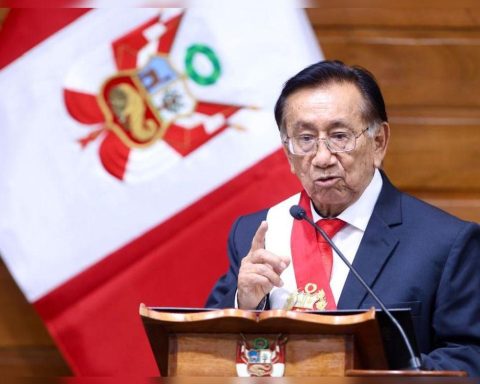
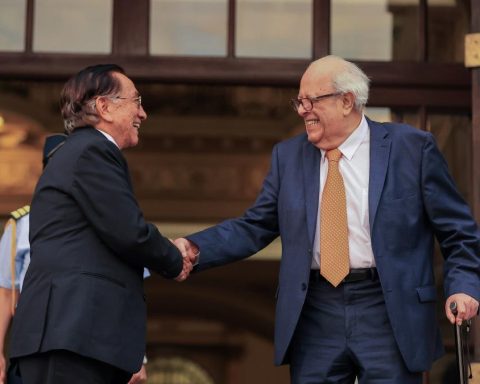
In the middle of the debate on the possible six -month suspension of the prosecutor of the Nation, Delia Espinozathe National Justice Board (JNJ) He decided to take Francisco Távara Córdova, a member of the institution and former president of the Judiciaryof the voting process related to this case. The measure was adopted in response to the request submitted by María Teresa Cabrera, also a member of the JNJ, who said that Távara would have publicly expressed his position, which constitutes an advance of opinion.
According to Cabrera, the counselor provided statements to the media that evidenced his support for the position of Delia Espinoza, contravening the internal regulations, which forces abstention in cases of opinion advance. Faced with this, the JNJ declared the request and, through an official resolution, determined that Távara will not be able to participate in any process related to the debate on the suspension of Espinoza, including the vote that would define the measure against the prosecutor of the nation.
“Declare, appropriate the application for abstention made by Mrs. María Teresa Cabrera Vega, titular member of the National Board of Justice, against Mr. Francisco Artemio Távara Córdova, for configuring the cause provided for in numeral 2) of article 99 of the Single Ordered Text of Law No. 2744,” says the resolution.
The decision to exclude Francisco Távara in this context is especially controversial, as it coincides with the key phase of deliberation and vote on the eventual Suspension of the Prosecutor of the Nation.
Francisco Távara response
In the resolution of the JNJ reference was made to an interview that Távara provided to RPP on June 17. In this dialogue, he said that the members of the JNJ should not vote in favor of annulling the sanction imposed on the former nation, Patricia Benavides, because the case is still in the hands of the Judiciary.
“If I had participated and had to vote in this delicate theme, my vote would have been accordingly with the communication I was studying and above all say: I cannot declare the nullity here because it is judicialized, first of all,” he said in the program ‘Things as they are’.
Távara also explained that he had previously refrained from participating in the vote related to Benavides, on June 6, in the absence of sufficient information. For this reason, he said that he formalized in writing the reasons for his decision not to intervene in that deliberation.
You can see: Congress presents a motion of censure against Juan José Santiváñez after revelation of audios
“I spoke and said: ‘President [refiriéndose a Gino Ríos Patio]I am worried about this issue, we do not know what it is, I do not know what it is, I have no copy of the writing or a resolution that grants the use of the word ‘. We exchanged word and told me that he didn’t know the writing either … then I told him that I was going to excuse me in writing, “he said.
For his part, Francisco Távara said there is no legitimate cause that justifies its abstention in the process. He also mentioned that the members of the JNJ had to take more time to reflect before making this decision, since it caused an institutional crisis within the Public Ministry.
“I think that my colleagues, more than all the president and the vice president, had to meditate more about transcendence and mature more about this decision, share more with colleagues, I do not know if they have discussed it. On the 6 expressed.