On the eve of the National Emergency Response Drill, which will be held on Wednesday, October 22, the Colombian Security Council (CCS) issued a warning that invites reflection, regarding protection and inclusion for people with disabilities in a scenario of disasters or natural catastrophes.
According to the Council, this sector of the population continues to be one of the most vulnerable populations in the face of natural disasters or crisis situations, for which they brought up data from the Pan American Health Organization, in which it is said that they have between two and four times more more likely to die during an emergency than those without this condition.
For reading: Recovery without foundations: economic activity shows signs of life, but not recovery
This is why they called on companies, institutions and organizations to strengthen their risk management plans with a differential approach. The executive president of the Council, Adriana Solano Luque, stated that “guaranteeing the full participation of people with disabilities in the planning, execution and evaluation of drills not only saves lives, but also strengthens the organizational culture and social responsibility.”
The Colombian Security Council stated that more than three million live in the country of people with disabilities, according to Dane figures and that the departments with the highest concentration are Nariño, Cauca and Putumayo. However, information on their participation in emergency prevention and response activities is still limited.
People with disabilities would be the most affected in the event of an emergency.
Image from ChatGPT
“In Bogotá, for example, the District Institute for Risk Management and Climate Change (Idiger) reported that of the more than 458,000 inhabitants with disabilities, only 24,731 participated in the 2024 Evacuation Drill,” they explained.
For the CCS, this low participation shows that there are still physical, communicative and attitudinal barriers that prevent equitable access to information and warning systems and because of this, Solano stressed that “The principle of ‘nothing about us without us’ must be the basis of all inclusive management.”
See also: Imposition of new tariffs on Colombia is ‘exclusive decision’ of President Trump
The warning is also based on figures from the United Nations Office for Disaster Risk Reduction (UNDRR), which indicates that only 20% of people with disabilities could evacuate without difficulty, while 6% could not do so at all and against this backdrop, the CCS insists that equitable management does not require large investments, but rather reasonable adjustments, internal organization and institutional commitment.
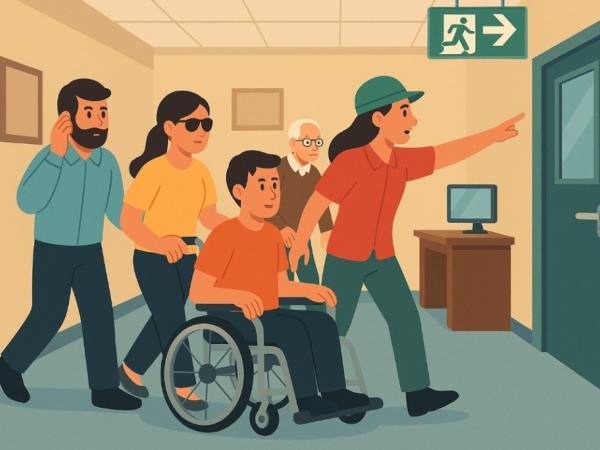
Among the recommended actions, the Council highlights the need to create support groups to assist those who require it during an evacuation, verify the accessibility of spaces, guarantee signage in braille or relief, universal pictograms and multisensory alarms, and train both staff and people with disabilities in emergency plans.

People with disabilities would be the most affected in the event of an emergency.
Image from ChatGPT
“During a real situation, it is essential to ask the person with a disability directly what is the safest and most comfortable way to help them, respecting their autonomy and experience of their own body. The accompaniment must be constant, avoiding the use of elevators and always following the defined safe routes,” they highlighted.
Likewise, they highlighted that after the simulation, it is recommended to evaluate the lessons learned, document the findings and adjust the protocols based on the feedback from people with disabilities. In this way, their experiences become inputs to improve future exercises and strengthen a more humane culture of prevention.
More information: SIC ordered the immediate closure of Andrés DC and Andrés Carne de Res stores: why
For the CCS, the 2025 National Drill will be an opportunity to measure not only the technical capacity of organizations, but their commitment to inclusion and human rights and they concluded their call by saying that “every action counts: from an installed ramp to an accessible message, every decision builds a safer environment for everyone.”
DANIEL HERNÁNDEZ NARANJO
Portfolio Journalist