The National Assembly of Venezuela approved this Thursday in the first discussion the Amnesty Law project promoted by the president in charge, Delcy Rodríguez, in the midst of a political climate marked by the capture of former president Nicolás Maduro and pressure from Washington.
The initiative, which seeks the mass release of prisoners for political reasons, must go through a second discussion before becoming law, after consultations with various sectors of civil society, according to press reports.
Rodríguez, who assumed the interim presidency after the United States attack and the capture of Maduro and his wife, said that the proposal aims to “repair the wounds left by the political confrontation since President Hugo Chávez came to power in 1999.”
The president assured that the amnesty is a necessary step to consolidate peace and coexistence in a country that is going through an unprecedented transition under the tutelage of Washington.
Jorge Rodríguez asks for forgiveness and “to heal wounds”
The president of Parliament, Jorge Rodríguez, brother of the interim president, urged the deputies to undertake the debate with responsibility and a spirit of reconciliation.
“The country forces us to be responsible, to heal wounds, to recognize each other, to understand each other and to build the steps and paths together,” he said during the parliamentary session.
Rodríguez insisted on the need for the consultation process to be “deep” and include relatives of detainees, victims of crimes and sectors of civil society.
“Let there not be a victim who has not been heard,” he stressed, while apologizing for the existence of political prisoners. “We ask for forgiveness and we have to forgive too, we ask for forgiveness because I say it clearly: I do not like prisoners,” said former President Maduro’s main international negotiator.
“Always keep in mind the early morning of January 3, the murder of 120 human beings, the kidnapping of the president,” he emphasized.
Criticism and caution from NGOs
The amnesty project has been received with caution by human rights organizations. The Venezuelan Human Rights Education-Action Program (Provea) demanded that the text be public before its final approval.
“The project must be made public urgently, given its impact on the rights of the victims, their families and Venezuelan society,” he said in a statement.
For its part, the NGO Justice, Encounter and Forgiveness (JEP) warned that the secrecy regarding the content prevents a serious analysis of its scope.
“The project must be known in advance so that victims, human rights defenders, independent experts and civil society can review it, make observations and warn about possible violations of international standards,” he indicated.
The draft law, with at least twenty articles, provides amnesty for crimes such as instigation, resistance to authority, damage to property, rebellion, treason and illegal carrying of weapons, as long as they have been committed in the context of political protests. This includes emblematic demonstrations such as those in 2007, 2014, 2017, 2019 and 2024.
However, the rule excludes those who have been convicted of homicide, drug trafficking, corruption and serious human rights violations.
According to Chavista deputy Jorge Arreaza, the project seeks to “smooth the political dialogue processes that are aimed at bringing peace and prosperity.”
The law would also cover infractions committed by judges, prosecutors and officials in the exercise of their functions, thereby indirectly recognizing that citizens were persecuted for their political positions or for disseminating messages on social networks.
Penal Forum and release figures
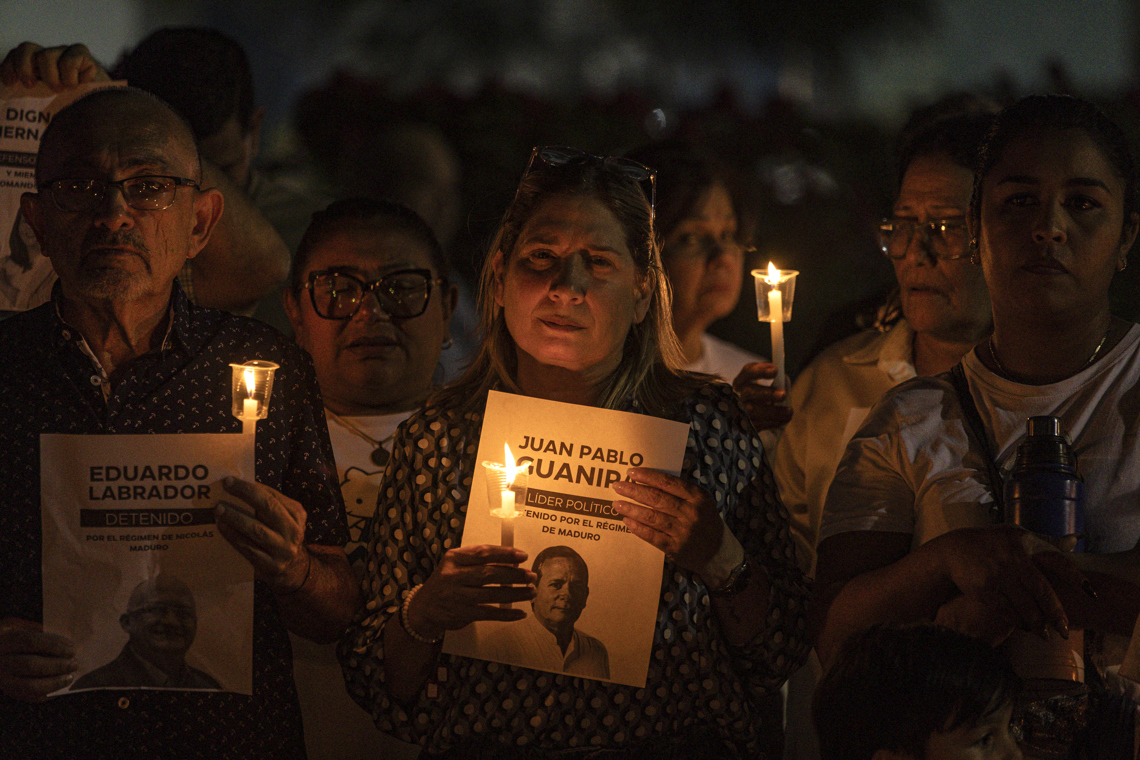
The Chavista government claims to have released almost 900 inmates since December, although the NGO Foro Penal, which monitors the situation of political prisoners, reports only 383 releases as of Thursday morning. The discrepancy in the figures reflects the contradictions and opacity of the process and fuels criticism from family members and civil organizations.
The Minister of the Interior and Justice, Diosdado Cabello, denied the existence of political prisoners and stated that the detainees were plotting to destabilize the country. However, testimonies from released prisoners and family members contradict this version, pointing out that many were arrested for participating in protests or expressing critical opinions on social networks.
The amnesty proposal has reactivated opposition sectors that remained underground. Leaders such as Andrés Velásquez and Delsa Solórzano have reappeared publicly to demand the release of all political prisoners and new elections.
“Not a single prisoner can remain for political reasons and the entire apparatus of repression of the regime must be dismantled,” Velásquez said in a video in front of the Helicoide prison.
Last week, Delcy Rodríguez announced the closure of that prison, a symbol of repression during the pre- and post-Chavista governments, and its transformation into a sports and cultural complex. The measure was presented as a gesture of reconciliation, although critics consider it insufficient without a profound reform of the judicial system.
“Venezuela’s civic space continues to be a desert,” warned Pedro Vaca, an expert at the Inter-American Commission on Human Rights, pointing out that the announced measures are just “crumbs” compared to the need for an independent judiciary.