Donald Trump has said: “We have enough nuclear weapons to destroy the world 150 times over.” And vice versa, I say. Furthermore, the United States is part of that same world sentenced to die. Obviously, this is a bluff. The world is too big.
Mutual assured destruction has existed since 1949, when the Soviet Union, in response to the three nuclear explosions carried out by the United States in 1945, carried out its first atomic detonation. Thus began the Cold War and the nuclear arms race, relaunched today by the war in Ukraine.
President Donald Trump’s announcement that the United States could restart nuclear tests suspended in 1996 unleashed a vigorous Russian response, as if it were a novelty. The truth is that, between 1945 and 1996 – the year in which the Comprehensive Nuclear Test Ban Treaty was signed – 2,056 tests were carried out. Of them, 1,032 corresponded to the United States and 715 to the Soviet Union. That is, to Russia. Curiously, they never hurt each other.
The first of the three atomic bombs manufactured through the Manhattan Project was tested on July 16, 1945. The experiment was necessary because that bomb used plutonium as fissionable material, a substance whose form of ignition was unknown and more complex than uranium-based bombs. The other two, one uranium and one plutonium, were launched on Hiroshima and Nagasaki.
In the initial moments, when the bombs were ready, doubts and fears persisted, some of them catastrophic. The failure of the detonating mechanism was feared, which would determine the failure of the Manhattan Project. Some believed that the magnitude of the explosion and the heat wave could destroy the state of New Mexico, and even that, given the presence of hydrogen and other gases in the atmosphere, the air could catch fire and incinerate the planet. The test ruled out such fears.
However, it was necessary to continue the tests because both the American and Soviet bombs were imperfect: they made little use of nuclear fuel and were extremely large, so much so that there were no planes or missiles capable of transporting them, which made them practically unusable. On the other hand, their cost—20 billion dollars—made them economically unviable.
The atomic bomb dropped by the United States on Hiroshima measured four and a half meters and weighed five tons. To use it, it was necessary to adapt B-29 bombers, the largest of the time. For its part, the Soviet bomb, called RDS-1, with a power of about 22 kilotons, was tested on August 22, 1949 and had similar dimensions.
The 1950s and 1960s were, for Americans and Soviets, decades of intense research, engineering work, and field testing, including hundreds of nuclear explosions aimed at perfecting the weapon, increasing the yield of nuclear material, and reducing the size and weight of bombs, a process that was called “miniaturization.”
At the same time, work was being done on the so-called “carrier means”, that is, airplanes and missiles capable of operating with them at great distances, which gave rise to intercontinental missiles and strategic aviation. Simultaneously, the space race was unfolding.
However, it was not until the 1980s, with the Strategic Defense Initiative (“Star Wars”) promoted by President Reagan, that systems were developed to intercept nuclear attacks. This, as part of an eternal wheel, gave rise to missiles and planes that, due to their speed, aspire to be undetectable and infallible. For each armor, a missile is created that penetrates it, and vice versa. This happens until reaching the Oreshnik Russian, capable of flying at speeds ten times the speed of sound.
While the United States and the Soviet Union waged a feverish and essentially ruinous nuclear arms race, European countries and Japan, freed from such expenditures, used their money to promote welfare states or real socialism. Stifled by that colossal squandering of resources, the USSR promoted peaceful coexistence and joined the policy of “detente” promoted by the social democracy of Western Europe.
Nuclear regulation began firmly when, in 1961, Presidents John F. Kennedy and Nikita Khrushchev met in Vienna, accelerating after 1962, when the “Missile Crisis” in Cuba revealed that the fiction of military tests and games could lead to a nuclear catastrophe.
From there arose the negotiations for the limitation of arms, the Agreement for the Partial Suspension of Tests (1963), the Non-Proliferation Treaty (1968) and, later, with the collapse of the Soviet Union, the end of the Cold War and a true nuclear detente, which today seems like a thing of the past.
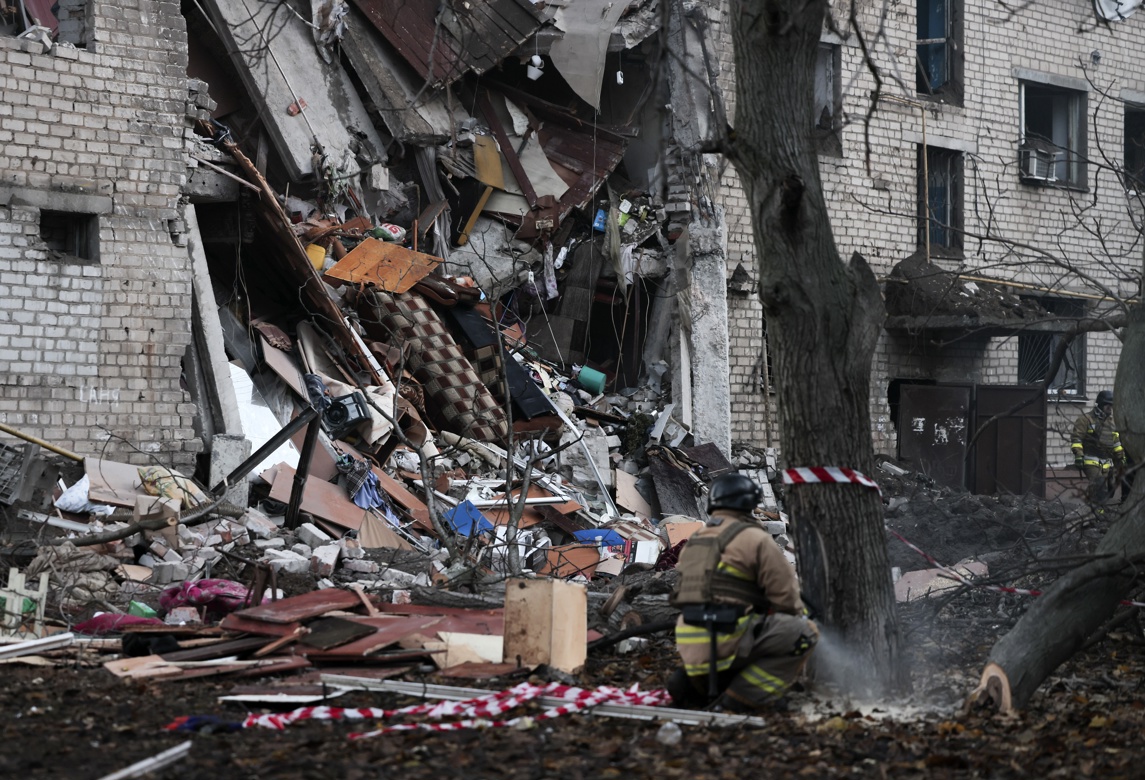
The war in Ukraine, which should never have started, may end in a stalemate or in a peace agreement. If, on the other hand, there is a collapse on the fronts and Ukraine is defeated, there will be no peace, but rather the prelude to a larger and much more lethal war, which will involve Russia and NATO, and naturally the United States, which will not be able to remain neutral.
As before, Russia can continue with its spectacular announcements of new missiles that it may never use, and Trump will be able to throw other bravado to the wind, protected by his country’s military power. He crux The point is not to use them, because that is where the real danger lies.
No nuclear test is an attack, and no unexplosive missile test constitutes a real threat. These are reckless military games and dangerous nuclear fanfare.
See you there.
This text was published in the newspaper For this! It is reproduced with the express permission of the author and editors. Read the original.