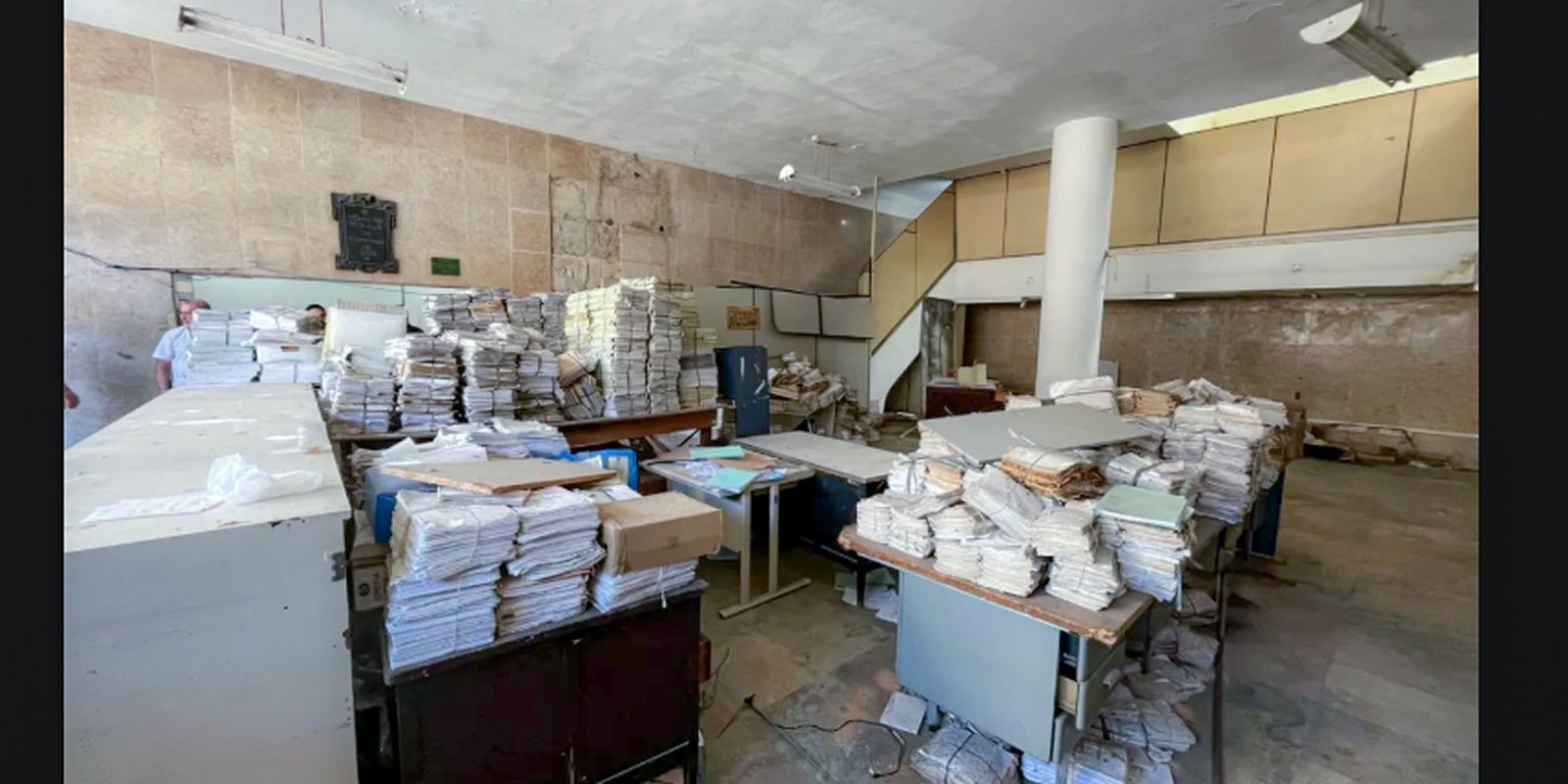
The Federal Public Ministry (MPF) filed a public civil action in the Federal Court to demand immediate protection from the Union and the government of the state of Rio de Janeiro for the historical collection found in the old building of the Instituto Médico Legal (IML), in Lapa, central region of the city. The document points to the abandonment of the building and urgently requires the preservation, security and immediate organization of the archives.
According to the deputy regional prosecutor for Citizen’s Rights Julio Araujo, the action became necessary given the accelerated deterioration of the building and the real risk of losing documents essential to the right to memory, truth and the country’s history.
“The collection is exposed to bad weather, animal feces, dirt and constant invasions. This is a clear, imminent risk and absolutely incompatible with the preservation of priceless documents”, he stated.
Abandoned collection
In technical visits carried out throughout this year, the MPF and specialized bodies identified microfilms on acetate and even on cellulose nitrate – a highly flammable material – already in advanced deterioration. There were also records of doors being broken into, files thrown on the floor and rooms that could not even be accessed.
“The structural precariousness and abandonment of the building put at risk not only the documentary heritage, but also the safety of neighbors and the right of the entire Brazilian society to know its history”, described the public prosecutor.
Memory and repair
For the Tortura Nunca Mais Group, which accompanied the MPF’s visit to the former IML building, in March 2025, the initiative marks the beginning of a new cycle in the fight for the preservation and research of human rights violations in Brazil, which include an even broader historical context than just the dictatorship.
“What we see here is a true opening of the archives of repression, something we have been fighting for for a long time. This process not only allows access to these documents, but also contributes to the elucidation of the facts and to guaranteeing the country’s memory”, stated Rafael Maui.
The member of Tortura Nunca Mais defended a joint effort to guarantee the preservation of the collection. “The support of public bodies and civil society will be essential. It is necessary to form an expanded working group, and the active participation of the Public Ministry in this process is essential. We need to join efforts from different institutions to guarantee the conservation and valorization of this historical material”, assessed Maui.
“Based on the documents found by the Tortura Nunca Mais Group here in the IML building, through death registration books, it was possible to locate the whereabouts of 14 politically disappeared people and, later, a 15th. They were buried as indigents in the Ricardo de Albuquerque cemetery. This indicates that other missing people can also be identified based on the information contained in these documents”, highlighted Felipe Nin, from Coletivo Memória, Verdade, Justiça e Reparação.
The MPF highlights that the state of Rio only maintains two guards per shift for building security, an insufficient number to prevent invasions. “Current protection is limited and ineffective. Even with surveillance, drug users continue to enter and remain in the area”, points out the document.
Historical documents
The collection brings together approximately 2,900 linear meters of documents and around 440,000 iconographic items, including Civil Police records from the 1930s to 1960s and materials from the period of the military dictatorship. These are documents that can provide new information about political disappearances, torture and human rights violations recognized by the Inter-American Court.
“The historical value of this material is invaluable. We are faced with documents that can clarify serious violations, reconstruct the trajectories of the disappeared and comply with international decisions that determine Brazil’s duty to preserve its memory”, highlighted Julio Araujo.
The prosecutor recalls that, in the Vladimir Herzog Case, the Inter-American Court expressly stated that States must preserve files on serious violations. “The deterioration of this collection compromises not only memory, but truth and democracy itself,” he stated.
With the request, the MPF requires the Union and the state to prepare, within 30 days, a work plan for the treatment of the collection and to begin, within 60 days, concrete actions to analyze and organize the files. Technical supervision must be carried out by the National Historical and Artistic Heritage Institute (Iphan).
Surveillance
The MPF also requests in the document sent to the Federal Court, a minimum of ten agents per shift and basic health measures, such as repairing windows, daily cleaning and preventing new invasions. “As long as the collection remains in place, it is essential that there is real and daily protection. The current scenario is unsustainable”, wrote the prosecutor.
The advancement of the judicial process is crucial so that the country does not lose documents that are fundamental to understanding its own history, says the prosecutor.
“Without knowing and preserving this past, we will continue to be unable to confront authoritarian practices that still persist. The existing documentation in the former IML is part of the memory of the Brazilian people”, assessed prosecutor Julio Araujo.
The request reinforces that, even with the reversion of the building already determined by the Courts, the Union has not yet initiated concrete measures. Therefore, the MPF requires the court to impose deadlines, obligations and, if necessary, a daily fine to ensure the immediate protection of assets.