“He who dwells in the secret place of the Most High will rest in the shadow of the Almighty. I will say to the Lord: He is my God, my refuge, my fortress, and in Him I will trust.”
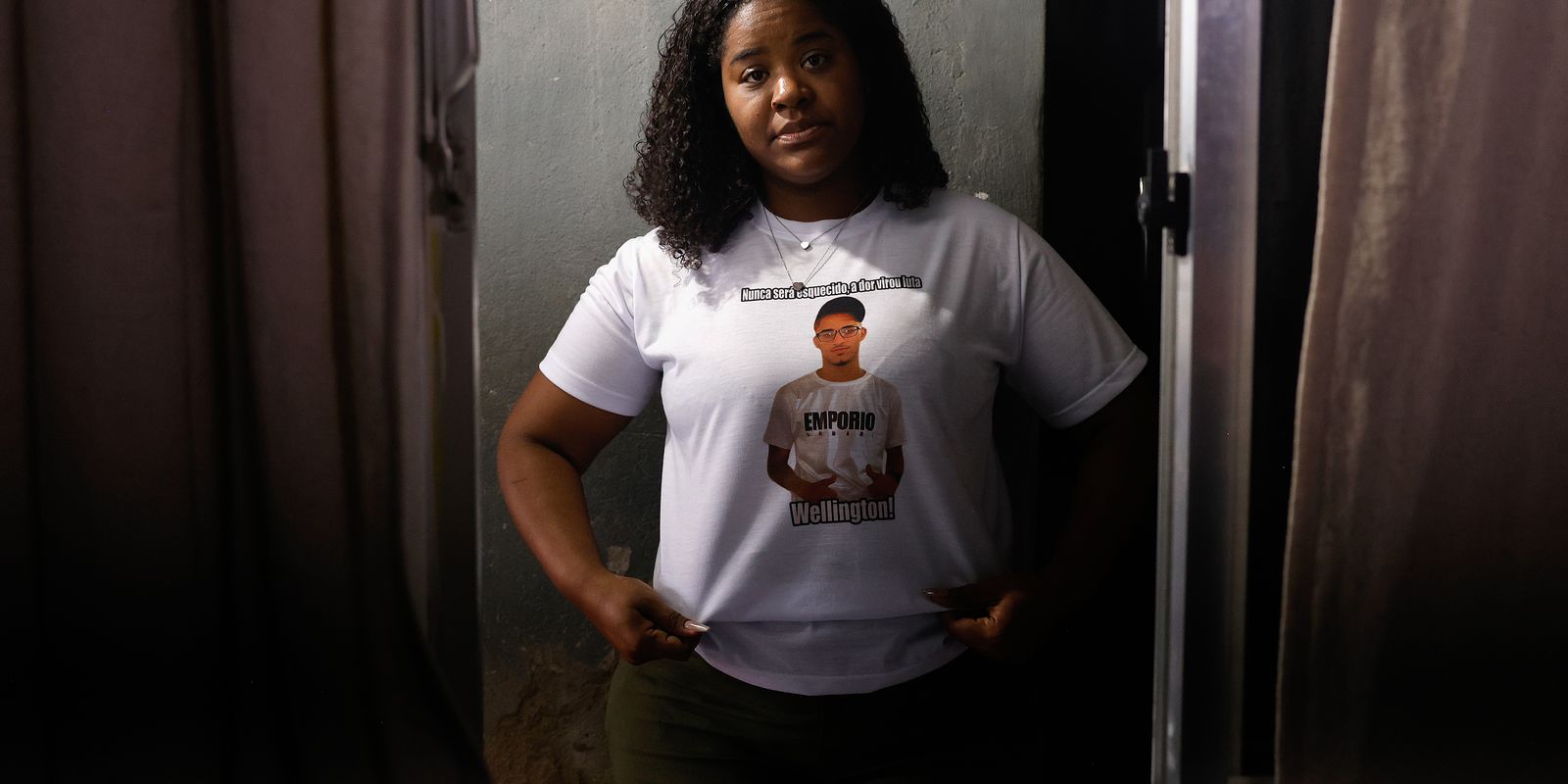
This is an excerpt from Psalm 91, from the Bible, that confectioner Tauã Brito, 36 years old, recommended to her son Wellington, 20 years old, during the police operation against Comando Vermelho, carried out in the Penha and Alemão complexes, last Tuesday (28), in the city of Rio de Janeiro. He was one of 121 killed in actionwhich is considered the deadliest in the state’s history.
>> Under factions and operations, the favela population experiences trauma and falls ill
Upon receiving the Brazil Agency at a family member’s house, in the north of Rio, She remembered her last conversations with the young man and reported that found his body with his hands tiedwhich indicates that he was surrendered before being killed.
“If a police officer managed to get to my son, tie his arm and stab him, it’s because he no longer posed any danger. So, why didn’t he take him to prison? In Brazil, there is no death penalty. If the person poses no danger, they have to be arrested”, criticizes Tauã, who has received a series of offensive messages and classifies the operation as a massacre.
A solo mother from Wellington for most of his life, Tauã had her son at 15 years old. She left her parents’ house and lived next to the child’s father for seven years, when she separated and raised him with her mother, in a simple house in Complexo da Penha.
She says that she worked as a waitress, selling cell phone chips and sweets to get Wellington to complete high school and even get a job in a supermarket, as a young apprentice, when he was between 14 and 15 years old.
“Wellington was a much loved, playful child, he slept in bed with his grandmother until he was 7 years old. He was always calm, studious and flirtatious. He always had a little girl”, laughs his mother. “There are a lot of people posting photos of him. He was beautiful, my boy.”

Tauã Brito with his son Wellington Brito when he was still a child. Photo: Tauã Brito/Personal Archive
It is with great affection that his 7-year-old sister also remembers him during the interview. While Tauã rewatched videos of the two together on his cell phone, showing the two children riding motorcycles through the community, recording “dances” for social media or playing dominoes before bed, the girl remembers.
“I liked playing with my brother, going out for açaí, going for a ride on the motorcycle. We did a lot of things together”, he confided.
Tauã says that the family lived together, Wellington returned home every day to sleep and they attended church and religious festivals together. Until the arrival of adolescence brought apprehension to the mother when her son was co-opted into drug trafficking.
“I told him, ‘for the love of God, my son, let’s leave this place, let’s live with my grandmother, in Rio das Ostras [cidade da Região dos Lagos do Rio de Janeiro]’, but he refused.”

Tauã Brito, mother of Wellington, killed during Operation Containment in Complexo da Penha, shows a photo of her son on her cell phone. Photo: Tânia Rêgo/Agência Brasil
Day of operation
During the police operation that brought together 2,500 police officers in the complexes, Tauã says he started talking to his son at 2 am.
“Actually, I asked, I begged him to stay at home, not to go out, but I couldn’t help it.”
They exchanged many messages throughout the night, with her recommending the biblical psalm and begging for help, for example, mediating a surrender. But there was no more time.
Early in the morning, Wellington was in the forest, in the Serra de Misericórdia region, where police officers from the Military Police’s Special Operations Battalion built a “wall”, preventing both residents from climbing up and those who were there from escaping. Without further answers, Tauã tried to go there, but was stopped by the Operation Containment police.
At night, as she had already said in interview with TV BrasilTauã was at the door of the Getúlio Vargas State Hospital, where the first bodies of the victims arrived, and begged for help from the press to be able to enter the forest without the threat of being shot by police, but the appeal was in vain.

Tauã Brito, mother of Wellington, killed during Operation Containment in Complexo da Penha, and her other daughter, aged 7. Photo: Tânia Rêgo/Agência Brasil
When the police left, she went up into the woods with Wellington’s father. With the light from his cell phone, he screamed, looked for his son and found him, among other bodies, at 1 am, with his wrists tied, a knife cut on his arm and a gunshot wound to the head.
“Guys, I never said that my son was right. I always said ‘I bless your life, but not what you do. I was never in favor of what he did, I never took his money for anything. I don’t even know how much I received. I always did my side jobs in a restaurant, I worked as a waitress at the pagoda, I always followed.”
“I didn’t support what he did, but he had the right to surrender, to be arrested”, he lamented.
Tauã watched over the young man’s body during the early hours and morning of Wednesday (29), when 80 people were also murdered were removed from the forest and lined up by residents in Praça São Lucas, in Complexo da Penha. The image referred to the Vigário Geral Massacre, which claimed 21 lives 30 years ago.
“The governor [do Rio, Cláudio Castro] said this was a successful operation. Successful for whom? What changed inside? This is his political platform: offering bodies?” he criticized.
“If the governor said: ‘look, I entered the community, the police left a hundred or so people dead, but I’m offering this here for you, for young people to change their lives. I’m filing this appeal’. But that didn’t happen. He came in, killed and finished. There’s nothing for those who stay, for those who saw the state of these bodies on the ground. When we were at the entrance to the IML, we saw two police buses mocking the families, laughing, clapping, laughing.”
Release of bodies
The mother also denounces the negligence in removing the bodies, which remained in the community for many hours, and in identifying them by the IML. She believes that the bodies should have been distributed to other IMLs in the state, and treated with more dignity.
“The bodies remained in the woods and in the sun for hours. On Wednesday, it took a while for the civil defense to come and collect them. So, the body was already in a state of decomposition. After it left here, when they arrived at the IML, the bodies remained on the ground, outside, many hours after they were dead.”
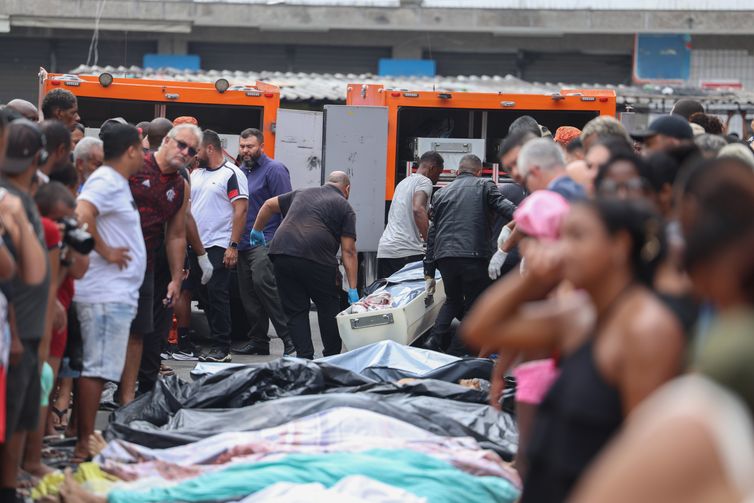
Dozens of bodies in Praça São Lucas, in Penha, north of Rio de Janeiro. Photo: Tomaz Silva /Agência Brasil
With this situation, Tauã changed the plans for Wellington’s burial. “I wanted to see my son, say goodbye, but it had to be with a closed coffin. I asked for it to be opened, but when it opened, I asked for it to be closed.”
Tauã says that he has not yet been able to return home, but that he has gathered the strength to talk about what happened as a way of defending his life. In her view, there is a lack of opportunities and public policies for young people in favelas and there is a lot of violence and death. It seeks to transform mourning into denunciation, so that the circumstances of lethality in Operation Containment are clarified and so that other young people are not deceived by organized crime.
“My war is over, but there are many mothers asking for help for their children, and my fight will be for them too”, he explained.
“I really want to talk about my pain, about what happened that day, about the right that was taken away from me, to reach my son so he can be arrested, because, soon, this will be forgotten, but there are other Wellingtons and mothers who need to hear it”, he concluded.

Tauã Brito, mother of Wellington, killed during Operation Containment in Complexo da Penha. Photo: Tânia Rêgo/Agência Brasil
Government of Rio
In press conferences given to the press during the week, public security authorities from the government of the state of Rio de Janeiro considered that Operation Containment was a success, stated that the criminals who surrendered were arrested and claimed that the dead were those who tried to kill the police officers in action, who were looking for the execution of 100 arrest warrants and 180 for search and seizure.
According to what they told the press, the conflict was moved to the forested area, where most of the deaths occurred, to preserve the population of the favela complexes, considered the “comando Vermelho headquarters”.
The governor, Cláudio Castro, came to assess that the only victims were the four police officers killed. The Secretary of Civil Police, Felipe Curi, said that the action was planned, but that the result “was chosen by them”.
“Massacre is illegal death. What we did yesterday was a legitimate action by the State to comply with arrest and arrest warrants,” he stated.
Entities defending human rights and favela movements classified the action as a “slaughter” and “massacre” and demand that the investigation be carried out independently.

Table with authorities from the State of Rio de Janeiro during a press conference on Operation Containment in the Police City, in Rio de Janeiro. Photo: Tomaz Silva/Agência Brasil