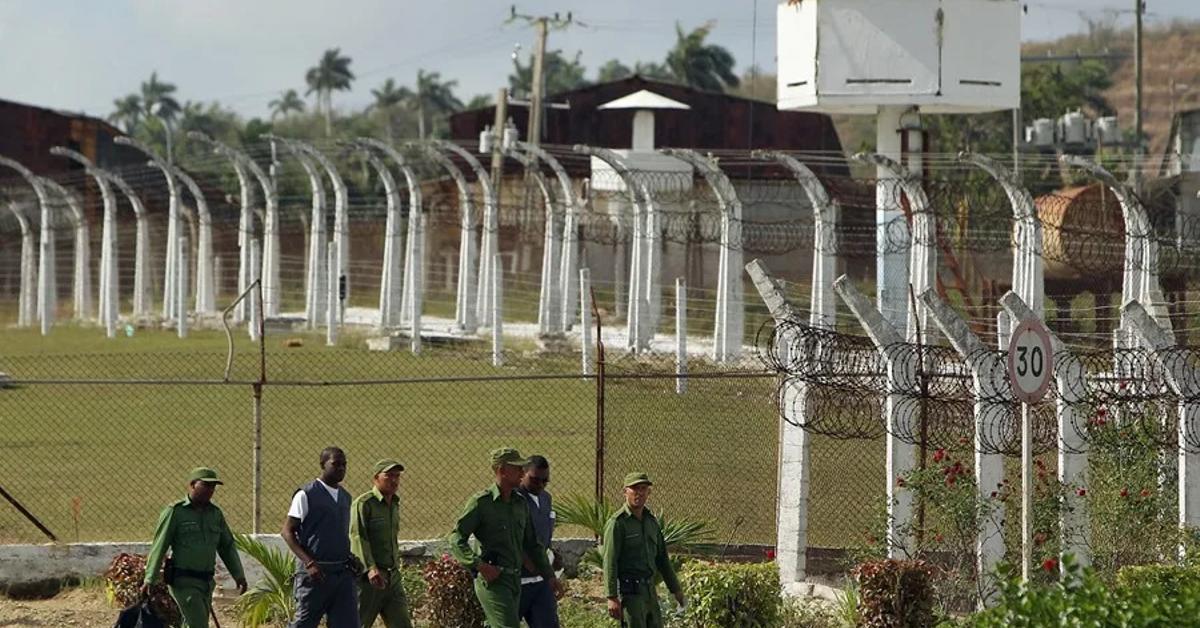
Madrid/An investigation by the Prisoners Defonders organization denounces that at least 60,000 people deprived of liberty in Cuba are subject to forced labor. This practice is normalized and institutionalized, and points to the economic benefit of the State, both for internal production and for export, ensures the study presented on Monday in Madrid and Brussels.
He reporttitled Cuba’s penitentiary business: 60,000 prisoners are used as a slave labor forceis based on 53 direct testimonies – taken between April and August of this year – and in tens of additional interviews. It also uses official documents, institutional information and databases verified by the Institute for Crime & Justice Policy Research, from the University of London.
The NGO, based in Madrid, estimates a penitentiary population of about 90,300 inmates after bars and another 37,458 under minimum security regime. It is estimated that almost half of all these inmates carry out forced labor, including both those who comply with prisons and those that are in lower internment establishments.
100% of the declarants (53 of 53) claimed to have been forced to work under coercion, threats, violence or reprisals. The vast majority (69.8%) did not sign an employment contract or received documents that regulated their link, and almost all (98.1%) worked without tools, training or necessary supplies. In addition, 96.2% were exposed to serious risks derived from climatic and environmental conditions, while 45.3% suffered physical violence during work.
The work in construction also stands out, usually to make their private homes to the security controls of the status of prisons
The effects on health were significant. 81.1% reported serious physical and psychological deterioration. In terms of remuneration, the majority did not receive a real salary: of the 35 that were allegedly assigned a payment, 18 did not receive any remuneration, 25 had retentions to cover tools, clothing or food, and 9 received only symbolic amounts, less than 4 dollars per month.
A 47 -year -old prisoner, with chronic sciatic, partial blindness and ulcer, reports that he was forced to load stones, debris, cut marabou and clean graves in the same prison. He says that his vision worsened until he lost 90%, which he can barely walk, that his ulcer was aggravated by poor diet and suffered the mutilation of a finger due to bad working conditions.
In view of the results of the study, it could be verified that 94.34% of the 53 declarating prisoners were forced to work with incompatible diseases with brutal performances, such as coal production, sugar cane and agriculture. The work in construction also stands out, usually to make their private homes to the security controls of the status of prisons.
Women prey denounce that they do physically inappropriate work, without hygiene or protection. They report that even pregnant women or those suffering from serious diseases are forced to work in degrading conditions. An HIV inmate and pulmonary disease tells that he suffered a six -point wound in his hand due to lack of protection. Not only was adequate medical care denied, but they imposed an infraction for snacking, despite being a vulnerable patient.
A 28 -year -old woman, a political prey on probation, was assigned to work in a hospital without providing hygiene products or protective equipment. She was threatened to return to the prison of greater rigor if she did not comply. Another 22 -year -old inmate, denounces that she was forced to clean streets being sick, newly operated from the teeth, without tools or sufficient rest.
The conditions are “inhuman”, say the inmates
The testimonies agree that the State does not perform medical evaluations prior to work or periodic monitoring. There is no proper supervision and inmates are exposed to risks of all kinds, without training or security measures. A dam ensures that he works in a large hospital, without water, loading cubes and climbing stairs, with ovarian disease and the injured hand. He says that he cleans without gloves or protection, exposed to all kinds of infections.
Several prisoners claim that they work with an average workload of 63.06 hours per week distributed over days of 6 to 7 days per week and an average of 10 hours of daily work. Many have suffered occupational accidents – classes, sprains, wounds without immediate medical attention – and those who suffered chronic diseases have seen their deteriorated health.
The conditions are “inhuman,” the inmates say: there is no drinking water, the tools are insufficient, suffer physical and psychological violence and the days are exhausting. In many cases they work without payment or with symbolic wages ranging from the equivalent of less than one dollar to seven dollars per month. Above, many must pay their own work instruments.
The report also documes cases of prisoners of consciousness that were forced to work in the same tasks. Who refuse, the exits, visits and other penitentiary benefits are removed.
Many Cuban products – like Marabú’s charcoal and cane sugar – end up in European countries markets
Prisoners Defenders denounces that Cuba breaches its obligations in international treaties such as the Agreement on the abolition of forced labor of the International Labor Organization. In addition, remember that European legislation prohibits the importation of products elaborated in conditions of modern slavery. However, many Cuban products – like Marabú’s charcoal and cane sugar – end up in the markets of European countries such as Spain, Portugal, Italy, Greece and Türkiye.
For those who denounce, the effects go beyond physical work, it is a process of systematic dehumanization. The relatives of political prisoners ensure that their loved ones return from tasks with brands of punishment and under constant threats. One of the testimonies affirms that “the regime, in prison, not only uses their gendarmes, also use common prisoners of the lowest calañas to intimidate, host and torture prisoners of consciousness with all impunity.” Other Recent report De Prisoners Defenders raises the number of political prisoners in Cuba to 1,185.
The research argues that it is not only about individual abuses, but an economic model. The exploitation of inmates has become an export engine and an unfair competition factor for producers that respect labor norms and human rights.
Entrepreneurs, distributors and importers abroad could be receiving products elaborated in modern slavery conditions, even without knowing it. This chain implies legal responsibility – according to national and international laws – and moral responsibility.
Prisoners Defenders, together with the United Nations Special Rapporteur for contemporary forms of slavery, demands independent research on working and correctional working conditions. They ask that importing countries investigate the origin of Cuban products and sanction trade with forced labor in accordance with the law. They also demand that the international community maintain attention to the situation of political prisoners, whose condition of dissidents usually aggravates abuse.