Citizen insecurity continues to mark daily life. According to a recent survey of Imasen, Public transport appears as the space where the population feels most vulnerable. In November 2025, 64.6% declared themselves unsafe and 14.7% very unsafe. For January of this year, insecurity remains high: 54.6% feel insecure and 16% very insecure, while only 25.3% consider themselves safe or very safe.
A similar situation is observed when walking through a neighborhood other than the one in which one lives. In November 2025, 61.7% reported feeling unsafe and 17.9% very unsafe. In January 2026, the negative perception continues: 56.5% feel unsafe and 14.4% very unsafe. In both periods, less than a third say they feel safe or very safe when traveling outside their usual area.
WE RECOMMEND YOU
JOSÉ JERÍ AND HIS HIRING + ELECTIONS | WITHOUT SCRIPT WITH ROSA MARÍA PALACIOS
Transit through the neighborhood itself shows a less critical perception, although with signs of deterioration. In November 2025, 49.6% felt safe and 6.5% very safe, compared to 37.3% who declared themselves unsafe. In January 2026, security decreases slightly: 42.6% feel safe and 8.2% very safe, while insecurity rises to 42.8% and the very insecure category reaches 5.1%.
The home continues as the space with the greatest sense of protection. In November 2025, 60.9% felt safe and 23% very safe, compared to 14% unsafe. By January 2026, although security continues to be the majority, there is a variation: 57.3% declare themselves safe and 17% very safe, while 22.4% say they feel insecure.
In contrast, restaurants and bars have high levels of negative perception. In November 2025, 55.6% felt unsafe and 7.5% very unsafe, while only 32.5% considered themselves safe or very safe. In January 2026, insecurity remains: 52.5% feel insecure and 7.9% very insecure, compared to 37.3% who express a feeling of security.
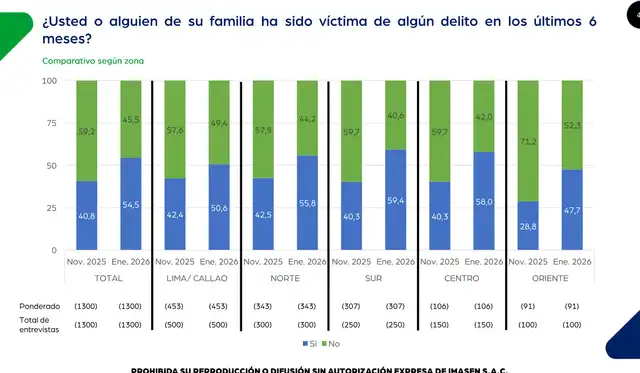
54.5% affirm that they or a family member was the victim of a crime in the last six months
The data of Imasen show that the percentage of people who report having been a victim of a crime, or that a family member has been, goes from 40.8% in November to 54.5% in January. In parallel, those who respond that they did not suffer any crime decreased from 59.2% to 45.5%.
In Lima and Callaovictimization also registers an increase. In November 2025, 42.4% indicated having been a victim, a figure that rose to 50.6% in January 2026. In contrast, negative responses decreased from 57.6% to 49.4%, confirming a higher incidence of crime in recent months.
The northern zone presents an even more marked variation. In November, 42.5% declared having been the victim of a crime; for January, the percentage reaches 55.8%. In the same period, the group that claims to have not suffered crimes decreased from 57.5% to 44.2%.
In the south of the country, victimization shows one of the highest levels. In November 2025, 40.3% reported having been a victim, while in January 2026 the figure rose to 59.4%. Conversely, those who respond that they were not victims fall from 59.7% to 40.6%.
The central area also registers a significant increase. In November, 40.3% reported having been the victim of a crime; In January, the percentage rises to 58%. In that same period, negative responses decreased from 59.7% to 42%.
In the East, although victimization is growing, it remains below other areas. In November 2025, 28.8% indicated that they had suffered a crime, a figure that increased to 47.7% in January 2026. Even so, the majority declared that they had not been a victim, with 71.2% in November and 52.3% in January.