The prisoners who began the hunger strike demand to be transferred to their prisons of origin. The Venezuelan Prisons Observatory also reported the death of a young man due to lack of medical care and Clippve documents at least 90 torture centers and more than 900 detainees for political reasons in the country.
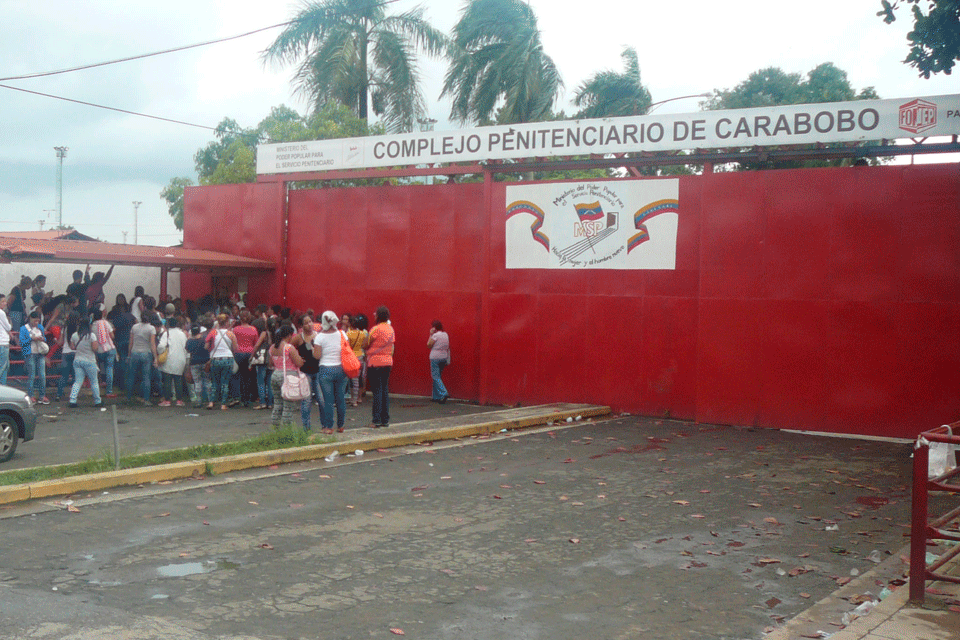
Relatives of prisoners held in the Tocuyito Judicial Confinement Center, currently known as Sesma Tocuyito, in the state of Carabobo, reported this Friday, February 13, that more than 300 prisoners began a hunger strike as a measure of protest against alleged physical and psychological torture to which they claim they are subjected daily.
According to reports released by the Venezuelan Prisons Observatory (OVP)the inmates protest by voluntarily refusing to receive food from the early hours of the morning after singing the National Anthem. Relatives point out that they were taken from their cells and taken to the field, where they remain exposed under the sun. The families can hear their screams and say that with them they prove the mistreatment by the prison guards.
The OVP has warned that Tocuyito has become a punishment prison, used to house prisoners transferred from different cities in the country with the promise that in six months they would be returned to their centers of origin. However, relatives say that many have been without return or official explanation for more than eight months.
The protest in Tocuyito once again highlights the deep humanitarian crisis in the Venezuelan prison system, characterized by overcrowding conditions, lack of access to basic services and serious violations of human rights, according to independent organizations.
In this sense, the OVP demands the immediate cessation of cruel, inhuman and degrading treatment, as well as the return of inmates to their prisons of origin and the intervention of international organizations.
Death in prison
On Wednesday, February 11, Edicson Gabriel Gil Pimentel, 26, died in the Fénix Penitentiary Community, in Lara state, due to an intestinal infection that, under normal circumstances, could have been avoided with timely and specialized medical care.
Family members and human rights defenders pointed out that the lack of basic health care, in a context marked by hunger, malnutrition and lack of drinking water, condemned Gil Pimentel to death inside a center under state custody.
Organizations such as the Venezuelan Prison Observatory have documented for years that in Venezuelan prisons there is no menu that meets the minimum caloric intakes, they affirm that the diet is based on flour and grains without proteins, and that the supply of drinking water is insufficient, conditions that, added to medical negligence, make health complications common among the inmate population.
Closure of torture centers
On the other hand, the Committee for the Freedom of Political Prisoners (Clippve) has denounced that in Venezuela there are at least 90 centers where torture is practiced and that there are more than 900 people unjustly detained for political reasons, many of them in conditions of incommunicado or cruel treatment.
This organization, dedicated to the defense of those considered prisoners of conscience, makes a forceful call: that all torture centers be closed and that all political prisoners be released.
The president of the National Assembly, Jorge Rodríguez, announced on January 8 that there would be “a significant number” of releases of political prisoners. Then, Delcy Rodríguez, in charge of the Executive, announced an amnesty law to benefit detainees between the years 1999 and January of this 2026.
Although the law remains under discussion in Parliament, some people have already been released. National authorities say that more than 800 prisoners have been released, but NGOs have managed to verify just over 400 cases.
*Journalism in Venezuela is carried out in a hostile environment for the press with dozens of legal instruments in place to punish the word, especially the laws “against hate”, “against fascism” and “against the blockade.” This content was written taking into consideration the threats and limits that, consequently, have been imposed on the dissemination of information from within the country.
Post Views: 2