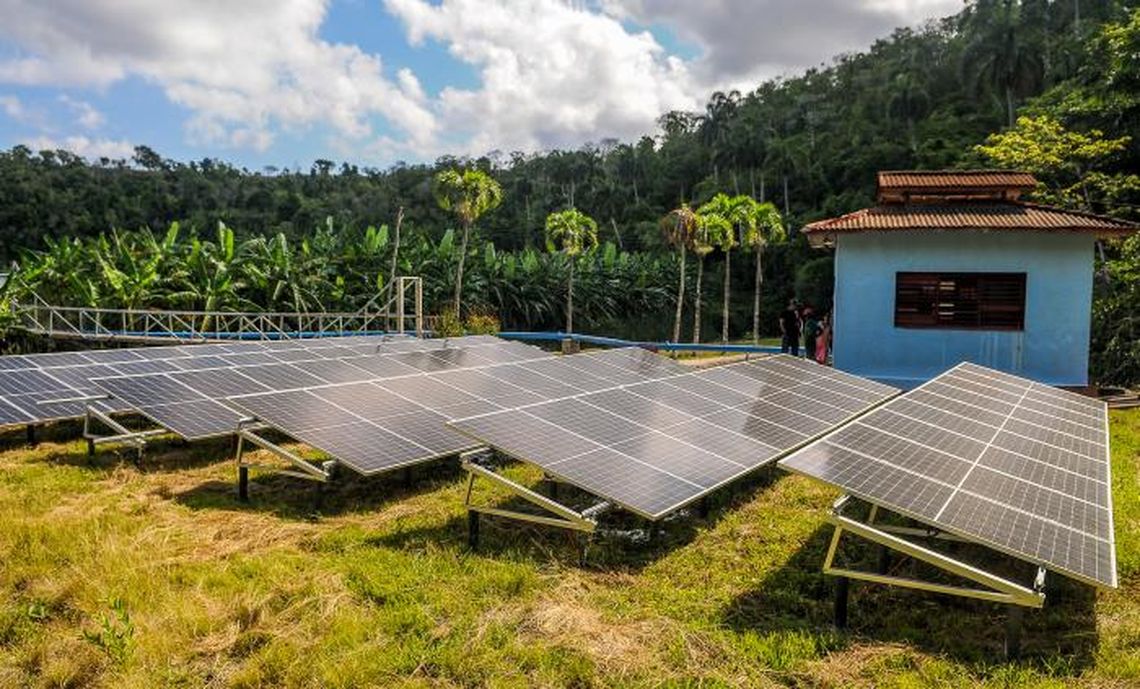
Installing more solar panels and specific electricity cuts for state companies and private businesses, are among the measures being carried out in Cuba to address the worsening of the energy crisis as a result of the United States oil blockade.
The solar panels that are currently installed on the island go beyond the solar parks that the Government has been setting up with the collaboration of China and others aimed at isolated families and communities, as part of projects also with international support.
In the current difficult energy scenario, the Cuban Government also “accelerates the installation of photovoltaic solar panels in prioritized institutions of the Health System,” report Granma.
According to the media, which cites the Ministry of Public Health (Minsap), the measure “is part of a government contingency program” and “seeks to protect vital services for the population, and guarantee the operation of the guard corps in polyclinics throughout the country.”
This project, already underway, extends throughout the entire island and includes the installation of panels in “161 maternity homes, 156 nursing homes, 305 grandparents’ homes, 556 polyclinics, among other vital infrastructures,” says the official publication.
The installation of solar panels in the Guard Corps of polyclinics in #Cuba.
⚕️ We work to guarantee the vitality of services, overcoming obstacles to protect what is most precious: the lives of our people.#CubaForLife #TumbaElLoqueo pic.twitter.com/0FrW83AEkL
— Ministry of Public Health of Cuba (@MINSAPCuba) February 15, 2026
Panels for workers and punishment blackouts
The installation of solar panels is also extended to other entities, such as banks, as well as to families with electro-dependent children due to illness and to Labor Heroes and Health and Education professionals, the latter after their sale as a work stimulus.
As reported by the minister of the sector, Vicente de la O Levyin a government meeting, to date 8,827 systems of the planned 10,200 have been sold, and 7,719 have been installed, representing 87.4%. All of this, in the official’s opinion, “has had a very good impact.”
In the province of Las Tunas, for example, 584 of these photovoltaic modules must be installed, which “are already in the territory,” Maritza González Llorente, territorial director of the National Office for the Rational Use of Energy (Onure), explained to the local newspaper.
The directive also detailed other measures that are being carried out in the midst of the current crisis. Among these, he listed punitive blackouts of at least 72 hours for state companies and private businesses that fail to comply with their consumption plan.
“All those who failed to comply with the consumption plan for the month of January are having their service cut off. This measure is notified 48 hours in advance. Then it is applied for at least 72 hours, and the maximum duration of the cut is extended until the defaulter recovers the overdraft,” he said.
Cuba responds with survival measures to the challenge of an energy collapse designed by the US
More disconnections and bakeries with firewood and coal
Furthermore, González Llorente confirmed that after an “exhaustive survey” all economic actors, both state and non-state, are being disconnected from the so-called “non-switchable” circuits.
The switches of state services are also being opened between Fridays and dawn on Mondays, and “progress is being made on a conversion schedule for the territory’s bakeries so that they can bake bread using firewood and charcoal, as an alternative to electricity,” the official added.
These measures are part of a broad survival package applied by the Cuban Government in the face of strong pressure from Washington after the events of January 3 in Venezuela. In this context, the island has stopped receiving oil from its traditional suppliers, while the Trump Administration threatens tariffs on those who send fuel to the Caribbean country.
Experts such as Jorge Piñón, from the Energy Institute of the University of Texas, affirm that Cuba’s energy situation is critical and that if by March the country has not received fuel “it will have reached zero hour.”