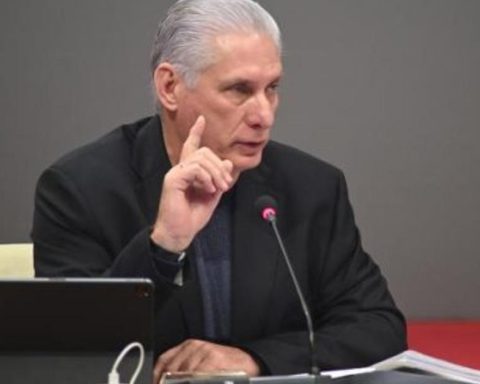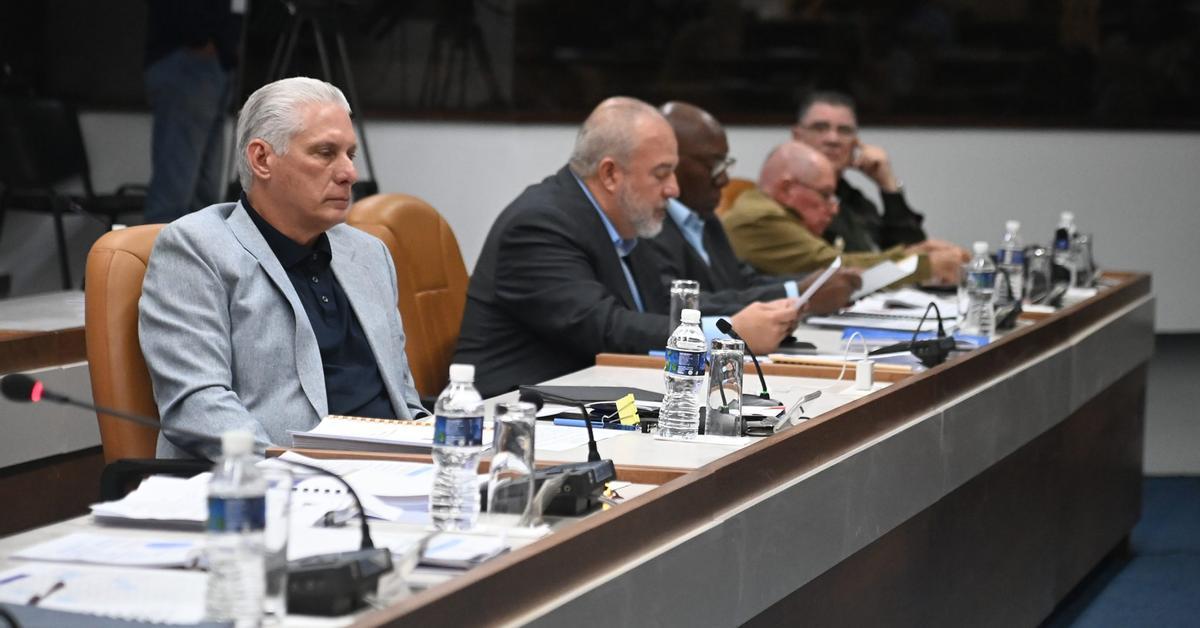
Havana/The XI Plenary Session of the Central Committee of the Communist Party of Cuba concluded this Saturday leaving many slogans, long ideological disquisitions and an almost total absence of real self-criticism. Miguel Díaz-Canel, first secretary of the PCC and president of the Republic, repeated before the party elite the same recipe that the ruling party has distributed for decades: unity, resistance, discipline and ideological battle.
All this in a country that faces the worst economic deterioration since the 90s, a health collapse in the midst of a viral epidemic and a citizen demobilization that neither the Party nor the Government have managed to reverse.
The president began his speech by announcing the need to “change everything that must be changed,” although he immediately placed nonagenarian Raúl Castro as his ideological compass. “If we want to move things forward, the first thing we have to achieve is that the grassroots organization of the Party in each place is strong,” he said, in a message that shifts the focus to ordinary militants and avoids attributing structural failures to the political leadership.
The Plenary dedicated much of its time to reviewing compliance with the agreements of the VIII Congress of the PCC, held in 2021, and the accountability of the Political Bureau. According to Díaz-Canel, none of these debates would make sense without a profound change in the internal functioning of the single party. “We cannot allow bureaucratism, formalism and inertia to continue being brakes,” he reiterated, as if it were a newly discovered diagnosis and not a historical burden that spans six decades of economic and political centralization.
In the absence of concrete solutions to the economic crisis, the official discourse reinforced the terrain where the PCC feels most comfortable: symbolic confrontation. The president insisted on the need to “intensify the ideological, cultural and communication battle,” repeating the formula of the “truth of Cuba” in the face of “manipulation” and the “media war.” According to him, each day of survival of the system constitutes “a victory” against the “most powerful enemy,” despite the fact that the most pressing problems – blackouts, inflation, shortages, epidemics – have essentially domestic roots.
About the obvious hospital collapse and the massive flight of health professionals, not a word
The allusions to the “American blockade” were constant. Díaz-Canel spoke of a “very high amount of pressure” and media intoxication capable of distorting internal perception. But, even when citing the health crisis caused by dengue and chikungunya, he once again placed the failures on a minor organizational level, the lack of personnel to fumigate, monitoring problems, control deficiencies. About the obvious hospital collapse and the massive flight of professionals of health, not a word.
The president asked to act “without improvisations”, promote “collective leadership”, encourage criticism and self-criticism and “confront corruption in a more decisive manner”, although the country’s political structure continues without independent mechanisms of control, transparency or citizen oversight. In an exercise now common in the PCC’s interventions, Díaz-Canel listed problems that the system itself generates and perpetuates, but without admitting the political origin of these dysfunctions.
The Plenary also addressed the country’s economic situation, marked – according to the Prime Minister, Manuel Marrero Cruz – by a “war economy” scenario. The government program to “correct distortions and re-boost the economy” accumulates 106 objectives, 342 actions and 264 indicators, a design that contrasts with the chronic lack of tangible results. The official narrative insists on the need to “prioritize tasks”, “integrate actors” and “mobilize reserves”, but the balance presented confirms that the country operates with a fuel deficit, prolonged blackouts, low levels of production and serious foreign currency restrictions.
The Minister of Energy and Mines, Vicente de la O Levy, admitted that the last few weeks have been “extremely difficult”, marked by the loss of generation and the inability to guarantee electro-energy stability. Not even the new photovoltaic solar parks, celebrated as a strategic advance, compensate for the obsolete technology and lack of fuel that continue to cause blackouts of up to 18 hours in several provinces.
The message, identical to the one that the ruling party has repeated for decades, shifts attention from administrative failure to ideological loyalty
Another of the critical fronts discussed was the epidemiological crisis. The Minister of Health, José Ángel Portal Miranda, recognized that Cuba faces an “extraordinary” challenge, with dengue and chikungunya epidemics aggravated by the lack of supplies, fumigation equipment, laboratory reagents and basic medications. He added that many territories have serious problems with vector control, sanitation and water supply, a structural deterioration that the Government has been unable to reverse for years. The official response, once again, insisted on “popular participation” as a solution in the absence of institutional resources.
In the midst of this panorama, the PCC once again placed “unity” as the cornerstone of the political project. Díaz-Canel affirmed that unity “is forged by participating” and that it is the guarantee that Cuba will continue to be “free, independent and sovereign.” The message, identical to the one that the ruling party has repeated for decades, shifts attention from administrative failure to ideological loyalty. Participation, however, is limited to consultation mechanisms without real decision-making capacity.
The Plenary closed with the confirmation of what had already been anticipated, that is, there will be no structural changes that alter the political monopoly of the PCC nor the centralized planning that keeps the economy paralyzed. Everything focuses on “correcting distortions” without touching the root of those distortions: the model itself. Neither political opening, nor real economic liberalization, nor full business autonomy, nor respect for civic rights. The Party once again proclaims itself the absolute arbiter of the country’s future and custodian of a unity that is demanded, but not built from plurality.
The few comments in official publications are striking, a sign of popular disinterest in this type of meeting. The system insists that the country’s problems will be solved “with our own efforts.” Cubans, who have been listening to the same thing for decades, already know the lyrics of that song, and they are fed up.