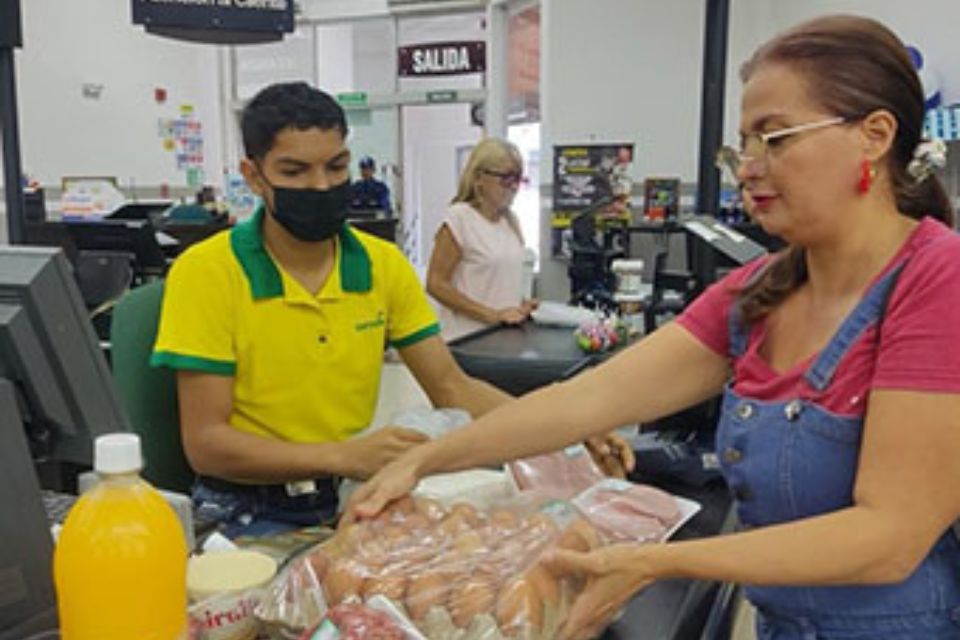
Unlike the rest of the country, three coins are used in the state of Táchira: Bolívar, dollar and Colombian peso, which generates complaints and confusion in the attempt to make money. Some people do not know how to calculate the real value of the products
While in most Venezuela the Bolívar and the dollar are the coins of common use, in the Táchira state, the economic reality is complicated with the incorporation of a third: the Colombian peso. This “monetary triplet”, as some say, generates frustration and confusion among some citizens, who see how money in Bolivars yields less and less.
They have been circulating for several years, but they continue to generate a lot of confusion when paying in Bolivars.
The complaints of the Tachirans, shared in the messenger of I report to The nationThey reflect concern about the purchasing power of Bolivar. “Yesterday I bought two flours, two rolls of toilet paper, a coffee bag and eggs and I almost died: 3 thousand bolivars. Terrible, the silver hard as long as one does not pass the card,” said a buyer, who added that this is the feeling of many.
Mathematics when paying in Bolívares
Complexity lies in the way commercial establishments calculate the exchange rate. Many use as a reference the official rate of the Central Bank of Venezuela (BCV), they must do so, it is the current one, and compare it with the price of the Colombian peso against the dollar. As explained, the calculation works as follows:
The value of the Colombian peso is divided by the official BCV dollar rate. For example, if the dollar is quoted at 4,000 pesos and in the BCV the rate in 160 bolivars, the calculation is: 4,000/160 = 25
This means that the change ratio between the bolivar and the weight is 25. that is, 1 Colombian weight equals 25 bolivars.
A recent example of a supermarket in San Cristóbal, dated September 12, confirms it. With the peso at 3,700 per dollar and the BCV rate at 158.93 bolivars, the result was 23.28 bolivars.
The problem arises when establishments apply a lower rate than this figure, for example, 16 instead of 25 or 23 as it has been in previous days in establishments that calculate BCV. In that case, the buyer must pay more bolivars to acquire the same product, which translates into a loss of the value of their money.
Consumer complaints
The difference between the official rate and that of the so -called parallel or black market further complicates the situation. According to the testimony of an anonymous buyer, the gap is approximately 40%. This difference is the key that consumers should use to calculate whether a product is more expensive in a supermarket or in a vegetable stall.
“If some Cambures cost two thousand pesos in vegetables, you put forty percent, which would be two thousand eight hundred pesos. If it exceeds that price in the supermarket, it is more expensive,” he explained.
Given this situation, Tachirens have learned to be more cautious. An I report user advised: “Buy in bolivars where they charge them at a BCV rate. Of course, they do not trust, carry their calculator and before paying they take out their accounts. They will not carry out an unpleasant surprise and demand both the invoice and the voucher of the point of sale.”
Other comments reflect confusion and discontent: “I don’t know where to buy with my bolivars, I feel that every day yields less. They charge me in pesos and when I pay I feel here the peso is more expensive than the dollar,” he said, and added that he always gets tangled up with the changes.
For many studs, the economic situation in Táchira, marked by the presence of three currencies, underlines the daily challenge they must face to make their money, especially the Bolívar, keep its value in the middle of a panorama of instability and lack of clarity in the change rates.
*Journalism in Venezuela is exercised in a hostile environment for the press with dozens of legal instruments arranged for the punishment of the word, especially the laws “against hatred”, “against fascism” and “against blockade.” This content was written taking into consideration the threats and limits that, consequently, have been imposed on the dissemination of information from within the country.
Post views: 87