The Cuban regime, through hundreds of projects and “individual” ventures, has benefited from and been strengthened by hundreds of millions of euros coming from European public funds.
HAVANA, Cuba – In the year 2000, a prominent Portuguese businessman was accused of document forgery, fraud, and embezzlement of money from the European Social Fund. At the time, according to reports in the press, the European Union demanded retroactive compensation based on the fraudulent use of funds intended for “vocational training.” According to the investigation, the money never reached the young people it was meant for, as the scholarships created by the businessman were fictitious.
This was one of many fraud schemes orchestrated by the shrewd Américo Amorim, the same man who, in the 1970s, lost his cork oak fields in Portugal to an agrarian reform law—fields that had made him the global leader in the cork market. But just days before the expropriation took effect, he set fire to the lands in order to claim insurance money. And who’s to say he didn’t collect it?
That payout, although insignificant compared to his vast fortune, would have covered perhaps a couple of months of expenses—a symbolic sum that served his personal pride. This was especially true as his secret dealings with communists from the European bloc were yielding excellent results, particularly in the smuggling of Soviet timber and hydrocarbons, which he funneled into Europe illegally for years.
It was a prosperous business that eventually spread from Moscow to the Caribbean, when his friend Fidel Castro opened the door for him to set up a semi-clandestine office in Miramar, Havana. From there, he expanded into Africa—specifically Angola—where sawmills created by the Amorim Group and the Dos Santos family would not have operated so efficiently without the “collaboration” of Cuban forestry specialists sent on “internationalist missions” as cheap labor.
But time passed, the “friendship” solidified, and amid business and intrigue, in May 2017, Portugal’s Secretary of Tourism, Ada Mendes Godinho, traveled to Cuba to sign a “cooperation agreement” with Américo Amorim’s representative on the island. This agreement included various arrangements for awarding scholarships to Cuban youth in the European Union, with the goal of training tourism personnel tied to the Amorim Group’s businesses.
Most notably with the Accor chain, which had arrived in Cuba in the 1990s not through the French, but via Américo himself. He had previously created the company Suncaribe Gestão e Investimentos Hoteleros SA for that purpose, and even helped the Meliá Group use it as a front in its dealings with the Cuban state employment agency ACOREC, with which it split 97% of salary funds. This setup helped them avoid any potential labor exploitation lawsuits in Spain and other European countries.
In the Miramar mansion where the Amorim Group operated, other deals and alliances were also forged. Following Raúl Castro’s 2005 visit to Portugal, the idea to launch the infamous Angola International Credit Bankemerged—an idea spearheaded by the aging Amorim and Isabel dos Santosthe so-called “African princess.” That bank would later become embroiled in multiple scandals involving fraud and embezzlement.
Considering these details—which are just part of a longer and more complex story—especially the preceding set by the 2000 fraud involving the European Social Fund, it’s not hard to guess what became of the 2017 scholarship agreement signed in Havana. The agreement involved several million euros that have since vanished without a trace—especially when the Amorim Group’s representative in Cuba was (and still is) Paolo Titolothe Italian son-in-law of Raúl Castro and father of young entrepreneur Lisa Titolo. Lisa’s company, not coincidentally labeled from its inception as a “Local Development Project,” has been the recipient of significant financial aid from various international programs—especially those from the European Union and United Nations—channeled through the Cuban regime via its Articulated Platform for Integral Territorial Development (PADIT).
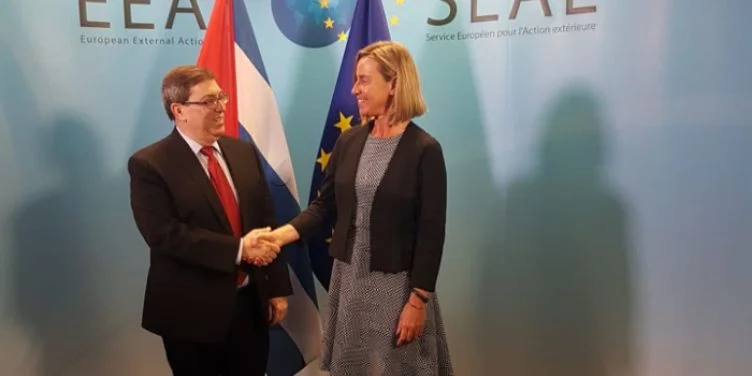
With all this in mind, it’s nearly impossible not to think of the recent fraud scandal that erupted just days ago, focusing on Federica Mogherinithe former High Representative of the European Union for Foreign Affairs and Security Policy—whom Bruno Rodríguez Parrilla once called his “dear friend.” In light of the growing noise around fraud, scholarships, and €2.5 million in manipulated funds, we are left to wonder about the true foundations of that “friendship”—perhaps not so different from those laid by the late Américo Amorim and Fidel Castro.
Those ties were so firm that even Miguel Diaz-Canelduring a stopover in Lisbon in July 2023—on his way to attend the European Union–CELAC Summit in Brussels—first made time to pay tribute to Luisa Amorimdaughter and heir of Americo Amorim.
Federica Mogheriniwho also served as Vice President of the European Commission from 2014 to 2019played a decisive role in the outcome of negotiations with the Cuban regime—outcomes we might now suspect were influenced by rather “weighty” reasons that led to the murky Political Dialogue and Cooperation Agreementsigned in December 2016. This agreement dismantled, in favor of the dictatorship, the Common Position that had previously tied trade and bilateral agreements to visible progress in human rights.
Thus, thanks to the “dear friend” of certain individuals even closer than the Cuban foreign minister himself, the dictatorship—through hundreds of so-called “individual” projects and ventures, development aid programs, scholarships, and other schemes tied to their institutions but, above all, to an artificial “civil society”” (which they’ve invented as yet another strategy in what we might call the accumulation and monopolization of foreign currency)—has benefited from and been strengthened by of hundreds of millions of euros in European public fundsall at the expense of democratization and human rights.
The ongoing investigation, it seems, is not intended to dig much deeper than what happened with the College of Europe and how its rector was awarded the contract—scandalous enough in itself. But it would be wise not to stop there. It should try a bit further, deeper in time. Some of us are almost certain that, at the bottom of that European swamp, there may still be more than one hidden shortcut connecting Brussels to Havana.
Receive information from CubaNet on your cell phone through WhatsApp. Send us a message with the word “CUBA” on the phone +1 (786) 316-2072, You can also subscribe to our email newsletter by giving click here.
OPINION ARTICLE
The opinions expressed in this article are the exclusive responsibility of the person issuing them and do not necessarily represent the opinion of CubaNet.