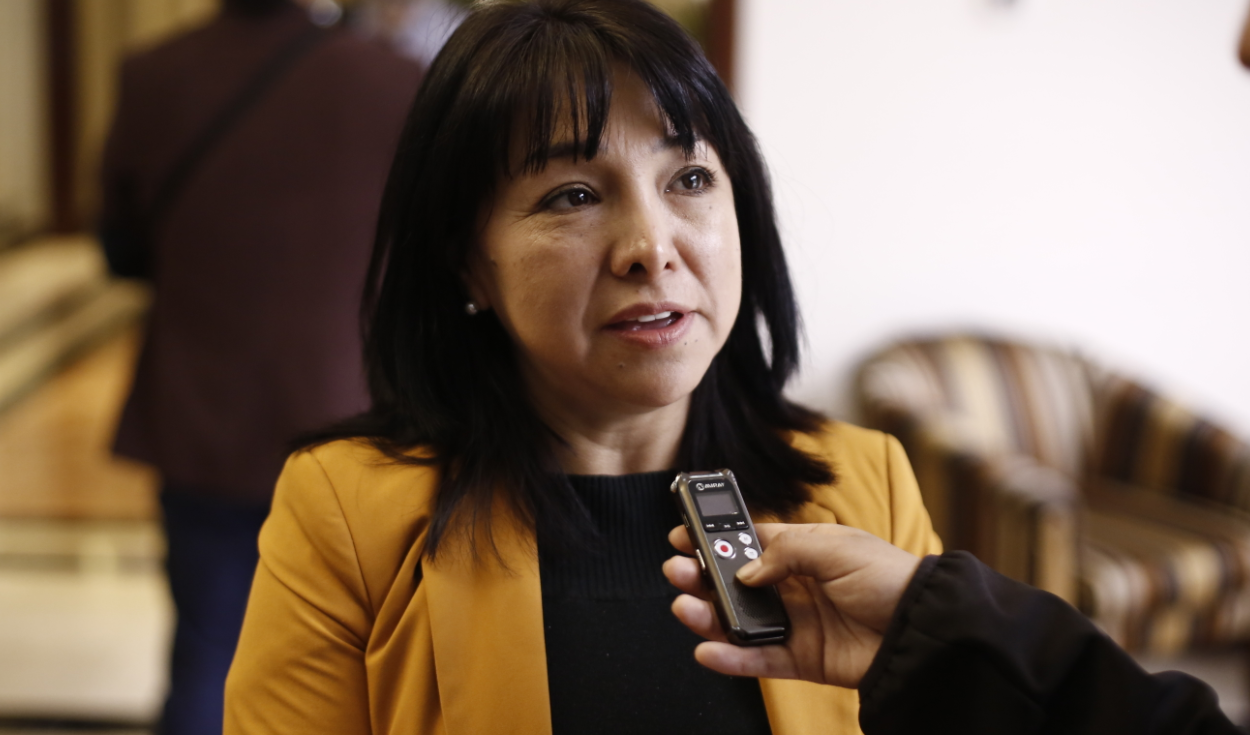
Mirtha Vasquez warned that the Permanent Commission of the Congress will evaluate this Monday, December 29, the final report of a constitutional complaint that recommends its disqualification for ten years, despite the fact that it has not been formally notified by any legal means.
Vásquez pointed out that he became aware of the session only through social networks and public communications from Parliament, which, in his opinion, shows a serious irregularity in the procedure followed against him.
The former premier also stressed that she has not received notification at her home or by email, a mechanism by which Congress itself had been communicating previous resolutions to her, a situation that prevents her from exercising an adequate defense.
Mirtha Vásquez denounces violation of the right to defense
Mirtha Vasquez He stated that it is “strange and worrying” that the Permanent Commission has scheduled the debate of the final report without previously verifying whether the complaint was validly notified, as required by due parliamentary process.
He explained that he currently does not have a lawyer or technical defense, precisely because he never received official communication from the Congressand that holidays further complicate the possibility of preparing an adequate legal strategy.
The former congresswoman questioned the haste with which the case was being pushed, recalling that the complaint was filed by Manuel Merino in 2021 and remained without substantial progress for several years.
Although he avoided making categorical statements, Vásquez warned that the coincidence between the reactivation of the process and the announcement of possible candidacies is worrying, since the disqualification would prevent their participation in future elections.
Why is Congress seeking to disqualify Mirtha Vásquez?
The constitutional complaint against Mirtha Vasquez It originated when he was president of the Congress and accuses her of alleged constitutional infractions and crimes of function, including incompatible negotiation and omission of functional acts.
One of the main charges points to an alleged irregular increase in salaries; However, the file details that these were administrative promotions that were never executed and that were annulled days later, without any worker benefiting.
Even a report from the Comptroller General of the Republic recommended shelving this point as it did not find sufficient elements, a document that, according to the former parliamentarian, was ignored during the preparation of the final report.
Despite the absence of conclusive evidence, the Subcommittee on Constitutional Accusations approved a report that proposes the disqualification for ten years, which will now be evaluated by the Permanent Commission and, if approved, it would go to the Plenary of the Congress.