Cubans residing on the Island are riddled by the combination of three different viruses and serious logistical deficiencies.
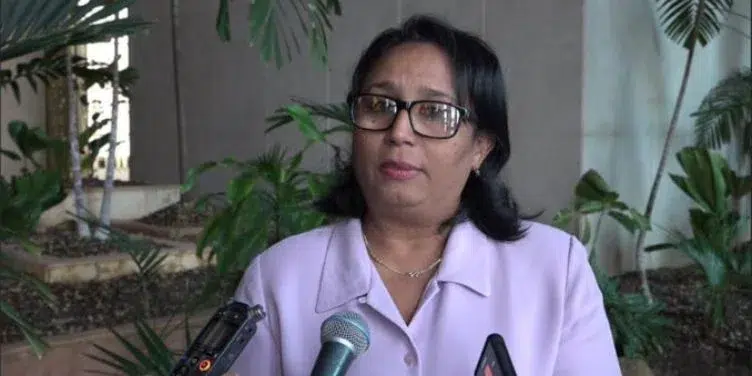
MIAMI, United States. – The Vice Minister of Public Health, Carilda Peña, recognized that Cuba is going through a “particularly complex epidemiological situation” due to the circulation of arboviruses and confirmed the introduction of the chikungunya virus in the country, with “high vector rates” and fuel limitations that prevent “carrying out large fumigations as in the past.”
The deputy head of the Ministry of Public Health (MINSAP) appeared at the Midday News this Wednesday. “We are in (…) a period of increase in diseases transmitted by mosquitoes, specifically the genus Aedes aegypti“said Peña. “We all know that Cuba is a country with a dengue endemic. What does that mean? That during the 12 months of the year there are cases of dengue fever,” he added.
The novelty, he specified, is that “the chikungunya virus was introduced.” The official recalled that “the World Health Organization has been issuing epidemiological alerts about its circulation, not only in the region of the Americas, but in other regions,” and explained that, since Cuba is “a country that is open to the world, international travelers can arrive during an incubation period of the virus” and facilitate transmission.
Peña located the first focus with “first evidence” in Perico, Matanzaswhere “an outbreak of local transmission of chikungunya occurred.” He differentiated this disease from dengue: chikungunya presents with “an acute period with high fever”, characterized by “inflammation of the joints” to the point of preventing normality, and also has subacute and chronic periods. “It is not that it has returned, it is that it is in a period of evolution (…) and this period can really last up to 90 days,” he explained about the persistence of the symptoms. At the same time, he stressed that, unlike dengue, “its evolution is not associated with the appearance of severe forms,” although he asked for special care with people with comorbidities.
Regarding dengue, he recalled that in Cuba “it circulates (…) with four serotypes,” and warned that sequential exposure to different serotypes puts people “at greater risk of suffering from severe forms and dying if (…) there is any level of complication.”
Asked about coinfections, she responded: “It can coexist.”
In relation to the diagnosis, the vice minister clarified that “there is a test that is the IgM summa for dengue, or the monoserum”, which is carried out on the sixth day of symptoms and serves as a “marker” to discern. For chikungunya, on the other hand, “there is no mass screening, mass screening of PCR tests, because the confirmatory diagnosis of chikungunya (…) is real-time PCR.” He stressed that in the event of “a non-specific fever” one should go to the doctor and that, with a negative dengue IgM plus the clinical picture and epidemiology, it will be assumed that the patient suffers from chikungunya.
Peña admitted a control strategy conditioned by scarcity. “We have to fumigate, we have to abate, we have to destroy possible deposits that become vector-generating deposits,” he said. However, he recognized material limits: “The vector indices are very high. The situation in the country at this time is complex to have the amount of fuel that we might need to carry out large fumigations like in the past.”
The official also described measures of home admission if the affected people do not suffer from comorbidities or “hospital if the person has some risk to life” and placed the combat also in the domestic environment, since the Aedes aegypti “lives inside the homes.”
The vice minister’s statements come a week after Dr. Francisco Durán, national director of Epidemiology at MINSAP, would deny versions of mass deaths in Matanzas and stated that “no deaths have been reported.”
Durán maintained that “the health system is working in an organized manner and with reinforcements in the most affected territories,” and that “despite the difficulties, services have not collapsed.” In that same official report, the MINSAP reported the simultaneous circulation of “dengue, chikungunya and Oropouche”, with active transmission of dengue in “12 provinces, 36 municipalities and 44 health areas”, presence of Oropouche in “12 provinces, 26 municipalities and 31 health areas, although with a decreasing trend”, and “four patients hospitalized for dengue: three in serious condition and one critical.”
However, citizens and independent media have documented hospitals without hygiene, with a lack of beds, a shortage of basic supplies and medications, patients who must sleep in hallways or come with their own sheets and syringes, and a chronic shortage of medications.
Added to this are garbage dumps and dirty water in streets and ditches that have turned entire neighborhoods into high-risk areas for the Aedes aegypti.
In the province of Matanzas, the epicenter of the first confirmed chikungunya outbreak, the authorities themselves they admitted personnel deficit for vector control: only 777 active workers out of a total of 1,341 planned. That lack of workforce motivated the transfer of doctors and nurses to the territory.
The combination of three viruses in circulation, limited confirmatory diagnoses for chikungunya and logistical deficiencies introduces areas of uncertainty. The official decision not to carry out “mass screening” by PCR and to infer chikungunya cases from clinical, epidemiological and negative dengue IgM can speed up classification in the field, but it also conditions the precision of the counts in a scenario with “very high vector indices.”
The very admission that there is not enough fuel to “carry out large fumigations” forces us to focus actions, as the vice minister pointed out, but it exposes a country where garbage and stagnant water have become a common landscape.