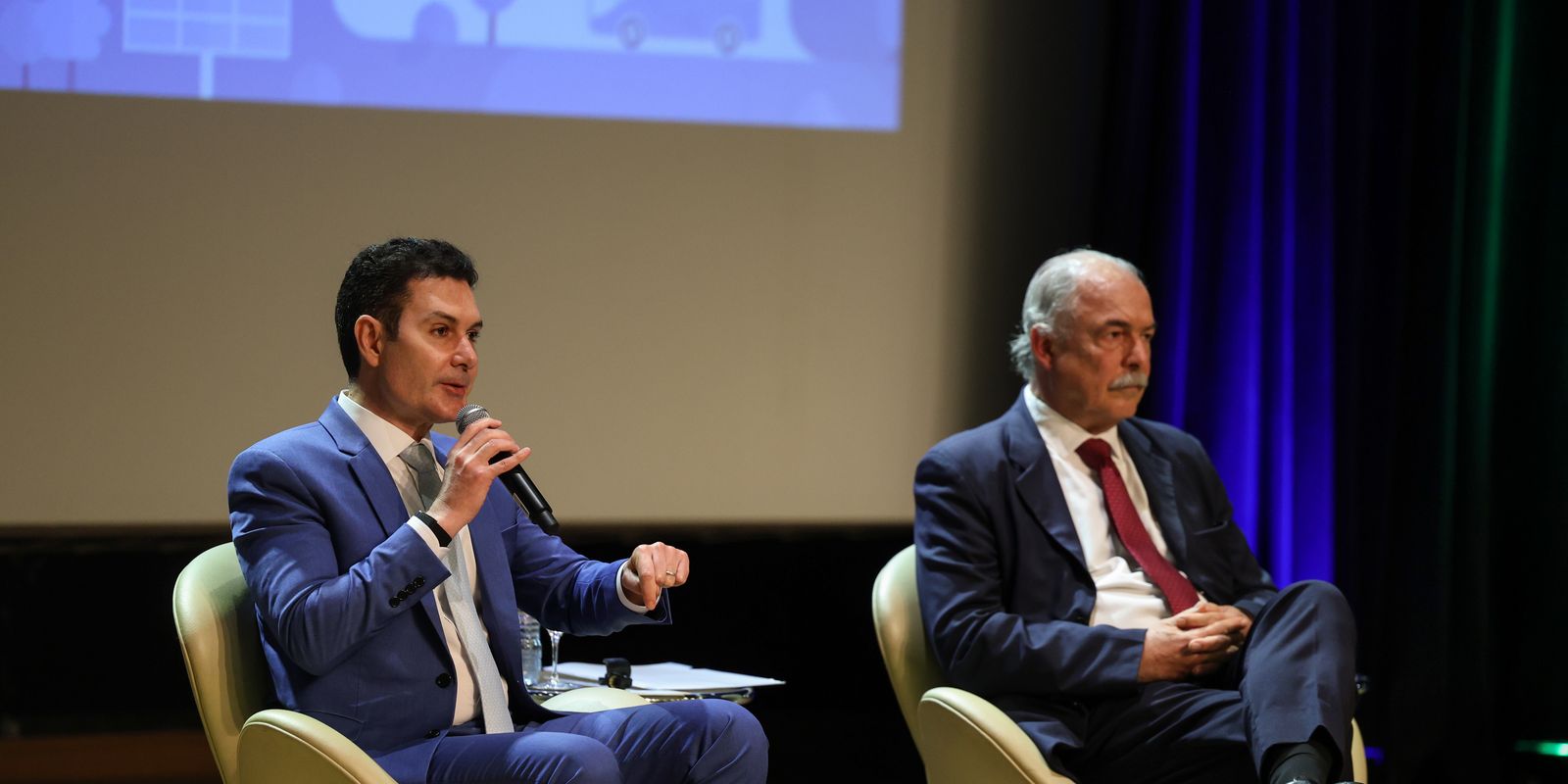
In a seminar at the National Bank for Economic and Social Development (BNDES), infrastructure ministers defended, this Monday (9), that investments in areas such as highways, ports, airports, sanitation and housing be made in partnership with the private sector.
The holder of the Cities portfolio, Jader Barbalho Filho, highlighted that investments must be a permanent policy.
“Brazil will only move forward if we have investments, and generating this, it has to be a permanent situation in this country so that projects continue to be produced, so that investments continue to happen, and Brazil enters a growth process”, he defended.
In the seminar audience were representatives from the private sector, such as companies operating in the infrastructure sector, banks and resource managers.
“The message we came to bring here today is that we will support investments”, said the minister to those present.
>> Follow the channel Brazil Agency on WhatsApp
The minister cited the government’s efforts to reduce the housing deficit through the Minha Casa, Minha Vida (MCMV) program.
According to Jader Filho, by the end of 2026 the ministry will reach 3 million contracts signed with benefiting families.
“My House, My Life was responsible for 85% of all real estate launches in this country”, he emphasized.
In addition to the role of the State as a driver of development, the Minister of Cities pointed out that, without partnership with the private sector, goals related to mobility and sanitation will not be achieved.
In conversations with journalists after participating in the event, the minister pointed out that the government invested R$60 billion in sanitation, but also needs private resources.
“Only in this way will we be able to achieve universal water supply and sewage by 2033”, declared Barbalho Filho.
External attraction
The Minister of Transport, Renan Filho, highlighted that Brazil has the largest highway concession pipeline (project horizon) in the world.
“We are going to contract R$400 billion in private investments in partnership with the private sector”, he announced, referring to works on highways, railways and mobility.
“Obviously, the R$400 billion will not just be invested in four years, it is a longer cycle”, he clarified.
BNDES
The president of BNDES, Aloizio Mercadante, pointed out that the country faces a “gap” (lag) in investments in infrastructure equivalent to 1.74% of the Bruno Domestic Product (GDP, sum of goods and services produced in the country).
“We need a minimum investment of R$218 billion per year”, he argued.
Mercadante emphasized that the New Growth Acceleration Program (PAC), a set of federal government investments, has reached R$788 billion since its launch in 2023.
“We are very optimistic that we will reach R$1 trillion,” he maintained.
BNDES is a public bank linked to the Ministry of Development, Industry, Commerce and Services (Mdic) and its function is to promote development in the country.
At the event, Mercadante announced that the public bank approved financing of R$9.2 billion for the concessionaire EPR Iguaçu to carry out improvement works on the 662 kilometers of highways in the western and southwestern regions of Paraná (BR-163, BR-277, PR-158, PR-180, PR-182, PR-280 and PR-483).
Capital market
The director of Infrastructure, Energy Transition and Climate Change at BNDES, Luciana Costa, defended the development bank’s participation in the capital market, a financial environment in which securities such as debt securities, company shares and participation in investment funds are traded. It is a way for companies to raise funds for investment.
“BNDES wants to share the risks with the banks, but we will share the returns too,” he said.
“The capital market here does not have the depth of terms and volume that more developed markets have. But it is growing, and the BNDES is making it grow,” he said, adding that the bank has a portfolio of R$80 billion in debentures (corporate debt securities).
Capture
The executive director of B3 (São Paulo stock exchange), Gilson Finkelsztain, highlighted that the capital market has become the largest source of funding for companies.
“Ten, 12 years ago, the agenda was non-existent, there was only bank financing”, he recalled.
According to the executive, in 2025 the Brazilian economy had R$496 billion in debentures alone, with R$172 billion in infrastructure.