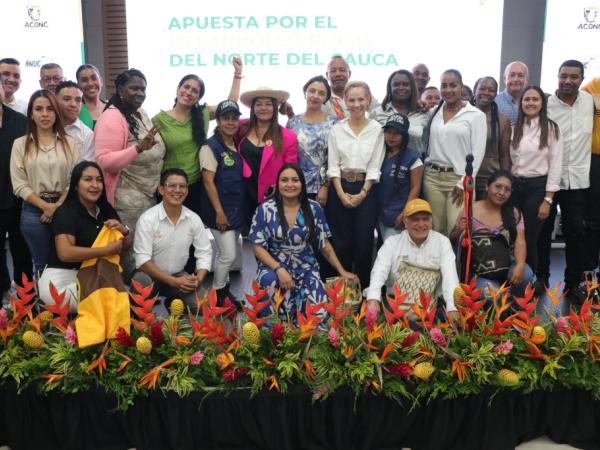
The Ministry of Agriculture and Rural Development, Asocaña and various social organizations signed the second phase of the Agreement for the Rural Development of Peasant, Indigenous and Afro -descendant Communities of the North of Cauca, which will have an investment of $ 15,851 million.
The initiative will benefit 3,018 families in 13 municipalitieswith the purpose of strengthening crop technification, business development and coexistence in the territory.
(Read: Digital card in airports: what formats do they accept and which ones officially reject)
The announcement was made in Santander de Quilichao during the presentation of the balance of the first phase of the agreement, implemented since May 2024, which benefited 1,200 families producing coffee, cocoa and panel cane. In that period more than 1,800 hectares were improved and the creation of community companies in the region was promoted.
The Minister of Agriculture and Rural Development, Martha Carvajalino, said that “There is a decision of the Government of Change and the Ministry of Agriculture to continue, continue and maintain this project. This strategic alliance between the agrarian movement, the business and the government demonstrates, in a country still whipped by the war, that it is possible to achieve a great national agreement for peace”
The first phase had an investment of $ 13,602 million oriented to the improvement and renewal of cropsthe implementation of sustainable practices, the strengthening of agroindustrial infrastructure and the consolidation of a rural development model with territorial identity and ethnic approach.
(See more: Is the debt a time bomb for Colombia? This they say from the market)
The first phase, with $ 13,602 million, improved 1,800 hectares of coffee, cocoa and panel cane.
Courtesy
Claudia Calero, president of Asocaña, stressed that “This was possible thanks to you, because together we work for a common purpose to transform the territory. This alliance is powerful and we hope it will be maintained over time, because the union of communities, with the support of the government and the private sector, is the best recipe to talk about well -being and transformation”
In this new stage a fourth production line will be added: rice, promoted by the indigenous communities represented by the Association of Indigenous Cabildos of North of Cauca (ACIN). The scope of the agreement will cover more than 3,400 hectares and maintain the focus on technification of productive systems and the consolidation of community companies for the transformation and marketing of products with added value.
The agreement is the result of the dialogue table in Norte del Cauca, installed in 2022 as a space for consultation between communities, government and sugar sector. According to the Ministry of Agriculture, The process has shown that inter -institutional cooperation and dialogue can translate into advances in productivity, inclusion and social cohesion.
(See also: With tight accounts and cuts, the 2026 budget begins its debates)

The new cycle will include a fourth production line: rice, driven by indigenous communities.
Courtesy
Among the beneficiaries of the first phase, Adam Orejuela, manager of the Chocotonga community company, said that “This agreement has been of enormous help for small producers because they are in the technical assistance part, which helps improve the quality of production in farm”
Rodolfo Montero, producer of panela, indicated that “That alliance of the Government, of the sugar sector, of the private company, making this support, is magnificent. That alliance had to have been born before I was born“Eduard Tabares, coffee growers, stressed that” we had never had such complete and in such a serious and responsible support, because here they have not left us alone. “
The implementation of the second phase will begin in the second semester of 2025 And as a goal will expand the coverage of beneficiaries, improve productivity and consolidate a rural development model that integrates communities from different ethnic origins, with the support of public institutions, the private sector and social organizations.
(See: If you receive this message from the Dian, care, it could be a hoax and a scam)
Diana K. Rodríguez T.
Portfolio journalist