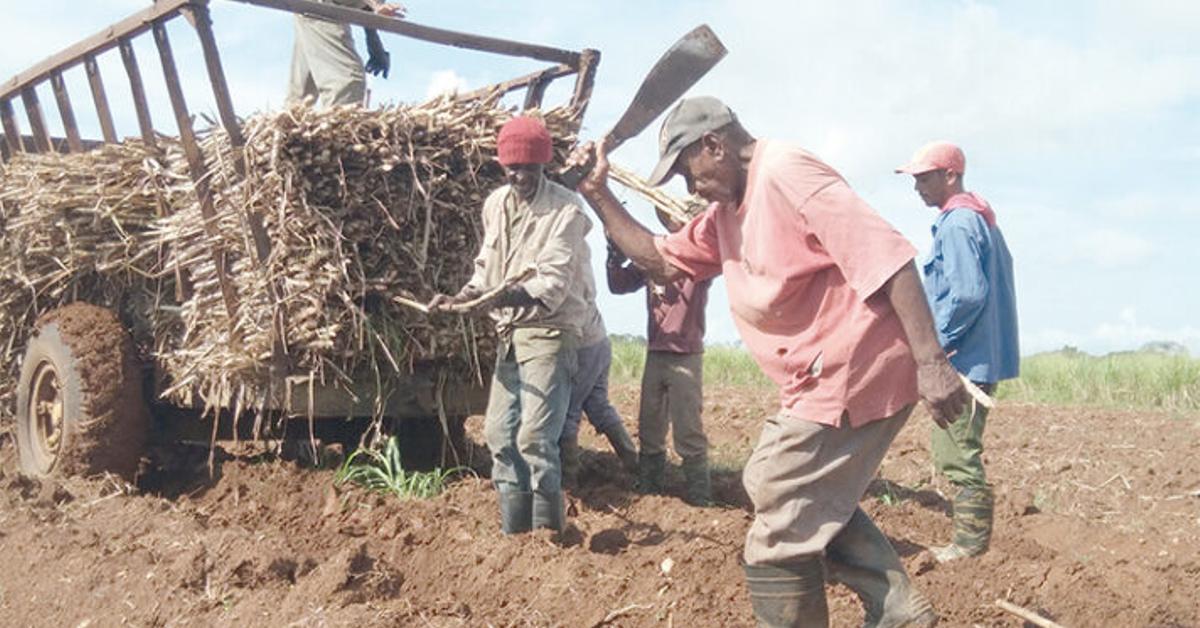
Madrid/Everything suggests that the next sugar harvest will snatch the title of “the worst in a century” again. The Minister of Economy, Joaquín Alonso Vázquez, who warned that the arrears in the sowing of the cane were persistent warned last July and, if it would not be possible, it would not be possible to “achieve significant increases in the Zafras of 2026 and 2027”. The official blamed the shortage of raw material but is thanks to A report published on Monday in Workers that the lack of cane is better understood.
It is known that the lack of fuel and supplies for planting affects, but not so much that the State owes million dollar sums of money to the producers. “At the 2024-2025 harvest I delivered 2,080 tons of the grass between April and May and I have not received a penny of the more than 4 million pesos of that sale,” says Joel Collazo Apaceiro, a cooperative artemiseño who emphasizes that the situation has nothing exceptional. “Zafra by Zafra The default is the same. The contracts are violated, but we continue in the groove despite the dissatisfactions,” he adds.
“Although the industry has not paid the cut cane, the planting campaigns of the spring and cold seasons do not wait for bureaucracies,” adds another producer. The secretary of the National Union of Sugar Workers, Yrrael Rouseaux Mansfvelopment, says that this delinquency in 33 basic cooperative production units affects, neither more nor less, than 4,700 cooperatives. “It is the responsibility of the administrative boards to seek an alternative to protect the salary of their workers,” he claims, although he affirms that Vice Minister Jorge Luis Tapia Fonseca is in the process of solving it with Azcuba.
This delinquency in 33 basic units of cooperative production affects, neither more nor less, than 4,700 cooperatives
The same reproaches Elba Peña Rojas, president of a cooperative located Banes, Holguín. “It is harmful to have strains three years ago, which have stopped cutting them for one reason or another, the contract is infringed to pay the Central Fernando de Dios and today the sugar agroindustrial company (EAA) of the same name owes us 22 million pesos, and the payment for linking to the cañeros and the distribution of the profits to the cooperatives is affected,” he reproaches.
Peña denounces that it is not the only thing missing. To the lack of fertilizers, herbicides, oil and other resources, – which have left the sugar yield, 100 to 45 tons per hectare – must be added the malicious fires, which have left great damage in their territory.
To the accumulation of misfortunes, producers add another. The robberies of the wire with which their farms close allow the cattle from the surrounding land to enter the ground and drag with the cane. “We maintain the attention to five cavalries. Again they authorized the raising of cows in the area and we have put fences in the cañaverals; although it is not enough because the wire and the animals end up with the plantations. We denounce it and nobody acts to stop the crime,” he complains.
Workers He has interviewed Antonio Viamontes Perdomo for the report, director of the only central who complied with the sugar plan of the last contest, Melanio Hernández, of Sancti Spíritus. “In the last four years the limitations mainly of fuel have influenced that the volumes of cane to be sown do not reach for seed. The idea is to stop the decrease in June 2026,” he says. Despite looking with honor of his status as good compliments, the territory they are supplied does not have good news. “There, 75% of the lands dedicated to grass cultivation are empty.”
More examples. Central Carlos Manuel de Céspedes, in Camagüey, grounded 21% of burned cane and 70% of the one transported, took more than 12 hours to arrive, harming the efficiency, which remained in just 20% of the plan. In Artemisa, the company November 30 had a lack of fuel such that it took 34 days to move the cane, so 1,762 tons were barely processed.
Antonio Guiteras, from Las Tunas, stayed at 16% of the projected, 7,200 of the 45,000 tons planned. The figure is very worrying because this is the central one that has agreed most sugar to deliver to the State, but everything that could happen to it, happened, including the shortage of personnel, which is increasingly pressing.
The Redondo Ciro, in the blind of Ávila, has been in charge of what is in charge seven consecutive years, aggravated because this year – when it was a little more than half – 70% was cane of previous crops, which gives worse results. The same goes for the neighboring bioelectric, which adds “millions of kilowatts stopped contributing since the implementation in 2020, although this press team did not have access to the official information on that subject”, the text specifies.
Workers The complaint reiterates when referring to the Uruguay Central, closed for years, when it was foreseen that the Russians will reform it. “Some obstacles, in addition, prevented firsthand what happens in the Uruguay industry, of Sancti Spíritus. However, by other legal routes it was known that its machines were extinguished in 2022, due to the Cañero decrease and the lack of resources to revitalize the manufacturing equipment,” says the note, which highlights the breach of the government of its own social communication law, when they refuse to give data to give data to give data to give data to give data. required by the official press.
The Urban Noris, in Holguín, made its last harvest in 2023, counts the directive of the sugar business group in the province, since “he needed a capital reparation that was not possible, because it depends on an investment”
The Urban Noris, in Holguin, made its last harvest in 2023, counts the directive of the sugar business group in the province, since “it needed a capital reparation that was not possible, because it depends on an investment.” Sowing, in addition, has another problem. It must grow, but you find the disadvantage that, if I did, there would be no industry to process it. “In the fields there is evidence, with the large amounts of Queñas and Requeadas reeds,” says José Luis Jomarrón Cera, president of another Tunera Cooperative.
“We were subtracted by reaping 14,000 tons of cane with approximately 28 million pesos receivable. On the other hand, the defaults of the raw material, already supplied and processed, harms the delivery of advances and the purchase of essential supplies for production, in addition, the costs are altered, because when they do not pay on time the credits granted by the banks, the interests increase and the interests are submitted despicable, ”he summarizes. The few measures taken, he adds, have been late, when the agonizing sugar industry.
The data of the last harvest have not been officially revealed, but it is known that They did not reach 150,000 tons And that even the amount can be much lower. In this contest, 15 sugar plants participated, of which 10 have contributed to the official media their results, which add up to 95,584 tons. The remaining five have not revealed their production, but it is known precisely that among all of them they aimed 52,068 tons of sugar. That is, in the event that they had fulfilled it, the harvest would amount to 147,652 tons. However, only one, the spirit, did it. 40 years ago, a historical record was achieved, with 8.5 million tons of sugar. Since then, the fall is like a bottomless well.