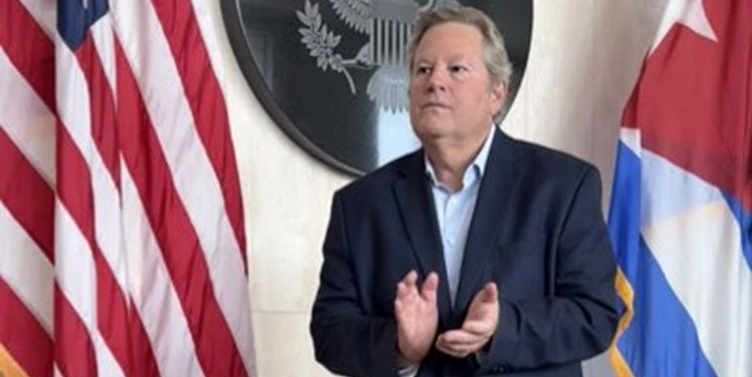
“More human rights violations will not be tolerated,” Hammer stated in an interview with Mario Pentón, in which he addressed the situation of political prisoners, immigration policy, sanctions against the regime and the prospects for change on the Island.
MADRID, Spain.- In a interview given to journalist Mario Pentón this Mondays, the head of the United States diplomatic mission in Cuba, Mike Hammer, addressed the main axes of the Trump administration’s policy towards the Island: the situation of political prisoners, immigration, sanctions, international pressure and the prospects for change.
Regarding the contradictory versions regarding conversations between Washington and Havana, Hammer did not offer details, but gave credibility to the US president’s statements. “When President Trump says something, he says it and it is very clear,” he stated, emphasizing that the current Administration maintains a position of support for “the Cuban people, ordinary Cubans,” as well as respect for their rights.
One of the central topics was the situation of political prisoners. Hammer reiterated that for the United States his release is not a subject of negotiation. “From the beginning, the Trump administration has said very clearly that all of these political prisoners must be released. This is not an issue for negotiation. It is either yes or yes,” he said. He recalled the case of the protesters of July 11, 2021 (11J) who remain imprisoned and described their detention as an injustice that must be resolved “immediately.” “They are abusing the human rights of the Cuban people, of innocent people who go out to demonstrate because the situation is very bad,” he added.
He also mentioned the case of opposition leader José Daniel Ferrer, recently released and now in exile, after what he described as a serious deterioration in his health in prison. “They almost killed him there in the jail in Santiago,” he said, while insisting on the need for greater international pressure. In his opinion, “the conduct of that dictatorship will no longer be tolerated.”
In immigration matters, the diplomat defended the restrictions and the so-called “travel ban” promoted by the Trump Administration. He explained that the president’s priority is “to protect the United States under all circumstances” and recalled that Cuba is on the list of countries that sponsor terrorism. “They have terrorist refugees there who are not being returned,” he said. When referring to the presence in US territory of officials and repressors of the regime, he pointed out that, with the support of investigations from the Department of Homeland Security, deportations are being carried out. “Our embassy will follow the laws of our country and the executive orders of the president,” he stressed.
Hammer rejected the official narrative that blames the United States for the economic and social crisis on the island. After visiting almost all the provinces and speaking with citizens in their homes, he said he had observed a widespread feeling of frustration and betrayal. “People tell me that not only has the revolution failed, but that it has betrayed them,” he said. He listed basic deficiencies: “There is no medicine, there is no electricity, there is no fuel, the garbage is not collected,” and he stressed that these problems are not due to the embargo. “The chicken enters, the food and medicine are not sanctioned,” he recalled, while maintaining that Cubans on the Island “do understand that the problems are being caused by the same regime.”
The head of the diplomatic mission announced that Washington is working on new measures to cut off the financial resources of the repressive apparatus, including possible sanctions on business structures linked to the Armed Forces, such as GAESA. Without offering dates or details, he assured that the objective is to “deny them the resources they use to repress the Cuban people” and reiterated that progress is already being made in sanctions against repressors and their economic networks.
On the other hand, he insisted on the need for more visible and coordinated international pressure, both in Europe and Latin America, and denounced practices such as medical missions abroad, which he described as “human trafficking.”
When asked about the future, he expressed his conviction that Cuba is heading towards change. “A free Cuba is what I see,” he stated, adding that that day “is approaching.” According to Hammer, the Cuban issue is a priority for Trump and Washington’s support for the people of the Island will be maintained until they can, as he said, “live without repression, with freedom and prosper.”