The Cuban ruler also warned that “the population’s claims are legitimate, but have to be done in established places.”
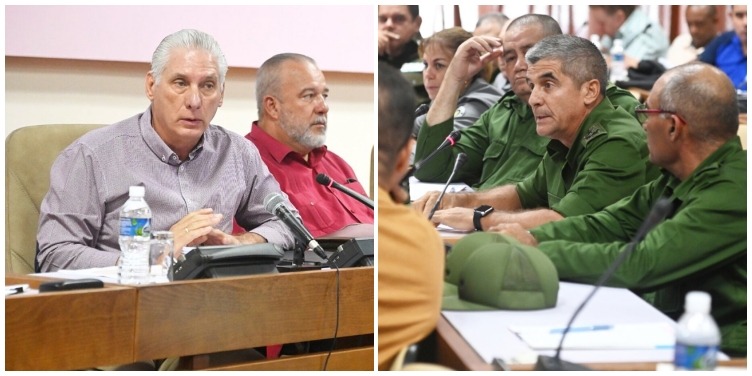
Lima, Peru-Cuban ruler Miguel Díaz-Canel recognized this weekend that his regime does not have enough fuel for electricity generation, water supply and even for the control of hygiene and timely food distribution. “
The statements arose as part of a government meeting of the Government held in Havana. The meeting sought to mobilize teams that tried to put a patch to the existing crisis on the island, trigger several protests in recent weeks.
“You have to order things in Havana. Cooperation has lacked. All forces that have the commitment to help save the capital,” Díaz-Canel wrote Through Facebook.
As is common in the official discourse, the Cuban dictator blamed the main dissatisfactions of the population (blackout, water shortage, unhealthiness in the streets) to the senses of embargo issued by the United States.
THE PROFILE IN X of the Presidency On the island also echoed this Saturday’s government meeting, recognizing energy problems and “the critical situation of garbage”, while leaving a notice to popular discontent.
“The population claims are legitimate, but they have to be done in established places: the party, government and state institutions. No one is authorized to close a public road, because they hinder essential services for our own people,” said Díaz-Canel.
Despite the constant warnings and threats of the Cuban regime, the situation has become unsustainable on the island. Just last Thursday, a massive protest It exploded during the night in Centro Habana, where neighbors of several blocks, including women and children, blocked Monte Street to demand the restitution of basic services after prolonged blackouts and a growing crisis of drinking water supply.
The protesters spontaneously came out to public roads with pans, protest slogans and even a fire in the street, such as evidenced videos spread on social networks. Among the most heard cries stands out that of “Libertad!”, Which resonated along with the demands of electricity and water. At some points, complete families – including minors – sat on the asphalt in peaceful resistance.
The official response has been containment. Díaz-Canel acknowledged that in the Cuban capital “the problems are large” and announced severity from the state sector.
“You have to visit the centers of the non -state sector, and control whether they are fulfilling their electrical consumption plan. Spandle cannot be allowed, although they can pay electricity. The place that fails to comply with it closes,” he said.
More discontent than solutions
In the neighborhood of the sites, in Centro Habana, a group of women accompanied by children closed one of the main streets last week. Activist Lara Crofs shared images on social networks and said addressing the ruler Miguel Díaz-Canel: “They are Chamas, Joneee Chamas, they will not think of sticking that I know them. Miguel Díaz-Canel Bermúdez you are directly responsible if something happens to some of those children.”
The presence of minors turns the protest into a symbol of vulnerability that thousands of Cuban families are going through, trapped between the shortage of services and the lack of official solutions.
Shared images on social networks suggest that manifestations were not limited to Centro Habana. Lawton neighbors denounced on Facebook despair after more than 15 days without water, and actions were reported where residents would have blocked streets amid new blackouts; as in Altahabana.
Although the magnitude of these protests has not yet been fully verified, different sources agree that citizen outrage has spread to several points in the capital.
In the East of Cuba, the blackouts unleashed a giant protest in mid -September in Gibara, Holguín, from which several arrests were.
The scenes of these last weeks revive the memory of other days of demonstrations on the island, such as those of the July 11, 2021, and confirm that social discontent continues to grow in the midst of the structural collapse of public services.