In an interview conducted by EL ECO, he explained the cumulative impacts on the coast, the particular situation of Nueva Palmira and the need to protect this natural heritage for future generations.
—What is planned in terms of Planning and Environment for the department of Colonia?
—With respect to the coastal strip, there is a very special concern in this period. It is a concern that comes from before, without a doubt, but in this administration we have emphasized the issue and concrete actions have been promoted to promote an in-depth study of the entire coastal strip.
Human intervention on the coast is not new; goes back centuries. The construction of streets, houses, the extraction of sand and stone, and the undertakings linked to the navigability of the Uruguay and La Plata rivers have generated cumulative impacts. All of this must be analyzed in a historical context to understand how our coasts were degraded.
Areas that previously had wide sandbanks, dunes or ravines that seemed firm, today show an obvious decline. The coasts of the department of Colonia have changed, and the concern is enormous. That is why we take the Coastal Belt Directive as our central axis, together with the national guidelines, the departmental guidelines and the local territorial planning plans.
The objective is clear and it is about protecting the environment and the coastline.
—What particularities does the case of Nueva Palmira present?
—Several factors come together on its coastal strip. On the one hand, the proximity to the main economic and industrial activity of the city, which are its ports.
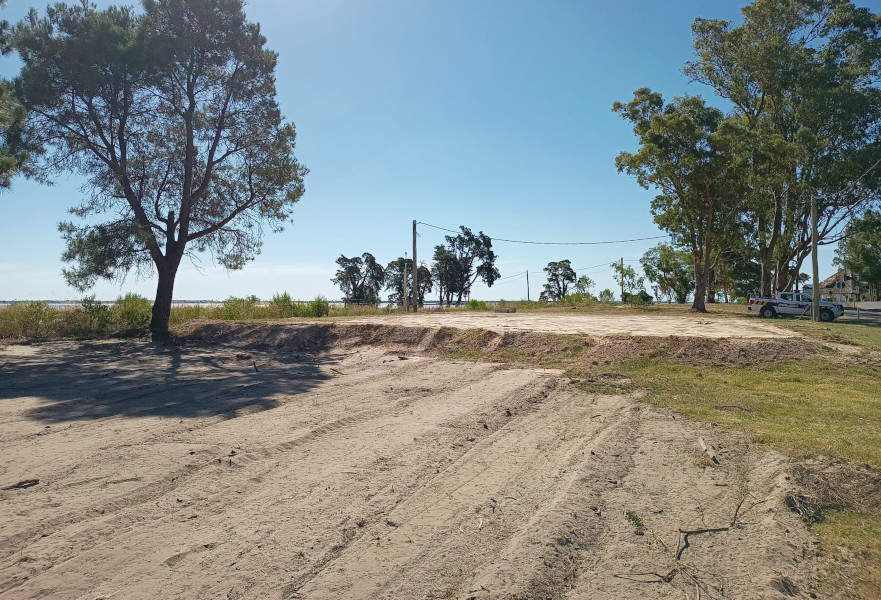
But if we focus on the urban coast, especially towards the northeast, in the Barrancas and Brisas area, we observe clear erosion phenomena. Edges are lost in the ravines and today there is less territory. On the other hand, in the beach strip, especially towards the mouth of the Sauce stream, there is a significant loss of sand, often aggravated by human actions that directly affect the coastal strip.
There is the need to preserve and especially care for the coast. For this reason, since this administration began in July, we have been very strict with all formal requests for new developments, subdivisions or buildings in the non-buildable strip in front of the coast. They are not approved. The reasons are explained and, many times, we have long interviews with neighbors, even people we have known for years, to make it clear that there are things that cannot be done on the coast.
—What control and participation mechanisms are planned?
—The Palmira Local Plan provides for the formation of monitoring commissions, and we are promoting its reactivation. We want serious monitoring, with the participation of the local government, the departmental government and relevant actors from civil society, non-profit organizations and committed neighbors.
We believe that it is necessary to generate one or more instances of discussion and follow-up to review some topics. Furthermore, there is political will – and we have discussed this with the mayor and with the technical teams – to analyze a possible reformulation of some article of the local plan, a proposal that already came from the previous administration.
—You were departmental councilor along with who was also councilor at that time, Heber Márquez, and they promoted a non-buildable strip of up to 100 meters between Ibicuy and Rondeau. How do you remember that process?
—That was about 25 years ago. We, along with other councilors, were active participants in the defense of the coast, with criteria that in some aspects were not coincident. In an ideal world, those 100 meters would be optimal, although it is also true that sometimes such strict criteria do not always contribute to the best development.
—There is talk again about the construction of boulevards or coastal walks in cities like Nueva Palmira and Carmelo. What is your position?
—In Uruguay, the traditional rambla is a paved, asphalt road, with heavy vehicular traffic, sidewalks and parking. This type of infrastructure eliminates natural vegetation and ends up affecting the environmental sustainability of the coast.
Today that model is no longer allowed in many places. This administration is going to align itself with modern environmental concepts, therefore, boulevards like the ones we knew in the coastal cities of the department of Colonia, Montevideo, and Canelones will not be promoted.
If a boulevard had been built towards Brisas, our children and grandchildren would not be able to enjoy it, because it destroys ravines, breaks and accelerates the loss of sand.
What is possible are environmentally friendly coastal walks, with a wide protected strip, light vehicle traffic, priority use for pedestrians and bicycles, and without parking. That’s a healthy city, a healthy habitat, even a walk that promotes mental health.
—And what is your opinion about the artificial replenishment of sand on beaches?
—It is a mitigation measure, but we must be clear, these are jobs that after two, three or four years, that sand goes away. Sometimes you have to do it, especially on very busy beaches that cannot be missed, like in Carmelo, where the beach is much more limited.
Interview Nancy Banchero