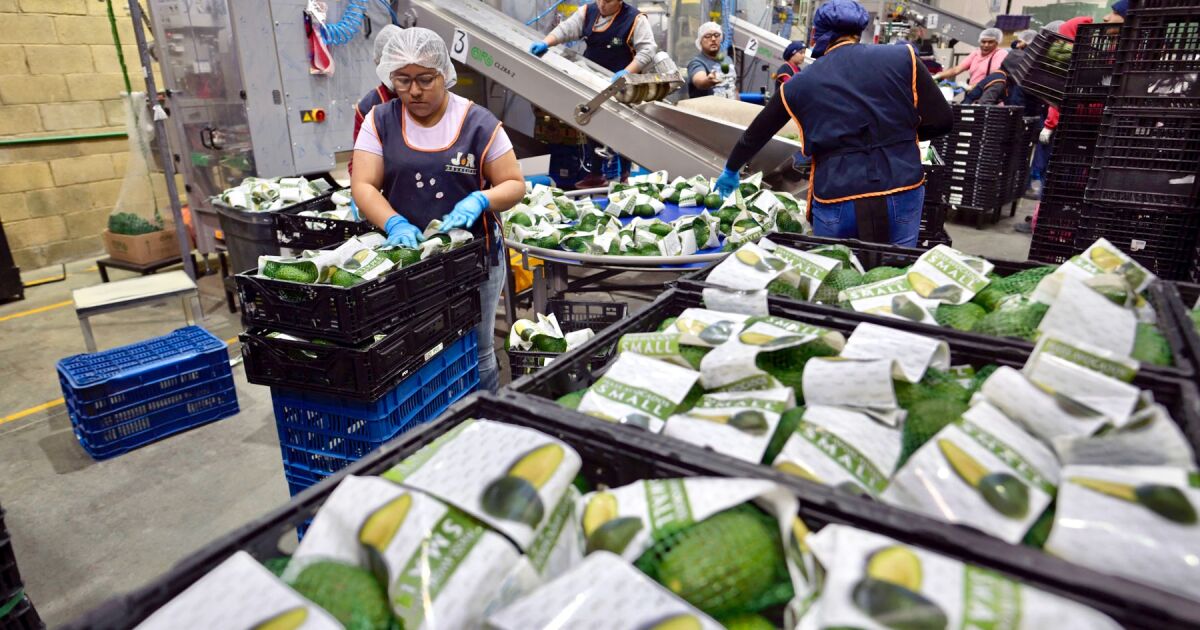
Despite the hostile environment, the export force does not give up. In the first half of 2025 it reached 2,818 million dollars, an increase of 19% compared to the same period of the previous year, according to Inegi data.
Avocado dominates the productive map with annual exports close to 3.5 billion dollars. The United States absorbs 90% of sales. Michoacán generates more than two million tons per year in some 182,000 hectares of orchards spread across 66 municipalities, including Uruapan, Tancítaro, Ario, Peribán and Tacámbaro.
In addition to the “green gold”, the entity sends guava, strawberries, blackberries, figs, pineapples and mangoes abroad, which strengthen its position in the agri-food market. More than 70% of Michoacan exports belong to the agricultural sector.
According to the state’s Secretariat of Agriculture and Rural Development, Michoacán occupies first place nationally in the production of avocado, strawberry, blackberry, lentil, peach and plum.
Research from the University of Cambridge indicates that most of what is known about organized crime violence comes from studies focused on illicit drug markets. However, criminal groups also dispute control of legal markets. This is shown by the cases of Mexican lemons and avocados.
The violent expansion towards licit goods usually arises when a product rapidly increases its participation in exports. That growth opens up opportunities to make immediate profits and manipulate the market later. Such incentives unleash confrontations between organizations seeking to expand their territory and economic power, the study points out.
The state’s economy is growing above the national average thanks to primary activities – agriculture, livestock and fishing – which, although they represent a smaller proportion of GDP, register the fastest pace. These contribute 14.6% of the state product, while secondary activities add 18%, tertiary activities 62.4% and taxes and net subsidies 5%.
During the second quarter of 2025, Michoacán’s economic activity increased 3.8% annually, driven by a jump of 12.5% in the primary sector, 5% in the secondary and 1.7% in the tertiary sector.
Foreign investment
In contrast, foreign direct investment shows ups and downs. In the second half of 2025, it accumulates 161.4 million dollars, 20% less than a year before. In 2021 it registered a record of 1,032 million, but since then it has maintained an irregular trend.
Between 2006 and the first half of 2025, Michoacán attracted more than 10 billion dollars in foreign investment. Luxembourg leads with around 4,000 million, driven by the presence of ArcelorMittal in Lázaro Cárdenas. The European steel company has become the largest source of foreign capital in the state.
Remittances
According to the latest Inegi census, prepared in 2020, 22.9% of the 1.5 million households in Michoacán depend on remittances.
In addition, the migratory flow places the entity as the third with the best command of English, according to the Mexican Institute for Competitiveness.
Employment
According to the state government, there is sustained progress towards the generation of formal work. Although it is an agricultural entity, commerce and services account for almost half of the employment registered in the IMSS
As of September of this year, Michoacán registered 495,360 people affiliated with the IMSS.
Although Michoacán shows favorable economic indicators, its competitiveness continues to lag behind. In the IMCO State Competitiveness Index it occupies 29th place, with red spots in perception of corruption, attraction of foreign investment and educational coverage.
In the Mexican Social Progress Index, prepared by Mexico, how are we doing?, the entity is located in position 26. This study evaluates well-being beyond economic data and places at the center people’s real access to fundamental rights such as health, education and development opportunities.