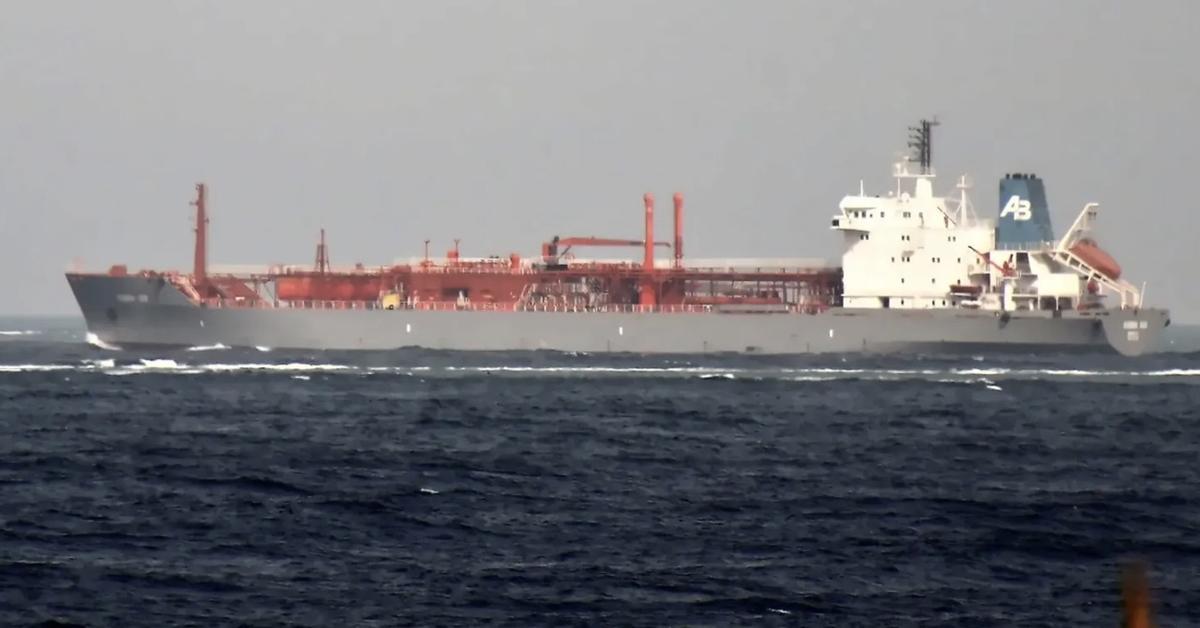
Mexico City/A total of 80,000 barrels of fuel They will arrive in Cuba in the coming days, loaded on two ships from Mexico, at a time when blackouts reach more than 20 hours a day and donations of Venezuelan crude oil are compromised by the military deployment of the United States. in the Caribbean. The calculations are made by specialist Jorge Piñón, from the University of Texas (USA), based on the capacity of the tankers, the Eugenia Gas and the Ocean Marinerboth with the Liberian flag.
The first is already in the Gulf of Mexico, on the way to Moa (Holguín), after loading at the Pemex de Pajaritos refinery, in Coatzacoalcos, Veracruz, as seen in the ship geolocation pages. The second is still in the same Mexican port, waiting to leave for the Island.
The shipments take place in the midst of the worsening energy crisis. The electricity deficit, as stated daily in the reports of the Electrical Unionrarely falls below 2,000 megawatts (MW), which almost always represents more than half of the country’s demand. Fuel is vital for distributed generation, which is around a 1,000 MW deficit daily.
On the other hand, the operation deployed in the Caribbean by the Government of Donald Trump against the regime of Nicolás Maduro is putting at risk oil shipments to Cuba from Venezuela, the supplier par excellence of fuel for more than a quarter of a century. Last Wednesday, the United States seized the tanker Skipper, who was heading to Cubain what represented the first direct seizure of a ship with Venezuelan crude oil since the imposition of sanctions by Washington in 2019.
That it is private is what exempts Pemex from providing information on the contracts that Gasolina Bienestar has with the Island.
The operation revealed something that was already suspected: that the Cuban regime resells part of the crude oil received to obtain foreign exchange. According to details published by The New York Timesfor example, the number of barrels that were transferred by the Skipper to the tanker Neptune 6 bound for Matanzas there were 50,000, although Reuters had initially counted 200,000. The rest of the cargo, 1.9 million barrels according to the Venezuelan state-owned PDVSA, went to Asia, more specifically to China, Caracas’ main client in the oil sector.
Although shipments have decreased this year, Havana continues to receive an average of 27,000 barrels per day from its Bolivarian ally, so Mexico’s intervention is providential. This has caused intense controversy in the North American country.
Last Tuesday, a journalist asked the Mexican presidentClaudia Sheinbaum, in her usual morning conference, why a private company was established, Gasoline Wellbeingas a subsidiary of Pemex, with public money, to export oil to Cuba. The fact that it is private (SA de CV, variable capital corporation), the reporter explained, is what exempts Pemex from providing information on the contracts it has with the Island, according to the transparency law.
These contracts, the journalist detailed, “Pemex does not have them, the Ministry of Energy does not have them, no one has them,” except Gasolina Bienestar, a company “created by former president Andrés Manuel López Obrador in 2022-2023 to exclusively sell oil to Cuba.” While waiting to know the data corresponding to 2024, what this subsidiary reported having exported to the Island in the last quarter of 2023 was about 6.5 billion pesos (more than 360 million dollars) in the last quarter of 2023.
What the subsidiary reported having exported to Cuba in the last quarter of 2023 was about 6.5 billion pesos (more than 360 million dollars)
“How does a private company work with public money, with public officials, but it is a private company that is not obliged to provide information about the resources it obtains?” asked the reporter, after indicating that in the subsidiary, even though it is private, Pemex has 99% and another subsidiary of the state oil company, the remaining 1%. “You are wrong,” Sheinbaum snapped at the journalist. “It is not that a particular company has been created solely for this reason, but rather that they are part of subsidiaries that have been created in Pemex that have specific objectives.”
In the case of Gasolinas Bienestar, provide service to indigenous communities, he explained, through the so-called Gasolineras del Bienestar. The president did not say, however, that some of these service centers – existing in Guelatao de Juárez (Oaxaca), Calakmul (Campeche), Cuetzalan del Progreso (Puebla) and other communities in Hidalgo – have been denounced by the local press for offering fuel that is more expensive than Pemex itself.
“It is not something strange that President López Obrador has created, that it is outside the law,” he insisted, without answering the specific question that the reporter asked him. To do this, he summoned the Secretary of Energy, Luz Elena González Escobar, and the director of Pemex, Víctor Rodríguez Padilla, “so that they can explain it.” And he repeated: “There is nothing that should be hidden in any way.”
In addition, the president recalled that part of the fuel sent to Cuba is “contracts” and another is “humanitarian aid”, without specifying the amount in each of these modalities.
In any case, the 80,000 barrels that Pemex – currently the most indebted oil company in the world – sends do not go far. The country requires around 110,000 barrels for its basic energy needs, of which about 40,000 come from national production.