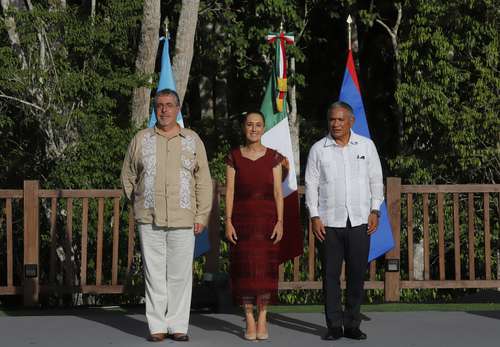
▲ The president poses with Bernardo Arévalo (left) and Prime Minister John Antonio Briceño.PHOTO AP
Emir Olivares Alonso
Sent
La Jornada newspaper
Saturday, August 16, 2025, p. 4
Calakmul, Camp., The governments of Mexico, Guatemala and Belize signed an agreement to protect and preserve the Mayan jungle, an extension of 5.7 million hectares shared by the three nations and represents the second most important nature reserve on the continent, only after the Amazon.
From the heart of this rainforest, yesterday, the presidents of Mexico and Guatemala, Claudia Sheinbaum Pardo and Bernardo Arévalo, as well as the Prime Minister of Belize, John Antonio Briceño, signed the statement of Calakmul Biocultural Corridor Gran Selva Maya.
It was an unprecedented meeting in which this “historical” trilateral agreement that compromises to conserve the wealth, biodiversity and cultural heritage of the area was announced.
Heirs of the ancestral civilization, the three nations have historical ties based on the cultural roots of the Mayan peoples who have inhabited these territories for thousands of years and, which today, are still home to their heirs.
Very close to the archaeological zone of Calakmul – from the Hotel Mundo Maya, built as part of the Trena Trena project, undertaken by former President Andrés Manuel López Obrador – Sheinbaum, Briceño and Arévalo held a trilateral encounter where they dialogued of issues of common interest for a region.
At the end, they offered two messages in which they highlighted the importance of the pact whose objective is to strengthen environmental cooperation in conservation and ecological integrity to benefit around 7 thousand species, 200 in the category of risk, 50 priority and 250 endemic in Mexico.
“We must be proud to be able to tell the world: we get our will to preserve and restore the legacy of this extraordinary biological and cultural wealth. Today’s agreement is historical, it is beautiful,” said Sheinbaum Pardo.
Also, the president reported that her administration will begin the second phase of the Sow Life program in regions of Guatemala and Belize.
The Mayan jungle covers 0.6 million hectares in Belize, 2.7 in northern Guatemala and 2.4 in southeastern Mexico.
Prime Minister Briceño said: “Mexico, Guatemala and Belize demonstrate once again that our political borders do not divide, but unite efforts to preserve one of the last lungs of the planet and the living inheritance of the Mayan peoples.”
In addition to its invaluable biodiversity, Mayan archaeological sites are erected in this region, such as Calakmul in Mexico, Tikal in Guatemala and the snail in Belize.
Guatemalan President stressed that the three countries are collaborating to respond together to common threats. “The peoples of Mesoamerica come from the same root and imagine a shared future. The great Mayan jungle is a living history of cultural and natural heritage of all humanity. This territory is an invaluable, infinite and diverse source of life.”
The three leaders were accompanied by senior officials of their respective governments. In the case of Mexico, among them, Chancellor Juan Ramón de la Fuente was seen among them; To the Secretary of Security, Omar García Harfuch, and the head of the Environment, Alicia Bárcena.
The latter was the only one that had the detail of sharing his water bottles with some attendees – among them reporters – who for at least three hours were in the sun’s ray and endured the inclement summer heat of the tropical jungle. His example was seconded by Governors Layda Sansores, de Campeche, and Mara Lezama, from Quintana Roo, as well as by communication collaborators of the Presidency of the Republic.
Life mosaic
The trilateral declaration recognizes the living cultures of the area, the Mayan and Afro -descendant indigenous communities, as caregivers of nature.
In a “life mosaic” in the Mayan jungle they live the jaguar, the tapir and the saraguato, the tucán, the red macaw and the quetzal, the American crocodile and the white turtle; and a large range of insects and other species; In addition to a richness in “millenary trees” – so Arévalo called them – such as the Ceiba, the sacred tree of the Maya.
The Gran Selva Maya Biocultural Corridor is formed by 11 protected areas of Belize, 27 of Guatemala and 12 from Mexico.