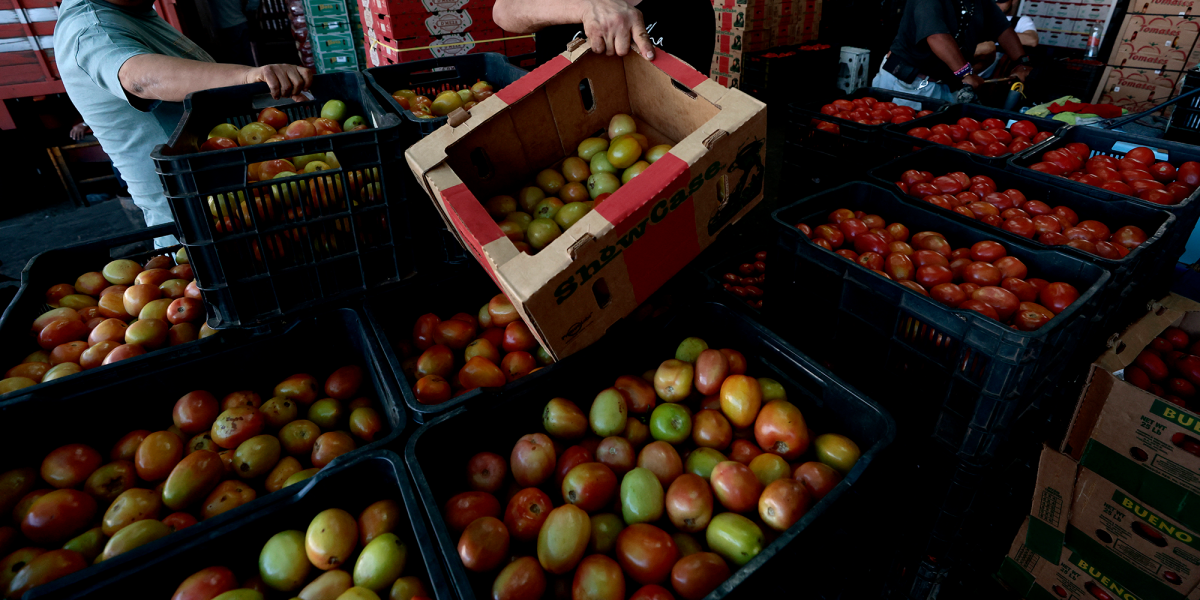
The Government of Mexico published an agreement that sets minimal export prices for the fresh tomato of Mexican origin as a result of an anti -dumping quota established by the United States.
The Secretariats of Economy and Agriculture The Agreement published this Friday the Official Gazette of the Federation (DOF).
“The measure seeks to protect the national productive plant, avoid distortions in the international market and guarantee the supply to domestic consumption, after the termination, in July 2025, of the Agreement for the suspension of anti -dumping investigation in the United States,” both secretariats said in a joint statement.
The minimum price (in dollars per kilo) will be:
- Tomato Cherry: $ 1.70
- Ball tomato: $ 0.95 | With stem: $ 1.65 | In cluster: $ 1.70
- Tomato Roma (Saladette): $ 0.88
- Tomato Grape (UVA): $ 1.70 Outs Varieties (Cocktail, Campari, Kumato, Mini Rome, Heirloom, Pera, Medley, San Marzano, Others): $ 1.70
Among the key points of the agreement are that Applies only to definitive exportsdoes not seek to restrict volumes or set maximum prices, but to maintain order in the foreign trade of the sector; In addition, prices will be reviewed annually or before if market conditions require it.
After considering the anti -dumping quota as a political measure, now this agreement has the support of all producer and producers associations of Jitomate, who participate in the United States export market.
Since mid -July, the United States applies an anti -dumping fee of 17.09% to Mexican tomato imports.
The Department of Commerce announced its withdrawal and termination of the 2019 agreement that suspends the investigation of anti -dumping rights on fresh tomatoes from Mexico (the 2019 agreement).
After the 2019 agreement was completed, the Trade Department issued an anti -dumping rights order, resulting in the rate of 17.09% on most import imports in Mexico. Anti -dumping rights are calculated to measure the percentage of Mexican tomatoes that have been sold in the United States at unfair prices.
The American tomato industry requested relief on March 29, 1996 claiming that he was suffering substantial damage for Mexican imports object of dumping.
In the last 27 years, Five suspension agreements have been signed (1996, 2002, 2008, 2013 and 2019). The 2019 Agreement was held in accordance with section 734 (c) of the Tariff Law of 1930, in its modified version, according to which “eliminating the detrimental effect of Mexican tomato imports” must be eliminated.
The Mexican signatory they agreed to comply with the terms of the 2019 agreementincluding selling at minimum sales prices or above them, and eliminating at least 85% of the dumping detected in the underlying research on each tomato ticket.
The 2019 agreement contained a duration section (section XI) that allows the Department of Commerce, an individual signatory or the set of signatories withdrawing from the 2019 agreement with a 90 -day notice. The Department of Commerce and Mexican signatories have used this provision previously to initiate the withdrawal and termination of previous suspension agreements.