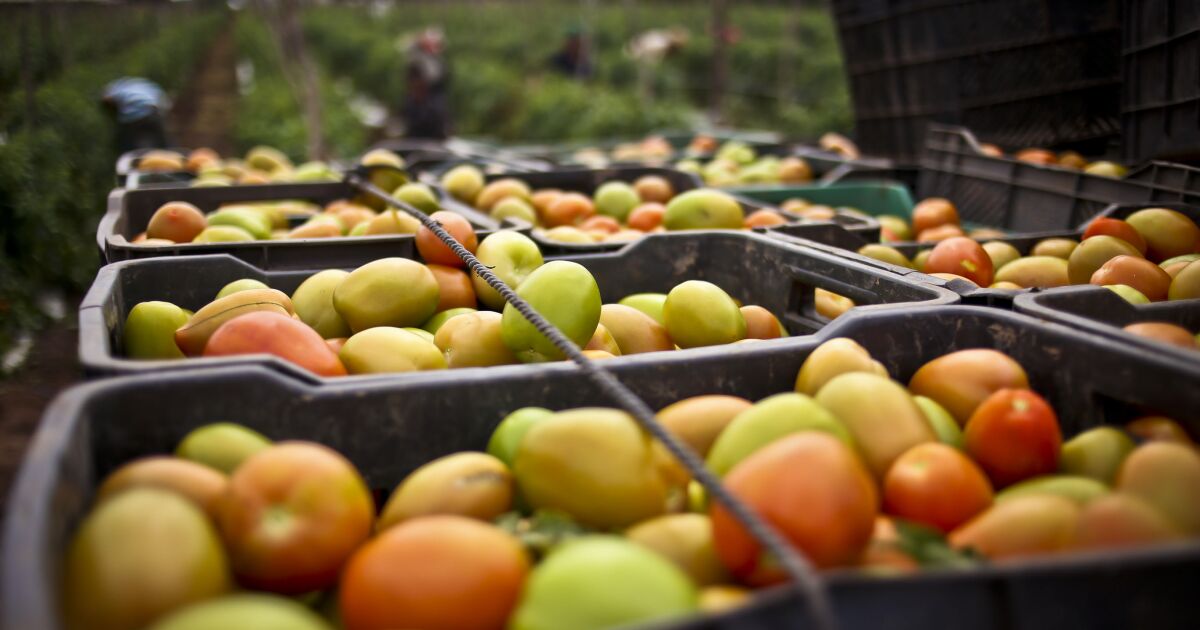
The downward trend in Mexican tomato sales began in April, when Washington announced its withdrawal from the agreement that regulated the market.
Between January and August 2025, exports reached 1,782 million dollars, 19.7% less than in the same period of the previous year. The United States Department of Agriculture anticipated a 5% drop for the entire year with a tariff, but the contraction already far exceeds that projection.
Mexico sends 99.8% of its tomato production to the United States. Sinaloa heads the list with 41.7% of the total, followed by Jalisco and Sonora, both with 11.7%, according to the Ministry of Economy.
Sinaloa, in the center of the impact
Sinaloa, the main producer and exporter, depends on this crop as an economic axis. Tomatoes represent about half of the state’s agricultural exports and generate an annual spill of 3,000 million dollars to the US market. The Culiacán River Farmers Association warned that the imposition of tariffs puts this source of income at risk and can alter the regional productive structure.
The organization anticipates that many producers will migrate to other crops in the 2025-2026 agricultural cycle. More than 72,000 people work in the Sinaloan tomato sector and more than 700 producers export to the United States, so the blow extends to rural employment and the local economy.
The US decision came in an environment of growing tension. Washington argued unfair pricing practices. Mexican producers and authorities pointed out political pressure from agricultural associations in Florida that for years have sought to stop the entry of Mexican tomatoes.
On July 14, when the agreement expired, President Claudia Sheinbaum promised to support the national industry and maintain dialogue with the United States. A week later, the government announced minimum export prices to stabilize the market and preserve the productive plant.
The prices set in dollars per kilo are as follows: cherry 1.70; ball 0.95; with stem 1.65; in cluster 1.70; Rome 0.88; grape 1.70; and other varieties 1.70. This measure came into effect on August 8 and will be reviewed every year or sooner if market conditions require it.
The Ministry of Economy and the Ministry of Agriculture affirmed that the decision protects producers, avoids distortions and guarantees internal supply. The tomato associations supported the measure, highlighting that the sector generates more than 3.1 billion dollars annually and employs more than 400,000 agricultural workers throughout the country.
For almost three decades, the Suspension Agreement avoided countervailing duties in exchange for respecting predetermined reference prices. These prices had not changed since 2013, despite inflation in both countries. With its termination, Mexican exports returned to a free market similar to that of 1996, when the antidumping investigation began.
America’s rhetoric
The White House says that it was a decisive move to protect local agriculture and restore equity, and assures that in a short time the Trump administration’s tariffs on Mexican tomato imports are already boosting American farmers, producers and business owners, even collecting a series of testimonies.
“It’s only been two days and we’re already getting more calls from customers, and the price hasn’t even changed,” said Chad Smith of Smith Tomato Farm in Alabama.
Matt Rudd of North Carolina said more local tomatoes will now be seen in stores. Rich Troccio, of Pittsburgh, was more blunt when he declared that he would not mind a 50% tariff because he prefers to buy American production.
Other stories highlight a more favorable terrain for local producers. Logan Duvall of Arkansas stressed that the money stays in the community instead of going to foreign conglomerates. Tennessee’s Steve Longmire expects better prices for growers in the fall and winter.
Tomato exports are a pillar of the Mexican agri-food balance and a symbol of integration with the United States, but now it is at risk. Sheinbaum’s government is trying to contain the impact with minimum prices and the search for new markets through its network of trade agreements.