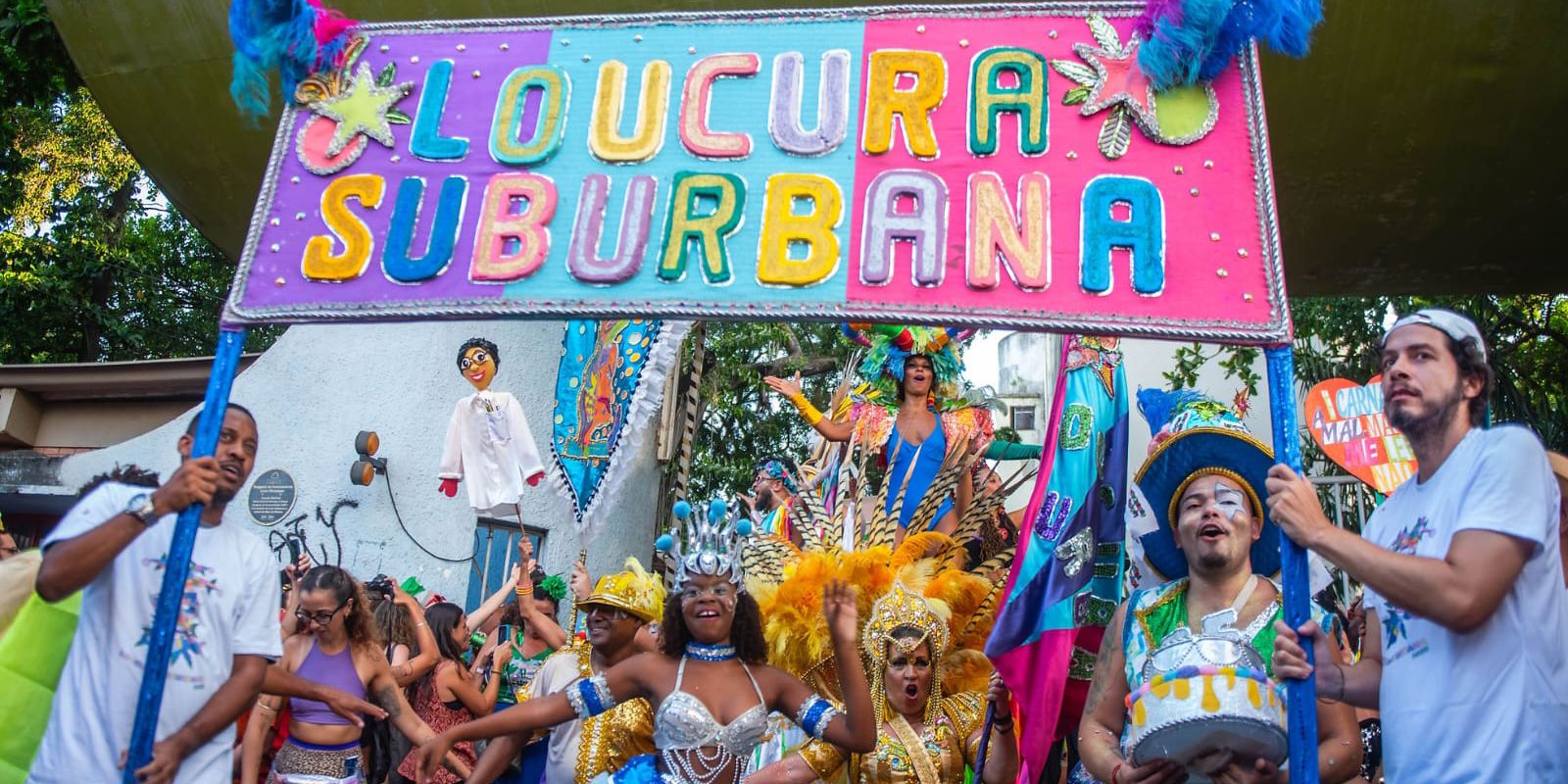
Rio’s carnival is joy, beauty, creativity, emotion and diversity. But it is also a space for inclusion. This is what the mental health blocks show, which promise to shake up the city by occupying different regions of the city and bringing together users of the psychosocial care network, family members, health professionals and the community from each location.
According to the Municipal Health Department (SMS-Rio), the associations show that the biggest popular festival in the country is also a place to raise awareness and combat stigma and prejudice.
In the assessment of the department’s Mental Health superintendent, Hugo Fernandes, the initiative reaffirms that people in psychological distress have the right to culture and joy.
“Mental health blocks are spaces for expression, belonging and citizenship, fundamental to a policy of care in freedom”, he pointed out.
The blocks also act as spaces for coexistence and care, offering music, costume, crafts and percussion workshops throughout the year.
These activities stimulate users’ artistic expression and expand dialogue with society about social inclusion, respect for differences and collective care.
Mental Zone
The newest of the mental health blocks, Zona Mental is a project created by users, families and professionals of the Psychosocial Care Network in the West Zone of Rio de Janeiro.
Created in 2015, with the aim of promoting the social reintegration of patients treated through music, art and carnival, Zona Mental held its first parade only in 2017.
In 2026, the parade will take place on February 6th, gathering at 4pm at Praça Guilherme da Silveira, in Ponto Chic, from where it will leave through the streets of Bangu, dragging revelers.
The music therapist on the Neusa Santos Souza Psychosocial Care Center team (Caps Neusa Santos) Débora Rezende shares the presidency of the block with the artist Rogéria Barbosa, a user of the same caps, and says that the idea of the block is also to break down prejudices.
“We open the mental health carnival. We want to see all our users, family members, together with the people there. Because we pass by and, suddenly, the block grows. The idea is this: everyone together and mixed.”
Débora highlights that the block has an important role as it represents the West Zone of the city, a peripheral region furthest from the center. The association brings together around 14 or 15 health services in Rio.
In addition to users, family members and service professionals, samba artists from schools such as Unidos de Bangu and Mocidade Independente de Padre Miguel participate.
At Carnival 2026, Zona Mental will honor northeasterners who live in the West Zone of the city, and the winning samba, written by CAPs user Neusa Santos Marco Antonio Amaral, talks about Brazilian multi-instrumentalist Hermeto Pascoal, born in Alagoas and resident in the Bangu region. Pascoal died last year, aged 89.
You’re Freaking Out, Freaking Out, Freaking Out!
25 years of approval of the Law 10,216/2001known as the Anti-Asylum Law or Psychiatric Reform Law in Brazil, will be celebrated by the Tá Pirando, Pirado, Pirou! block, a collective that reaches 21 years in 2026.
The parade is scheduled for February 8th, gathering at 3pm, on Avenida Pasteur, in Urca, near the Federal University of the State of Rio de Janeiro (Unirio).
The block also pays homage to the Italian psychiatrist Franco Basaglia, who was in Brazil in 1979, in the company of his wife Franca Ongaro Basaglia, and who contributed to the Brazilian psychiatric reform.
Psychoanalyst Alexandre Ribeiro, founder of the block, says that he “perhaps was the greatest inspiration for psychiatric reform in the country”.
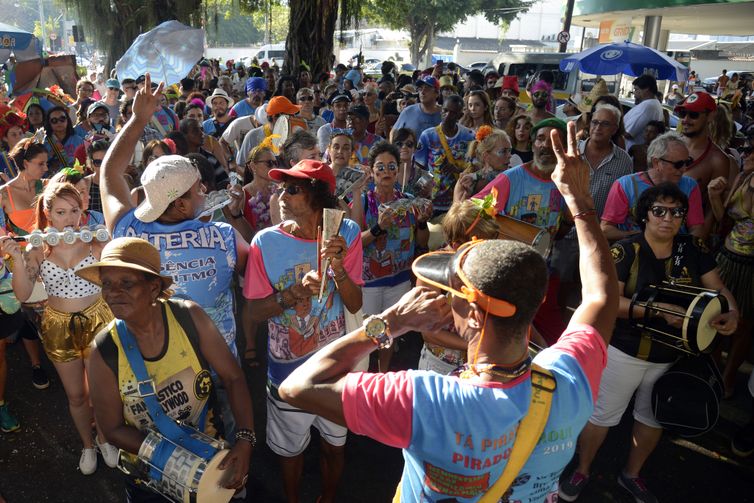
Block Tá Freaking Out, Freaking Out, Freaking Out! parades in Urca, south of Rio on pre-carnival Sunday – Tomaz Silva/Agência Brasil
The Italian experienced the horrors of the Barbacena Colony Hospital (MG), where more than 60,000 people died as a result of mistreatment, and called the Minas Gerais asylum a “Nazi concentration camp” and the mental health professionals who accepted that reality “jailers”.
Influenced by the Italian democratic psychiatry movement, led by Basaglia, mental health workers wrote the Bauru Manifesto in 1987, establishing May 18th as National Anti-Asylum Day and the motto “For a society without asylums”.
The growing popular mobilization for human rights and care in freedom resulted in the approval of Law 10,216, in 2001.
The block will be accompanied by the Portela drums and two guest blocks: Céu da Terra and Vem Cá Minha Flor.
Colonial Empire
In the Império Colonial block, the plot will be a tribute to Arthur Bispo do Rosário, highlighting the trajectory of the artist diagnosed with schizophrenia, who was also a sailor, boxer and inmate at Colônia Juliano Moreira, where he stayed for almost 50 years.
The block was founded in 2009, based on culture, leisure and territoriality actions by the Bispo do Rosário Museum itself, which operates at the Juliano Moreira Municipal Health Assistance Institute (IMASJM). In 2012, the block became headquartered at the Pedra Branca Community Center (Cecco Pedra Branca).
Director of IMASJM, Luciana Cerqueira said that, for the first time, the block comes with wings, which proves the maturity of the group itself. The author of the plot is the user of the Psychosocial Care Center (Caps) Jovelina Pérola Negra Alex de Repix.
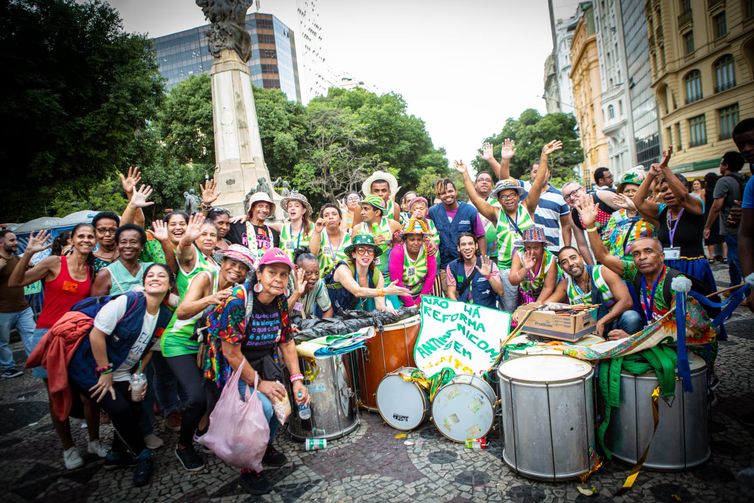
Members of the Colonial Empire Bloc. Photo: Império Colonial/disclosure
The parade is scheduled for February 10th, gathering at 2:30 pm at Praça Nossa Senhora de Fátima, in Jacarepaguá, in the Southwest Zone of the city.
The Colonial Empire is a small block, made up of 20 people, including battery members, mental health professionals and users.
Last year, the group did not hold a street carnival, instead holding a dance at Areninha Jacob do Bandolim, in Pechincha, Jacerepaguá, where 200 people gathered.
As the block will parade this year during Carnival week, the expectation is to double this number, bringing together local residents, network users and service workers from the surrounding area.
Suburban Madness
Chosen among 25 candidates, samba So the people can sing will host the Loucura Suburbana block parade in 2026. The parade will take place on February 12th and the expectation is that the audience will once again exceed 3 thousand people.
The oldest of the group, Loucura Suburbana took to the streets of Engenho de Dentro, in the North Zone, for the first time in 2001. This year, it celebrates 26 years of activity.
The association’s general coordinator, psychologist Ariadne Mendes, says that this year’s parade will be the result of a synthesis of ideas. The approved plot ended up being: “Bastions, Territory and Madness”.
“They brought so many themes that it was difficult to choose just one. We preferred to separate the ideas that people brought into thematic groups.”
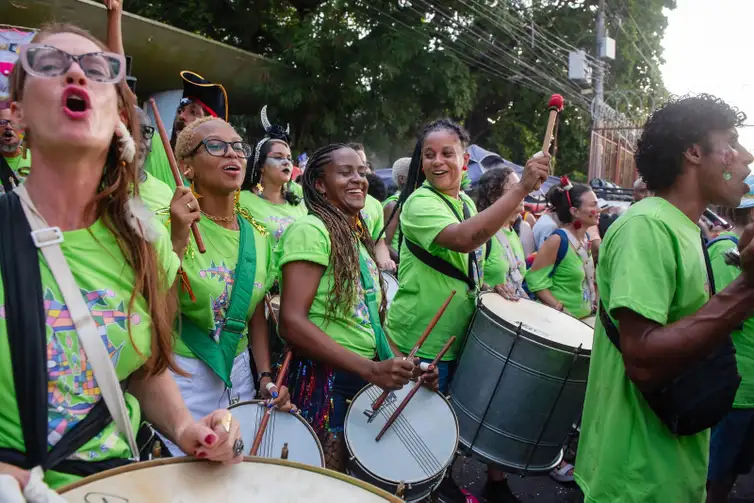
Bloco Loucura Suburbana parades in the Engenho de Dentro neighborhood Photo: Loucura Suburbana/ Pâmela Perez
The Baluartes make reference to two musicians who left the group and the association’s tradition of contributing to the memory of the Engenho de Dentro carnival, in the North Zone of Rio de Janeiro.
The name Território refers to the roots and work in the community. “It’s about continuing, rebuilding, putting our feet on the ground and our hands dirty and moving forward. Our roots are rooted here. We’ve revitalized the street carnival here.”
The third theme, Madness, talks about the importance of the block not only for the neighborhood, but for people’s lives. “It ends up being a celebrated place. It’s a joy, a meeting place. Madness Suburbana is always revered”, confirmed Ariadne.
For those who cannot afford to buy or have no time to look for costumes in stores, the block has the solution.
“The shed is now open to receive revelers who wish to reserve their costumes. On the day of the parade, they pick up the costumes, wear them and return them later.”
The block also offers free carnival makeup on the day of the parade.