Melissa arrived at the worst moment and without gentle warnings: she shook an economy in the red with winds of more than 200 km/h, devastating eastern Cuba after claiming lives in Jamaica (32) and Haiti (43).
Until now, no deaths have been officially reported in Cuba, although citizen reports speak of fatalities and missing persons without independent confirmation.
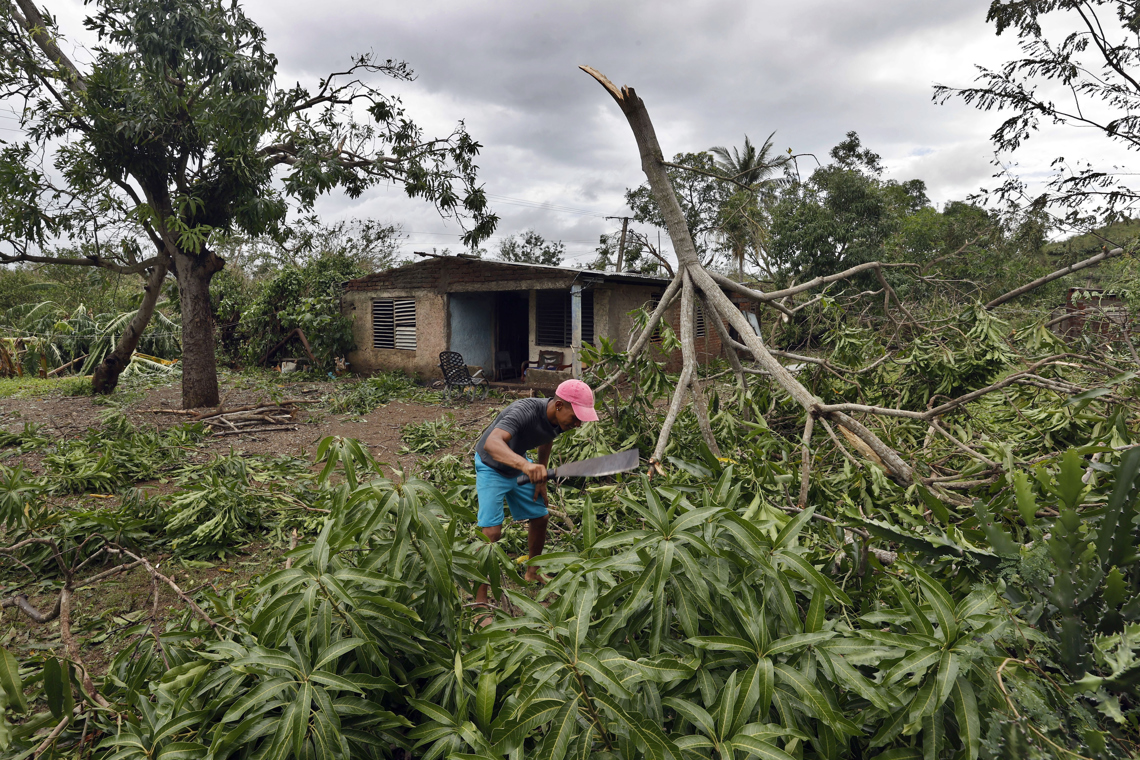
In any case, the material bill is brutal. You just have to stop at the violated landscapes: houses without roofs; schools and dairy farms reduced to rubble; twisted or uprooted crops; towns and photovoltaic parks under the chocolate waters; stones perched on the roofs by the fury of the sea; bridges split in two like a soft loaf of bread that is distributed.
Poverty is now much more visible, aggressive, in a vast territory where more than 2 million people live and which has historically been the least favored in Cuba.
Melissa damaged more than 45 thousand houses and 1,500 schools in eastern Cuba
The disaster numbers
The numbers are samples of losses. Many are irreparable; others that will take years, decades, to be compensated, ruining the lives of the victims, consuming energy, macerating childhoods and youth, accelerating old age.
More than 45 thousand homes were damaged; 1,552 schools and 461 health facilities suffered impacts that disrupted goods and services. The overflowing waters of the Cauto River, the longest in Cuba, erased small towns and crops; 78 thousand hectares of crops were destroyed, more than half of them bananas.
In the Granma province, for example, there are losses in coffee, livestock and crops that fed entire communities, such as rice, of which of the 200 tons planned, only about 60 or 70 will be able to be harvested.
According to the local newspaper The Demajaguathere is an impact of nearly 28,500 heads of livestock – without specifying whether these are deaths or loss of animals -, equivalent to 17% of the total cattle mass of the province, as well as other losses in small livestock, horses and beekeeping.
Meanwhile, barely half of the users in the eastern provinces receive electricity. A television report on Tuesday night said that in the city of Santiago de Cuba only 4.92% of the electrical service has been recovered, although, according to the Minister of Energy and Mines, Vicente de la O Levy, in Las Tunas the restoration of energy was already close to 95% of the province.
This time, the evacuation plan was formidable in numbers. In just a few days, 735,000 people were transported to safe places, considered by authorities to be a logistical feat. And it was. Even so, episodes of rescues by amphibians and helicopters, and other means of the armed forces and firefighters have filled the pages of newspapers and news programs: people trapped by the floods escaped death by climbing to the roofs of their houses or even in the tops of trees.
As testimony, desperate calls for help from small communities were recorded on the networks whose residents lived hours of anguish surrounded by instantaneous floods, after days of the hurricane having passed through their regions.
Even today, some 120,000 victims are sheltered in shelters, not always with adequate conditions of food, hygiene and health care, judging by the complaints and denunciations of the virtual communities, to which the Government has contrasted opposite narratives told by sheltered people who appear happy and grateful.
A week after the attack, the Cuban transportation system is limping. Stopped trains, diverted bus routes, roads turned into strips of mud and rubble. The airports of Santiago and Holguín return to service, but many roads remain with restrictions; Granma and other provinces show cuts that complicate the arrival of aid.
The Minister of Transportation, Eduardo Rodríguez Dávila, always media-friendly, talks about provisional itineraries and technical certifications before the trains resume their march: normality, for now, is a goal, not a reality around the corner.
Suspended trains, buses with detours and damaged roads: transportation in Cuba a week from Melissa
Statistics and slogans hide human realities
The statistics outline emergencies, but in reality the corporeality of the figures refers us to homes, belongings, purposes, sentimental trajectories, genealogies, symbolic capitals and existential routines whose form and meaning would have to be reconstructed, in many cases from scratch, which implies challenges that cannot be assumed or overcome, at least in years.
The official motto that no one will be “abandoned to their fate” is known to be denied daily, without a hurricane serving as a sponsor of disasters.
The massive evacuation prevented many fatal tragedies, but the recovery is now entering a slower stage, subject to the acute crisis of shortages that the country is suffering and the thousand and one flaws, bureaucratic and otherwise, of a resource management model with many deficiencies.
Solidarity that disarms tensions
The catastrophe opened channels where there were often walls. Humanitarian gestures came from Washington—and donations managed even by the Archdiocese of Miami, the historic capital of the exile—for which the Cuban Government publicly thanked after some political inconsistencies in the assimilation of the neighbor’s proposal.
The international response has been extensive: UNDP has so far mobilized 6,000 metal sheets, tarps, generators and mattresses for 2.2 million dollars; India sent 20 tons of aid; The European Union, China, Colombia, Panama and Venezuela joined immediate efforts. Shipments from the Red Cross, the IFRC – the International Federation of Red Cross and Red Crescent Societies, the world’s largest humanitarian network – and multilateral donations add up to a government package that will subsidize 50% of construction materials and offer soft loans and bonuses for affected families. It is not just material help: it is the gesture that, when nature destroys, borders give way to what is essentially human.
Rebuild with heartbreak and hope
Melissa left behind a geography of wounds and an opportunity to measure priorities: repair critical infrastructure, ensure a return to school, and reactivate the agriculture that feeds and employs. The task is to rebuild not just walls, but communities; not only deliver roofing sheets, but also restore certainty on an island where there is a housing deficit that exceeds 800 thousand homes, according to official figures from 2025.
If the mass evacuation was the first line of defense, reconstruction will be the most challenging test of civil and political resistance of the moment, which extends over a prolonged exercise of surviving the daily hurricane of poverty, hopelessness and lack of citizen empowerment.
Melissa left with her fury; It left great destruction, but also its opposite: reconstruction, and vital convictions like those of an elderly woman from the Santiago community of Cañizo, whose house completely lost its bathroom and part of the roof flew into the air. “But there were people who were left with nothing, with nothing, with nothing… that when we got here that the bus brought us, we put our hands like that (on our heads) and said, My God! It was hard, of course, it was very hard… but hey… we are alive,” he said, looking into nothingness.