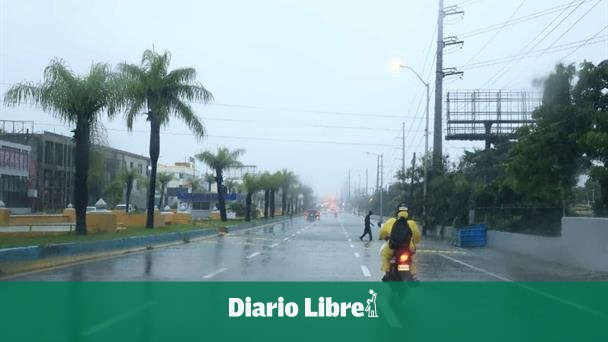
The economic losses derived from the passage of Storm Melissa (now a category 5 hurricane) could exceed 17,000 million pesos dailyaccording to estimates by economists and business associations, while the Faculty of Economic and Social Sciences of the UASD calculated that the country stopped producing more than 10,000 million pesos per day at the time when productive activities were officially suspended.
The estimates reflect the blow suffered by the consumer, commerce, manufacturing and agricultural sectors, after the suspension of activities productive in much of the country for several days.
According to economist Ellen Pérez Ducy, the stoppage of activities From Thursday to Sunday, equivalent to about 2.5 working days, it mainly affected private consumption, which averages 17,000 million per day.
“With 24 provinces affected, including the National Districtwhich weighs a lot, it is inferred that the effect would apply to about 80% of the national total. But consumption did not stop completely, assuming a reduction in consumption of 50%, this would result in a loss of approximately 17,000 million pesos,” Pérez Ducy explained.
The economist indicated that the manufacturing, construction, commerce, hotels, bars, restaurants and transportation sectors were the most impacted, while education and communications They did not register major effects, and health had a partial impact.
For its part, the National Council of Merchants and Entrepreneurs of the Dominican Republic (Conacerd) reported that the small businesses They accumulate budgeted losses of 550 million pesos, due to electrical interruptions, floods and damage to perishable products.
The vice president of the organization, Antonio Cruz Rojas, stated that the grocery storesminimarkets, small supermarkets, hardware stores, beauty salons, hairdressers, cafeterias and soup kitchens were the most affected.
Conacerd also reported that the rains They devastated livestock animals, such as cows, pigs and goats, on several farms in the interior, especially in communities in the south and northwest.
According to your data, the phenomenon It affected more than 3,785 families, of which 20% correspond to retail businesses, with the deep south (20%) and Santo Domingo (15%) as the most impacted areas.
UASD: the country stopped producing more than 10,000 million pesos a day
To the previous estimates are added the calculations of the Faculty of Economic Sciences and Social Sciences of the Autonomous University of Santo Domingo (UASD), which estimate the losses due to the interruption of productive activities during the days of official suspension at more than 10,137 million pesos per day.
“This impact is only due to the reduction of the productive activities”explained Dean Antonio Ciriaco Cruz.
The economist warned that real losses could be greater when considering damage to productive assets, such as the destruction of agricultural crops and infrastructure.
“For loss estimates direct due to suspension of activities, it has been assumed that the Dominican economy generates a daily GDP of 20,274 million pesos, and the economy operated at 50% of its activities in those days,” Ciriaco Cruz stated.
Risk of increase in agricultural prices
Pérez Ducy highlighted that they have not been estimated flooded crop losseswhich would require a more detailed analysis. “This could increase the price of some items if supply is reduced.”
Preliminary figures
The Minister of Agriculture, Limber Cruz, reported in LA Semanal con la Prensa that there were agricultural losses valued at about 1,340 million pesos, with damage to items such as coffee, rice, vegetables and tubers.
Of this total, only 74 million pesos were lost in future coffee sales, which were frustrated with the damage to 2,847 quintals.
Alert levels
The Emergency Operations Center (COE) maintained alerts for the National District and 23 provinces due to the direct effects of the Hurricane Melissacategory 5.
In red alert There are Bahoruco, Barahona, Pedernales and Independencia.
In yellow Gran Santo Domingo and San Cristóbal were placed, in addition to Dajabón, San José de Ocoa, Azua, Monte Plata, Elías Piña, Peravia, San Juan and Montecristi.
While on green alert Monseñor Nouel, San Pedro de Macorís, La Romana, Hato Mayor, La Altagracia, Santiago Rodríguez, Samaná, El Seibo and Duarte are located.
State collections
According to the report “DGII collection analysis, monthly report September 2025”, between January-September 2025, state income for the collection offices they stand at 900,640.7 million pesos, this represents a growth of 1.5%; 13,352.6 million pesos more compared to January – September 2024.
The fulfillment of the fundraising goal compared to the estimate it is 99.4%.
In detail, the General Directorate of Internal Taxes It collected 76.2% of the total tax revenue in January – September 2025, while the General Directorate of Customs contributed 21.7% of the collection and the National Treasury the remaining 2.1%.
As for the tax type91.6% comes from Internal Taxes and the remaining 8.4% from foreign trade taxes.
Behavior of DGII collection in September 2025
The collection September 2025 amounts to 67,707.5 million pesos, for a growth of 6.7%, equivalent to 4,272.0 million pesos more than the same month of the previous year.
In the absence of the income non-recurring in the same period, an interannual increase of 6.0% is observed, that is, 3,767.4 million additional pesos than the same month of 2024.