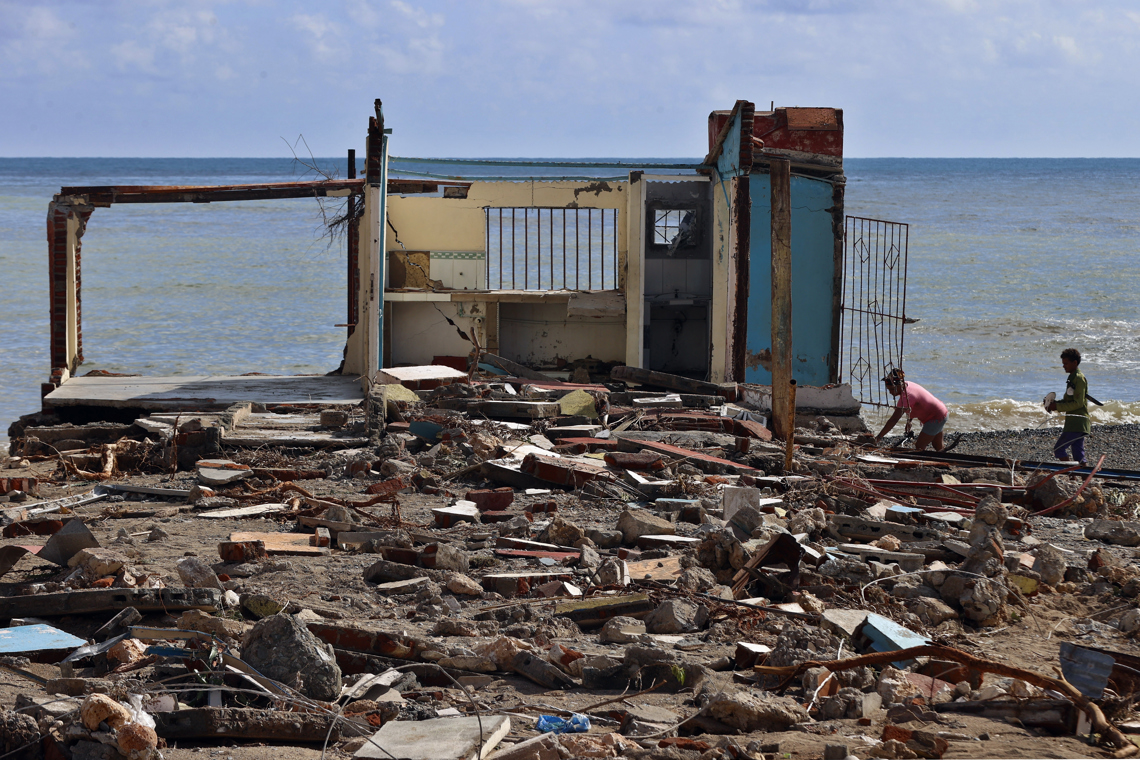
In just 48 hours, Melissa transformed from a moderate storm into a brutal Category 5 hurricane, on the Shaffir-Simpson scale, a phenomenon that atmospheric science attributes to the consequences of climate change.
An attribution study aforementioned by the Spanish newspaper The Country and conducted by the Graham Institute of Climate Change and Environment at Imperial College London confirms it bluntly: Melissa was four times more likely due to global warming caused by human activity. The reason? The average global temperature today is 1.3°C higher than in the pre-industrial era, making the ocean a perfect cauldron for incubating meteorological monsters.
“Man-made climate change clearly made Hurricane Melissa stronger and more destructive,” said Ralf Toumi, director of the Institute. And he didn’t stop there: “These storms will be even more devastating in the future if we continue to overheat the planet with the burning of fossil fuels.”
Faster winds, deadlier damage
The data from the study are as compelling as they are alarming. Compared to pre-industrial conditions, Melissa generated 7% faster winds as it hit Jamaica with sustained speeds of 280 to 300 kilometers per hour.
If the planet reaches a 2°C rise—the limit the Paris Agreement seeks to avoid—wind speeds in similar hurricanes could increase another 2.1 meters per second.
To put it in perspective: between 2025 and the pre-industrial era, the increase was already 5.3 meters per second. And every extra meter per second is one less house, one more life at risk, one more devastated economy.
A mirror of climate inequality
Melissa wasn’t just a storm. It was a mirror of climate inequality. “It’s a reminder of how climate injustice works,” said Dr. Emily Theokritoff, one of the study’s authors.
While the countries that have contributed the least to global warming—like many Caribbean nations—suffer its worst consequences, the great powers continue burning oil as if there were no tomorrow.
Jamaica, for example, emits barely 0.02% of the planet’s greenhouse gases. However, it was one of the territories hardest hit by Melissa.
Cuba, another of the countries hardest hit by the storm, ranks number 101 on the list. ranking of countries by CO2 emissions made up of 184, in which they are ordered from least to most pollutants, according to the Datamacro.com portal.
The ocean, a pressure cooker
In 2024, ocean surface temperatures broke records, which is perfect fuel for hurricanes like Melissa. Warmer waters fuel storms, speed them up, make them grow faster and stronger. It is as if the sea has become a laboratory of destruction, fueled by human emissions.
Scientists warn that this pattern will repeat itself. Faster, more intense, more unpredictable hurricanes. And with each degree that the global thermometer rises, the probability of more “Melissas” emerging multiplies.
And now what?
The question is not whether another Melissa will come. The question is when, given the current auspicious scenario, in which fossil fuels continue to be burned, while climate commitments remain a dead letter and rich countries do not assume their ecological debt given their highly polluting energy systems since the industrial revolution of the late 18th century.
Melissa was a warning. It earned the status of being the third most intense hurricane ever recorded in the Caribbean, only behind Wilma (2005) and Gilbert (1988). Melissa devastated entire islands, leaving at least 50 dead and generating losses that could reach 20 billion dollars. But beyond the disaster, what it revealed was an uncomfortable truth: climate change is putting more muscle in every storm.
In the Imperial College exercise, researchers also found that if the planet’s average temperature rises by 2°C – which is the goal of the Paris Agreement – the wind speed for a similar hurricane would increase by 2.1 meters per second. Between 2025 and before the industrial revolution, the increase was 5.3 meters per second.
COP 30 at the doors
In less than two weeks, the United Nations Climate Change Conference (COP30) will begin in the Brazilian city of Belém, in which countries must finally outline the rules of the game to comply with the Paris Agreement, from which Trump has also decided to withdraw the United States, a country from which he has amputated key functions of its satellite atmospheric forecast services.
“Although by the time COP30 takes place, in mid-November, the country will still be formally linked – despite the fact that the Republican announced it after coming to power, it takes a year for it to become effective – it is most likely that they will not send any delegation to the summit in Belém. At COP30, then, it will be measured how much nations can maneuver without the leadership or blockade of a country that, historically, has emitted 20% of the gases that cause climate change,” the article opined. The Country.