Yucatán, a vulnerable territory
The pollution problems attributed to pig farms are aggravated by the geographical characteristics of Yucatán.
There are no surface rivers in the state; All the water that supplies the communities, the city of Mérida and the industry comes from the underground aquifer. This is part of a karstic system composed of rocks such as lime and gypsum, which is highly permeable and is interconnected by cenotes, cracks and caverns.
This condition makes the aquifer an extremely vulnerable system, since any contaminant that infiltrates the soil can quickly reach the water consumed by thousands of people.
In this context, the discharge of millions of liters of wastewater generated by industrial pig farming has raised alarms.
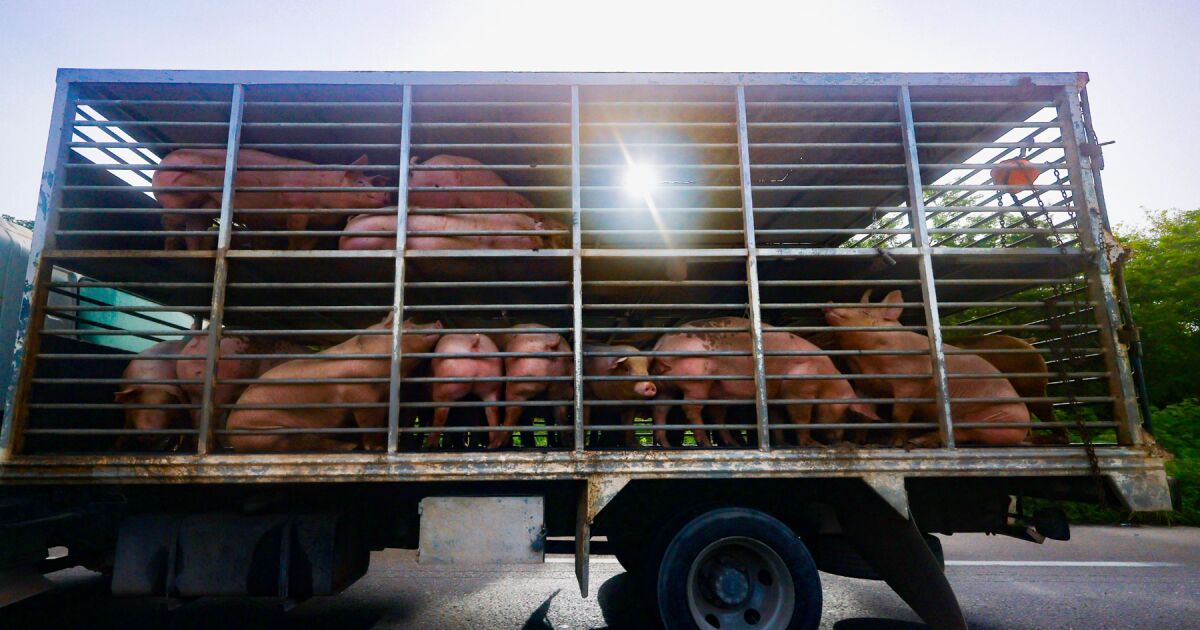
(Photo: Hector Vivas/Getty Images)
In June 2025, the Ministry of Environment and Natural Resources (Semarnat) reported that 186 pig farms in Yucatán were integrated into the Public Registry of Water Rights (REPDA).
The authority also detailed that these facilities generated around 11 million cubic meters of wastewater per year, which represents close to 1% of the total that is discharged into the aquifer for all uses.
Likewise, 116 farms—producing 7.3 million cubic meters—reported reusing their treated wastewater for agricultural irrigation. However, these data contrast with the findings of environmental organizations.
In 2023, the organization Mercy For Animals Latin America identified, through satellite analysis, at least 872 possible mega pig farms in Yucatánmany of them located within Protected Natural Areassome recognized as Ramsar Sites or wetlands declared of international importance.
Years before, in 2020, Greenpeae México documented the existence of 257 hog farms in the stateof which until then only 22 had an Environmental Impact Statement. That is, more than 90% operated without environmental authorization, despite the risk it implies for one of the most important water systems in the country.
“The installation of these mega farms puts enormous pressure on ecosystems, especially in a region as vulnerable as the Yucatan Peninsula,” Greenpeace has warned, also pointing out the deforestation of at least 11,000 hectares of jungle associated with the expansion of the pork industry.
“It is not progress, it is a legacy of pollution”
In the Mayan community of Santa María Chí, located just over 20 kilometers from Mérida, the impacts that these farms have are experienced daily. The San Gerardo industrial pig farm has operated there for more than 30 years, which is operated by the company Peninsular Livestock, whose effects—assured by its inhabitants—were intensified with the expansion of the number of animals and ships, since it is estimated that it housed more than 49,000 pigs.
In interview, Wilberth Nahuat Pucmunicipal commissioner and environmental defender of this community, as well as Candelario Colli Sansores, activist from the Halachó municipality, members of the Network for the Defense of Water and Mayan Territory, To’one Ja’o’on, We Are Water —which brings together representatives of 21 Mayan communities— denounced that the operation of mega farms, including those of Kekén, a subsidiary of Grupo Kuo—the largest pork exporter in Mexico—have caused environmental damage, health problems and a growing violation of collective rights.
Nahuat reported that the environmental crisis in Santa María Chí, derived from the operation of the farm, worsened in May 2023, when burning of pig excreta began within the facilities.
“That generated toxic smoke. Children, adults and elderly people began to get respiratory tract illnesses. We experienced it as a health contingency,” he recalled.
From then on, the community documented the impacts with photographs, videos and drone flights. Other damages also began to become visible: contaminated wells, fruit trees that stopped producing, vegetables that no longer grow, and domestic animals with skin lesions.
Before we planted citrus trees, cornfields, vegetables. Today many houses no longer produce anything. “The water from the well is no longer suitable for drinking or irrigation.”
Wilberth Nahuat.
Given these effects, the commissioner of Santa María Chai highlighted the organized and community work that has been carried out in the region with the purpose of demanding the right that children and adults have to live in a healthy environment, a fight that he said does not seek personal benefit but for the health of those who live there and who will inherit future generations.
“It stinks every day, you can’t understand it at night because the next day the pig clothes stink, in the mornings taking the children is terrible, smelling the smell of pig shit… there are flies, mosquitoes, I mean, there are people who come to visit relatives, who come to visit the community and it’s embarrassing that they say how can you live here. It stinks every day but since we are inhabitants of here, we feel it is something normal because we are already used to it,” he said.