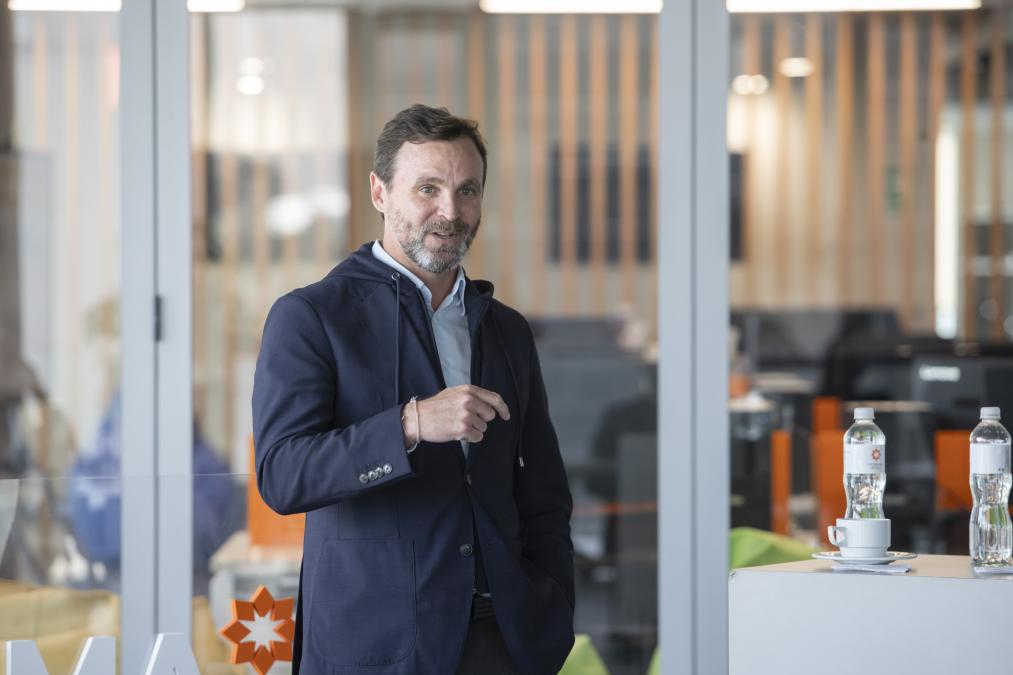
Mauricio Schwartzmann is one of the “sharks” of Shark Tank Mexico: a mix of investor and municipal cash analyst who, just by listening to a pitch and without financial statements in sight, evaluates “with a good eye” if it is worth investing a few million pesos in Mexican ventures.
He did not study economics, accounting or administration, but his training as an industrial engineer and his ambition to become CEO led him to enter the world of finance and investments. He worked for 16 years at Citibank in various positions, then assumed the general management of Rappibank and today is general director of Mastercard Mexico.
Schwartzmann recently arrived invited by the Alumni Network of the University of Lima, his alma mater, and gave himself a space to talk with Perú21.
You tell me that you wanted to be CEO and, therefore, you had to meet certain goals to reach that final goal. Does this also apply to investments?
Anyway. The truth is that few people are lucky enough to receive an inheritance from their grandmother. Most have to work to generate their savings and be able to invest. And that makes your investment process much more careful, because you know what it costs to generate a surplus.
Secondly, when you are looking to invest in a venture, money is usually not the biggest problem; The important thing is to make sure that it comes with what is known as smart money: that it comes accompanied by advice, support and a network of contacts that help the venture achieve its objectives. That’s where experience makes the difference.
What do you think is the key to start saving?
The first thing you should do is set aside some of your income to save. Obviously, you can indulge yourself, but if you spend everything you get, you’re dead. The second thing is that there is the miracle of compound interest. Many people say: “I’m only going to save when I reach US$1,000.” What they don’t know is that from US$1 you can generate passive income with that interest. The third thing is that you should not spend more than your need. If you have your house, food, health, etc., the rest of your income is a number in the bank.
How to decide where to put our money?
The first thing is that I think one has to seek help. There are very simple products, such as term deposits, that we can start with. Then we can include mutual funds. Today many financial institutions offer these products in their applications. From there, when our capital grows we can move towards higher risk assets, such as stocks and ETFs. And when you have more experience, you can include investments in venture capital or private equity, which involve betting on companies with a higher risk and that require greater knowledge and risk tolerance to enter.
Anything else?
Yes, and perhaps it is the most important thing. Many times we focus so much on work that we neglect the personal part. We “get the hell out of it” by working and leave aside our finances and savings with the excuse of “I’ll see about it later”, and that is the worst mistake. Something that works very well for me is to dedicate an hour on the weekend to review how we are doing, how my investments are performing and if anything needs to be moved. We should all do financial planning on a recurring basis.
On Shark Tank, where you’re a judge, how do you determine which venture is worth it?
Each investor has their style. The first thing I do is like the product. Why would I invest in a company that does something I wouldn’t buy? The second thing is the size of the market. If you tell me that you sell shoes in sizes 15 to 20, it is very likely that few will buy it. Another thing is that it must solve a problem in society. I love to talk about the example of Uber to talk about this point. Then, I am interested in having the technology component. Technology allows you to scale businesses without having to invest so much capital. Finally, validate how things went.
What other aspects do you take into account?
The most important decision is how much they ask you to invest. First, because you must evaluate if you have the money. Second, because if the entrepreneur values his company at US$15 million and you only invest US$10,000, your participation will be irrelevant. If I contribute my experience and time to generate profitability, I do not want to have less than 10% of the company. Of course, in the case of technological companies with greater development, the valuations are usually higher and you can enter with 2%, 3% or 4% without problem, because the potential is considerable. But if it’s a smaller company and I want to sit down at the table with the founder and say, “I don’t think we should go this way,” I need to have some political power.
What do you think about investing in bitcoin?
I’m going to give you three answers. The first is that it depends on the type of investor you are, how much time you want to dedicate and the risk appetite you have. You can go from having the money in your account to lending it to someone you find on the street. So, if you are too affected by price movements and volatility, you probably won’t want to get close to the crypto world.
What is the second answer?
The second thing is that, like any good new instrument, it generates doubts, curiosity and also fear about what may happen. You wonder, “Is it true? Will I be scammed? Will it have intrinsic value or not?”
But I would tell you that, more than digital currencies or cryptocurrencies, what I like most is the technology behind it, which is called distributed ledger technology or blockchain. What this technology allows is to do many things, one of them being cryptocurrencies. Today we talk, for example, about making flows with stablecoins, which are currencies linked to a real currency and that use this rail in a simpler way to move funds throughout the world. I am a firm believer in blockchain technology.
Third?
Yes I have invested in cryptocurrencies. Did it go well for me? Yes, it went well for me. Obviously, if I have 10 soles, I didn’t put the 10 soles into it. I put 10 cents into it. You diversify your portfolio and put in the instruments with which you feel comfortable and that you know. But, as they say, you never put all your eggs in one basket. So if you need that money to live, don’t put it in bitcoin. But if you have something saved and you want to put a percentage there to try and see how it goes, it can go well for you, it can go bad, but it is your decision and it is your peace of mind that you have to manage, so that you can then sleep.
Receive your Perú21 by email or Whatsapp. Subscribe to our enriched digital newspaper. Take advantage of the discounts.
RECOMMENDED VIDEO