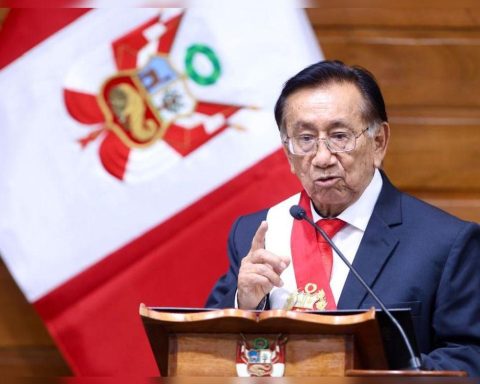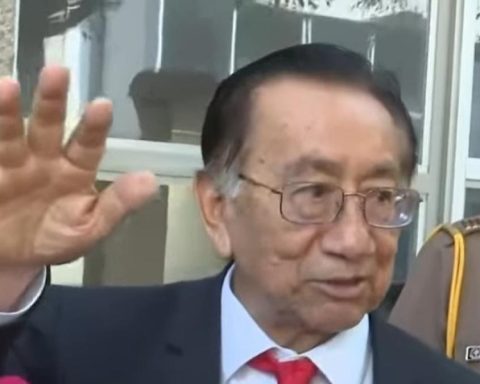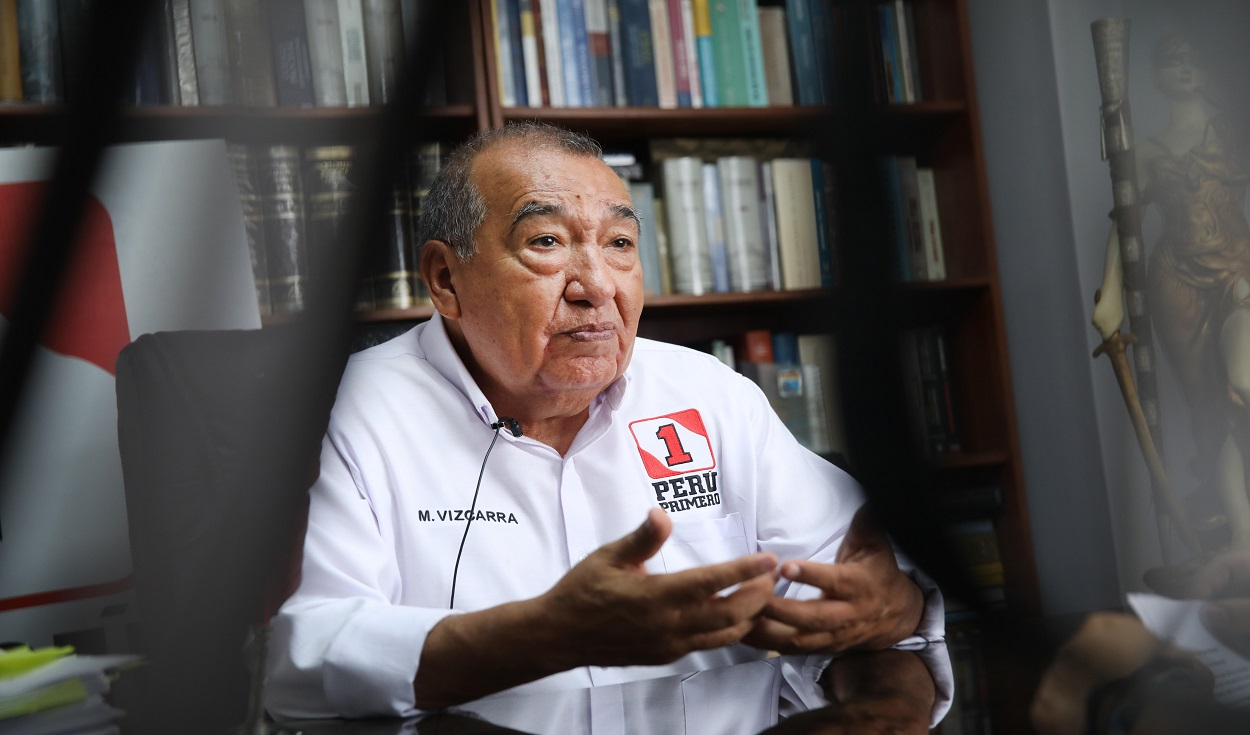
A problem in his right eye causes Mario Vizcarra to tear frequently. So sometimes, in the middle of a conversation, you involuntarily wipe your face. “Many think that I am crying, but the truth is that the tears are carried inside,” says the presidential candidate of Peru Primero, as if making a funny comment about his condition, but also a summary of what has been a bittersweet week in which it was confirmed that he is still in the electoral race, but his brother Martín presented health difficulties. We are at the headquarters of his party, a mansion in La Victoria where there are plenty of stuffed lizards and a series of gifts that honor Martín Vizcarra’s time at the Government Palace. There are altarpieces, paintings and sculptures in wood and metal, all with the name of the former president. It is as if it were a museum. Mario Vizcarra says that this accumulation of memories does not bother him, but on the contrary gives him strength. He is the candidate of his party, but not the star figure. And he – he assures – is fine with that.
What is your brother Martín’s health situation at the moment?
Well, Martín is admitted to a clinic suffering from a serious kidney problem. It is a problem that began in the first days of January when he was in Barbadillo, where he is being held, and unfortunately the medical staff, both from INPE and MINSA, did not give him the required attention and it worsened until the 20th, when his situation became much worse. And after a doctor’s examination he only became aware of its seriousness and he underwent surgery on his right kidney the next day, Wednesday the 21st. In that same surgery they observed that the left kidney was very compromised. It has practically lost 80% of its functionality.
Did you have to suspend your schedule because of this issue?
Yes, of course, yes. I had scheduled trips to the interior of the country, we had been in Huancayo. And well, that is not something to be expected.
And isn’t that going to be a problem during the campaign? I mean, it is understandable that you as a brother worry about Mr. Vizcarra. However, you have a planned agenda and it seems that it will always respond to your brother’s health issue or legal issue.
Well, it is a specific fact, the serious situation that Martín suffers. Once that is over, which will be between today or tomorrow, a period of rest and recovery will begin. I will still maintain my concern, but that will not prevent me from returning to the agenda.
Isn’t your brother’s situation a major part of your agenda?
Of course. But since I am not a doctor, I cannot be permanently at his side. We do everything we have in our hands so that you can have medical care, but once that care is overcome, recovery comes. And yes it is a concern, but that is not going to prevent the political agenda from returning.
If any voter, a Peruvian on the street, said: Of the 33 million Peruvians, the one who matters most to Mr. Mario Vizcarra is his brother Martín. Would I be wrong?
Well, I care about them as a brother and as a human being, it is obvious, it is evident, but the 33 million Peruvians have mattered to me for a long time and in the future as well, because we see that the vast majority are being neglected, not only by this government, but that they have been neglected for decades by most governments.
Is it true that your brother Martín is the campaign manager of your party?
Yes, he is the campaign manager, of course.
And in this health situation, will you be able to do that job?
Well, these days he is already admitted to a clinic and there is a pause in his work, but when he has been in Barbadillo, in the prison, we have usually been coordinating, with the frequency that the norm allows, and obviously also through people.
Is it really possible that he can do that job as campaign manager in prison, or rather has he been hired to tell the Judiciary that he has work roots and try to get him released?
Look, let’s look at a simple topic. Remote work is becoming more and more popular every day. So why not think of him as a strategist? Martín, as campaign manager, does not see the creative part, the size of the banner. He sees strategic issues. Due to his experience and knowledge of the subject, he may well be able to do that work, although not physically. It’s a remote job.
But it also helps you in legal terms, you can prove that you have a permanent job and, therefore, you can choose to go free.
But that work does not date back to November 16, when he was detained, it dates back months, no work has been forced. We have been active for four years and in these last few months we started a political campaign and Martín is our campaign manager.
And the party pays you a salary for that?
Sure, sure.
YOU CAN SEE: Luz Ibáñez after withdrawing her application to the Court of The Hague: “I have not hooded myself to fulfill my role”
Your brother once said that, if you were elected and he were vice president, he would try to address the issue of citizen security by appointing a commission of experts who would take charge of the matter. Does that still stand?
Sure, sure. That is, the alignments given by Martín when he was free also respond to party guidelines. We are an organic party, we had a great government and I now assume that responsibility and I assume it with total interest and courage, even though it was a little unexpected, for obvious reasons. I have had the support of the bases of the party and the leaders of the party, who allow me to be in this situation and I do not suck, I do not run.
I specifically asked him about his brother’s intention to work on the issue of citizen security, because it will be strange for a person who is imprisoned in a prison to deal with that issue.
As I told you, he is campaign manager and the direct actions of citizen security correspond to all of us.
But he expressed his intention to work on the issue of citizen security if you were elected.
I think that remains.
And are you going to do it from the prison?
Well, what he proposed remains, they are action plans and that is what will take him. Not only the citizen security plan, but also the closing of gaps in health and education. We are a party that has come to transform the foundations of Peru.
You have once said that Martín Vizcarra is the most popular politician in the country. Do you confirm that?
Totally, of course. Even now that he is deprived of his freedom. I have continued campaigning and wherever I go, thousands of people complain to me and ask me: hey, when are you bringing your brother here? Well, we trust that Martín will soon regain that freedom and the journalists will accompany us.
Then you are aware that the support you receive is basically because of your brother, it is not because you are popular.
Well, there is a transfer, a natural endorsement. I am not a well-known political figure, but let us remember that preventive detention dates back to August of last year and after 15 days I was already at 3%. At 21 days at 5% and then at 8%. I have to admit that this is Martín’s endorsement, but undoubtedly that endorsement is not going to last forever, nor am I going to trust it. I must also have my own speech, a speech linked to the bases of the party, so that people see me as a candidate who will embody what we say.
It’s good that you mentioned some figures to me. I have some. Ipsos included it in its voting intention survey since August of last year. It debuted with 7% support. It remained that way until November, but it began to fall in December, when it had 5% support, and today it has 3% voting intention. It seems that you have liquefied the endorsement that your brother has given you.
Not so much that, not so much. Look, there have undoubtedly been events that may have generated some uncertainty in the militants or sympathizers. The fact that Martín has been unjustly convicted is one of them. And when they saw that Martín was in prison, the parties and the government began to direct their batteries against me, and they took me out of the electoral race. That was until 10 days ago, more or less. And then the National Elections Jury, truly showing an example of independence of powers, returns me to the political arena. These changes will surely be seen in the coming days. But in any case, we do not reject the surveys outright, nor do we accept them at face value, they serve as a reference for us. And the reading that our opponents give is very anecdotal. When I went from 3 to 7 and I was even at 8%, their criticism was that those surveys were wrong, they were trout. And when the pollsters tell me that I have dropped a few points, now they say that I have deflated. So what are we left with? For us, the best survey is the one we do daily, visiting the country.
YOU CAN SEE: President of the IPD used state boxes for family and friends at the Bad Bunny concert
Do you have your own surveys?
Yes of course. We have had polls since before November and Martín was there at 25%. We have no doubt.
But they will always be your brother’s numbers, not yours, and you are the candidate.
As I told you, for that 25% I captured 8%.
And now it has 3%.
I take that 3 calmly. I continue walking through Peru and continue carrying the message of hope to everyone else.
There was a doubt about whether or not he was going to continue in the race, due to a blemish. The jury decided that you were still in the campaign, but with that we learned that you had a sentence for having received double remuneration at the CTAR Moquegua. How did that happen?
It’s good that you asked me. Look, I have more or less almost 45 years of professional life. Of which, 95% have been dedicated to private activity. There was a period of 6 or so months when, at the invitation of Dr. Valentín Paniagua, who was the interim president after the fall of the corrupt Fujimori, I was entrusted with the presidency of the CTAR. That was December 28, 2000. Fujimori had already fled, he had submitted his resignation.
Now, I have a doubt, because I was reviewing the verdict of the sentence against you. And it says there that he was appointed president of the CTAR in December of ’98. Therefore, it was Mr. Fujimori who appointed him.
No. I have the resolution of the Ministry of the Presidency that appoints me on December 28, 2000.
Didn’t you have any relationship with the CTAR before?
Neither with the CTAR, nor with any State activity. But, I explain, when I take over the CTAR on January 1, 2001, the end of the month arrives and they tell me: these are your salaries, which were divided into two. One, on the payroll, about 1,800 soles. And since years ago the freezing of salaries and wages had been determined, one way to compensate for this prohibition, especially for positions of certain importance, was for the Peruvian State to make an agreement with the UNDP. That agreement clearly stated that for officials of a certain level there was an effective bonus.
That is double remuneration.
There were thousands of public officials who received not double remuneration, because double remuneration is punishable. What I received was 1,800 soles in payroll and another 2,000 dollars through an agreement. They deposited it into my account and I signed the receipts every month. When my term ended, the Attorney General’s Office included me in an investigation, along with the two former officials who preceded me who were from Fujimori.
Now, if you are clear that this was a legal issue, why didn’t you challenge the sentence?
Because, as I say, my activity has always been in the private sector and I was sure that I would be acquitted, because I consulted with other officials and they all told me that it was crazy, why? Because it was not double remuneration, it was not a crime. So, I let it go, it was totally integrated into private activity, and in the end it was my negligence, I admit it, that’s how I ended up sentenced. I did not appeal because I did not have an effective prison sentence, they sentenced me to four years of prohibition from holding public office and I had no intention of returning to state activity.
Until today.
Yes. Twenty-five years later.