Starting from the Greek myth of Antigone, the choreographer and dancer Marianela Boán, with her dance ensemble, achieves a lucid, fast-paced show, taken care of down to the smallest details, which keeps the spectator rooted in his lunette for the sixty minutes that the performance lasts.
I had the pleasure of attending, on November 9, the last performance of a cycle of three presentations in the Miguel Covarrubias room, of the Autonomous University of Mexico, within the Latin American dance meeting Ser Sur.
As the reader will remember, Antigone, the mythical character, has remained in the Western imagination as the symbol of opposition to tyrannical power, that which tries to bend the arm of the individual so that he obeys blindly even against his own family loyalties, ancestral knowledge and moral conceptions.
Antigone, from the tragedy of Sophocles (442 BC) to the present day, has been covered hundreds of times. Sometimes, operating with the trail of prestige that comes from working on a character from antiquity fixed in cultural veneration, the same one that has resisted the passage of time. Other times, to polemicize with the Greek tragic or to show that the human essential is of permanent validity: for example, irrational violence, the subjugation of women, cruelty as the basis of any established power.
In her own words, Boán takes as a reference to put together her speech two works by Sophocles, the aforementioned Antigone and Oedipus at Colona. In the first segment of the choreography, Antigone is presented accompanying Oedipus into exile: “they are two emigrants” in search of a new environment.
Polyneices —“quarrelsome” in Greek—, brother of Antigone and, like her, son of Oedipus, is the other component of the trio. Creon, the tyrant, who unleashed the tragedy, and Eteocles, the third brother, king of Thebes, from whom Polyneices tries to take the kingdom by force of arms, do not appear anywhere.
Marianela focuses her work on the parental aspect. Antigone’s relationship with Oedipus and Polyneices, her role as mediator, the basis that supports the precarious balance of the family, with all the sacrifices that this entails.
In 1993, in Havana, the choreographer had created Antigonea dance that reflected, in its essence, the character’s vicissitudes to bury the body of Polyneices, against the express prohibition of Creon, who denies that right to whom he considers a traitor. Here he retraces his steps in one of the show’s greatest moments of brilliance.
As the name indicates, the work has Antigone as its central character, with deletions of some of the original references and additions by the author, in an exercise of what she calls hyperliterality and which also seems to me to be intertextuality, with the starting works and with the circumstances of the contemporaries on this side of the world, who are her fellow humans.
Daymé del Toro (Antígona), Rafael S. Morla (Oedipus) and Samuel Manzueta (Polinices) perform their roles with virtuosity, in a display of grace and deep understanding of the psychologies of their characters.
The lighting design, costumes and scenographic solutions were carried out by Raúl Martín, while the soundtrack, in which quotes from sacred Yoruba music sometimes appear, was created by José Andrés Molina.
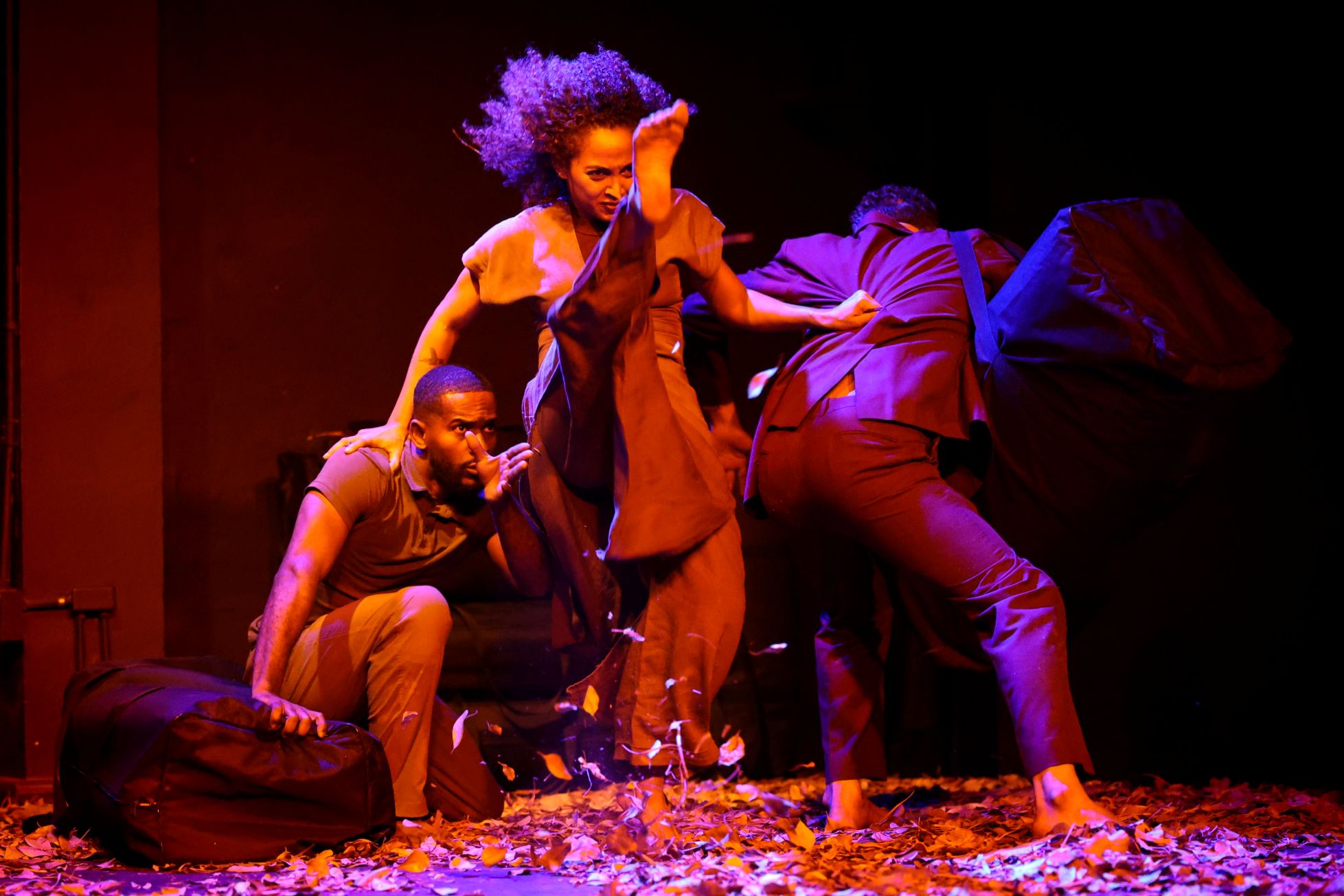
A stage full of dead leaves, some travel bags, the kind that we Cubans call worms, extremely expressive lighting, which at times segments the scene and at times accompanies the action like another character, and the music that invades everything, strong, suggestive, mobilizing emotions in itself, in addition to the careful choreographic evolutions, is all Marianela Boán Danza has to weave this new prodigy.
In this way, Boán alerted viewers in the program:
“This is an Antigone without Creon, trapped in the dictatorship of kinship. She lives with her internal dictator. She rebels against Creon’s power but succumbs to the supposed feminine virtue of submission. Female sacrifice established as a daily habit to the limit of self-immolation. Antigone, Oedipus and Polyneices, always emigrants, cling to their essences to survive. Elegguá to open the roads, Oyá to announce death, accompany these Greek characters who come from the Caribbean.
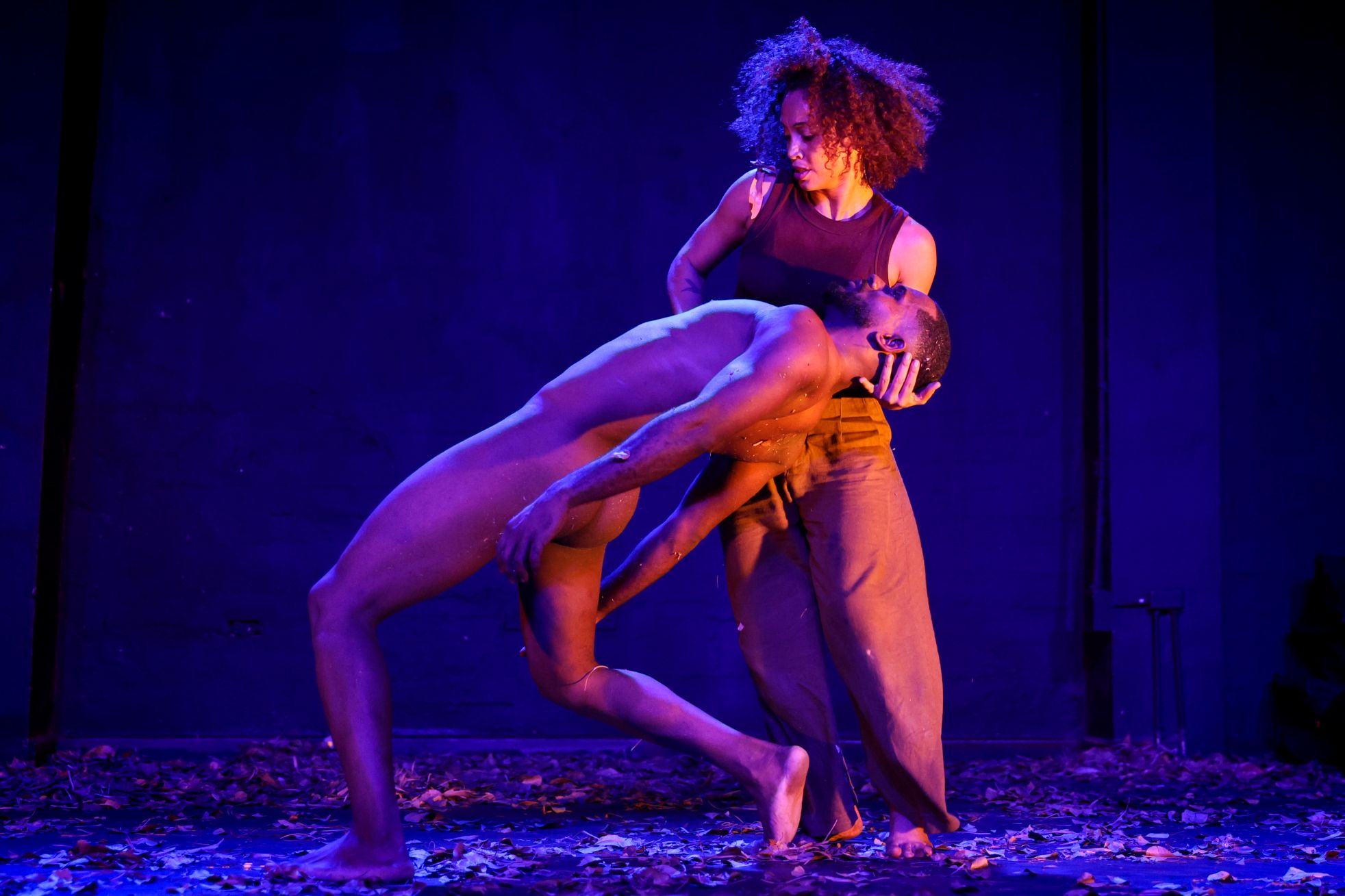
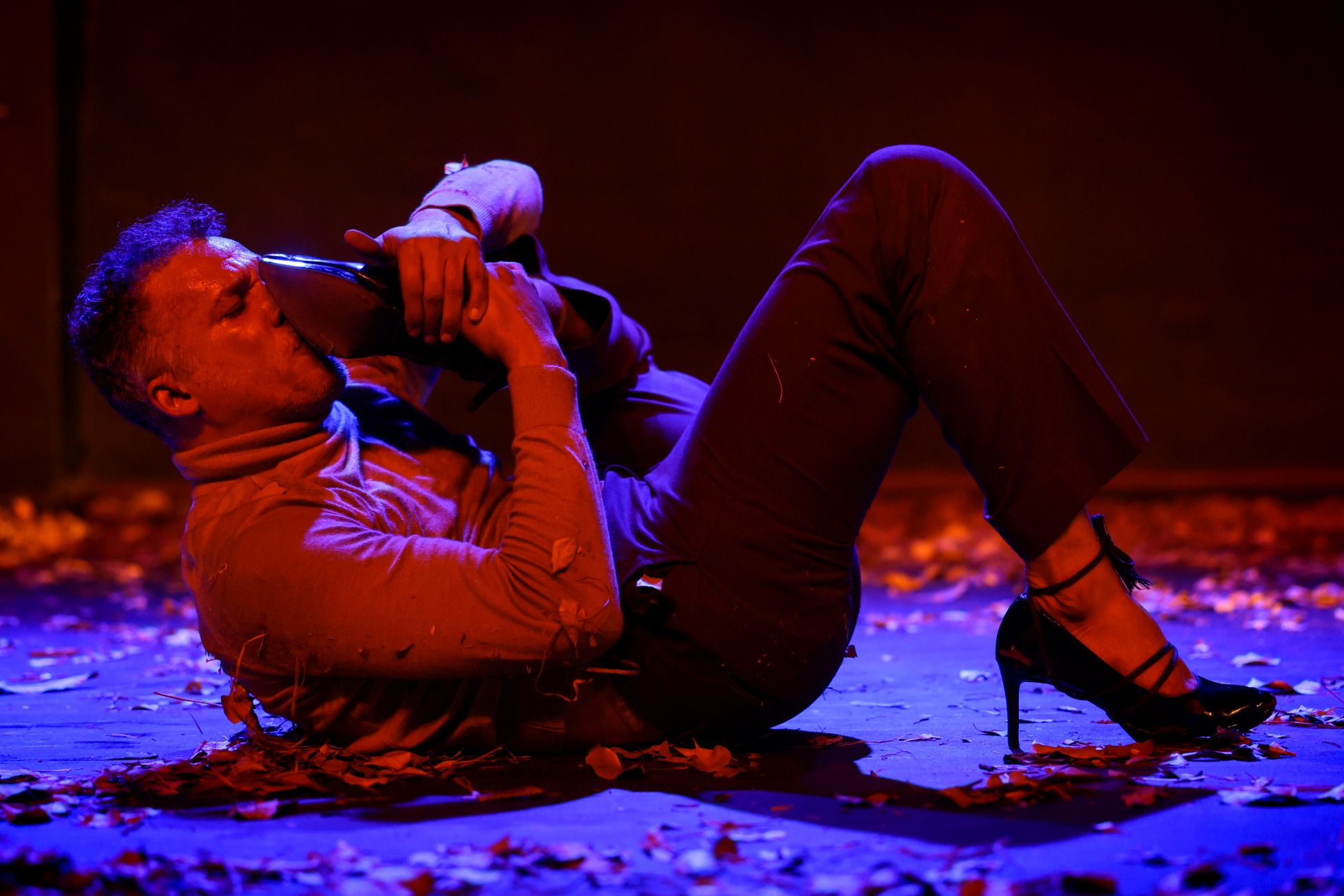
“Antigone, caregiver, emigrant, rebel and submissive, brave and coward, is a reactor that generates a magnetic field that moves the rest of the characters and the audience. Polyneices is a boxer and is obsessed with violence. Oedipus wanders blind and cross-dresses remembering Jocasta. Antigone carries the enormous naked body of Polyneices trying to hide it. Theatre, dance, dry leaves and the heavy packages carried by those who emigrate.”
This work has already come a long way. It premiered on May 15, 2025 at Casa de Teatro, Dominican Republic, Marianela’s country of residence for several decades. She then participated in the Fragmentos International Dance Festival in June, Ecuador, and in the International Classical Theater Festival in Mérida, Spain, in July.
Next to me, in the Covarrubias room, an art critic was amazed by the plasticity of the show. At every moment he told me about the evolutions of the dancers, “they are drawings.” Which speaks of the beauty of the compositions with the bodies and the stage atmosphere created.
Now Reactor Antígona needs to travel to Cuba, the place where Marianela emerged, as a dancer and choreographer, into the world, where she is remembered and loved. There he belonged to the Cuban Contemporary Dance group, founded the Danza Abierta company and formulated the theory of contaminated dance, which has governed his poetics. She deserves, at the very least, a retrospective of her work in Havana.
I want to finish these notes on the fly with a fragment of the message that Marianela Boán made known in 2018 for Dance Day:
Your body begins before yourself and is the place of all the rituals that belong to you.
When you listen to your body through dance, you also listen to the bodies and dances of seduction and celebration of your ancestors and your species.
In your body you carry the dances that will save you.
Whoever dances touches the other beyond the skin; It touches its weight and its smell, defeats touch screens and erases the borders between bodies and nations.
Being a choreographer in Cuba and the Dominican Republic, the magical islands where I live, surrounded by the Caribbean Sea and people who dance before they are born, is an unspeakable privilege.
Dancing is the great antidote to humanity’s madness.
To every displaced person, refugee and exile in the world, I say: you have a country that goes with you and that nothing and no one can take away from you; the country of your body.”
Amen.