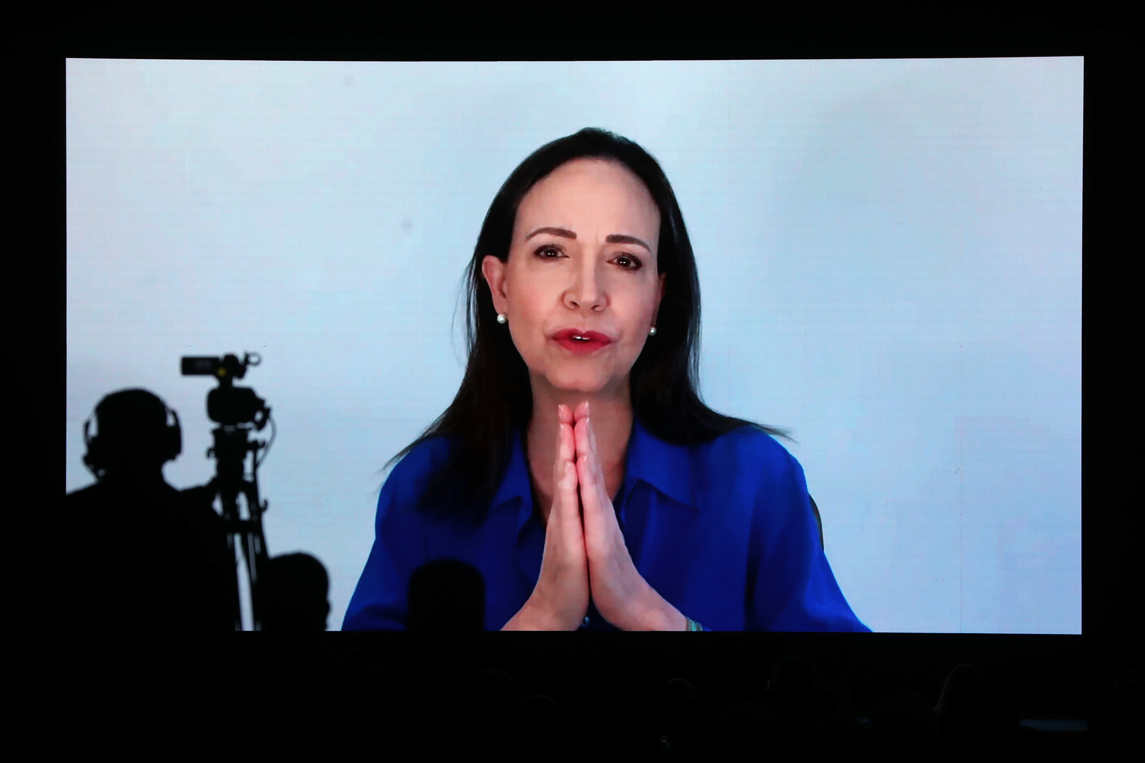
When the pressure on Venezuela continues uphill, the opposition leader and 2025 Nobel Peace Prize winner, María Corina Machado, publicly and without fissures supported Donald Trump’s military strategy against the government of Nicolás Maduro, which she described as “absolutely correct.”
That position, however, contrasts with the call for dialogue by Pope Leo XIV, who warned that “violence does not win” and called for a peaceful solution to the crisis.
During her participation this Wednesday by videoconference at the America Business Forum in Miami, the leader of the opposition party Vente Venezuela defended the military actions of the United States in the Caribbean, which target drug trafficking and the alleged involvement of the Venezuelan authorities in the so-called Cartel of the Suns.
The Nobel Peace Prize winner argued that Nicolás Maduro is not a legitimate head of state, but rather the leader of a narco-terrorist structure that has declared war on the Venezuelan people and the democratic nations of the region.
“Maduro started this war, and President Trump is ending it,” said Machado, who highlighted that criminal networks in Venezuela survive thanks to drug trafficking, gold smuggling, and arms and people trafficking.
For her, the Republican president’s strategy is a turning point in the region and should mark the end of the current Venezuelan government, something that “will happen no matter what Maduro does,” the agency reports. EFE.
The leader of the Venezuelan opposition, María Corina Machado, affirms that the ruler of Venezuela, Nicolás Maduro, “started this war” and that Donald Trump “is ending it.” https://t.co/AhiJKAQHvB
— EFE News (@EFEnoticias) November 5, 2025
Another Caribbean crisis?
Machado’s statements coincide with the growing US military deployment in the Caribbean, which includes destroyers, reconnaissance aircraft and armed drones. According to official sources, these operations target drug trafficking networks allegedly linked to the Maduro Government.
In October, the Gerald R. Ford aircraft carrier strike group entered the Caribbean, sparking speculation about possible military action inside Venezuela.
Since August, Washington began concentrating a major deployment in the southern Caribbean as part of a force that included three destroyers equipped for anti-aircraft, anti-submarine and missile defense missions, in addition to an amphibious group of about 4,500 troops. P-8 reconnaissance planes and long-range surveillance flights have mapped the routes of illicit trafficking, according to published reports on the matter.
The operation was expanded in September with the stationing of 10 F-35B fighters at the Ceiba Air Base, in Puerto Rico, and the deployment of MQ-9 Reaper armed drones at the Rafael Hernández Airport. According to US officials, these aircraft can attack drug laboratories, clandestine airstrips and vessels linked to smuggling networks.
Until now, the attacks have focused on vessels suspected of transporting drugs and have left more than 60 alleged traffickers dead, in a practice that international experts and governments opposed to these operations, such as Cuba, describe as extrajudicial executions.
In 1962, the world was very close to the Third World War with the placement of Soviet tactical missiles in Cuba, with nuclear charges, which unleashed the so-called Caribbean crisis or missile crisis, given the punitive intervention of the United States. That scenario is connected to the current one due to its geopolitical implications in the Caribbean area and because it has as a backdrop the actions of nuclear powers such as Russia, China and the Americans themselves.
The domino effect of Machado vs. the Pope’s call for dialogue
During her videoconference at the America Business Forum, María Corina Machado referred to the possible domino effect of a fall of the Government of Nicolás Maduro. “If Venezuela is liberated, Cuba and Nicaragua will also be liberated,” he said in his speech before business and political leaders.
Graduated in industrial engineering and known for her rhetorical duel in 2012 with then-president Hugo Chávez in the National Assembly, Machado also presented her vision of what the transition to democracy in Venezuela would be like.
In this regard, he pointed out that the first 100 days of an eventual democratic government led by the opposition would seek to emphasize security and social order, while establishing bases for economic development, based on greater openness to foreign investment, particularly the country’s oil reserves, and a “massive privatization,” he said. EFE.
Contrary to the recent Nobel Peace Prize winner’s support for the White House’s military strategy, Pope Leo XIV urged the search for peaceful solutions to the Venezuelan crisis. During a statement at Villa Barberini this week, the pontiff expressed concern about the increase in military tensions near the Venezuelan coast.
“We do not win with violence,” said the Pope, who asked the governments of the United States and Venezuela to seek dialogue to resolve their differences. Nicolás Maduro publicly thanked the Holy Father for his call, describing it as “very forceful.”
Trump widens the angle of his war scope
For his part, Donald Trump stated this Wednesday in the same forum that the bombings against “terrorist cartels” are not limited only to Venezuela, pointing out that there are “other” countries involved after more than two months of US attacks on boats in the Pacific and the Caribbean.
“We are exploding terrorist cartels and we are bursting them, linked to the (Nicolás) Maduro regime in Venezuela and others. Look, it is not just Venezuela, but a lot of things are coming,” Trump declared, opening the way to speculation.
The president, who did not clarify which other countries he was referring to, defended the attacks that have killed at least 66 people on almost 20 boats in the Caribbean and the Pacific since September 1, and assured that “for every boat bombed, 25,000 Americans are saved,” by preventing the alleged drugs destroyed by the Southern Command from entering the country.
His statements occur while his Government is analyzing bombing military targets inside Venezuela, as reported days ago by media such as The Wall Street Journal and Miami Herald. These versions were denied by the president and Secretary of State Marco Rubio.
At par, NBC reported this week that the US Government is studying military attacks against cartels in Mexican territory.
In his words yesterday, Trump also reiterated that “Venezuela emptied its prisons within our country,” a statement he has made before without data support.
“No one wants that. They emptied their prisons in our country. We are freeing our cities from the scourge of violent crime, making our country safe and beautiful again,” he said.
In addition, he maintained that his Government is “arresting and removing from the United States thousands and thousands of dangerous gang members” such as MS-13 – the so-called Mara-Salvatrucha – and the Tren de Aragua. “These are criminals, they are bad people. We are taking them out of the country, back to where they came from,” commented the Republican.
Previously, in statements to the program 60 Minutes of the C.B.S.the president responded to the question of whether the United States was going to go to war with Venezuela: “I doubt it. I don’t believe it. But they have treated us very badly.”
When asked if the United States planned to carry out ground attacks, Trump refused to rule it out, responding: “I wouldn’t be inclined to say that it would… I’m not going to tell you what I’m going to do with Venezuela, if I’m going to do it or if I’m not going to do it.”
Venezuelan capabilities
In theory, Venezuela appears to have solid defenses that could match the military power of the United States, commented the newspaper The New York Times in an extensive report on the defensive capabilities of Caracas and its military trade with powers such as Russia, China and Iran, the latter to a lesser extent.
“The country’s unusual arsenal, acquired largely from U.S. adversaries and complemented by years of weaponry given to civilians to bolster its defense, shows the challenges the United States could face as it concentrates its forces in the Caribbean,” observed the Timeswho pointed out as one of the weaknesses of the Venezuelan army that it lacks “the experience of actually having fought in a war,” unlike its Colombian counterpart.
The Venezuelan arsenal is mainly composed of Russian weapons, complemented in recent years by material from China and Iran. It signed a similar partnership agreement with this Islamic country in 2022 and also locally manufactures Iranian-designed drones.
In addition, Caracas also still has equipment from France, the United Kingdom, Spain, the United States and Germany, although both Europe and Washington maintain arms embargoes against Venezuela.
“The United States is also not interested in risking having a conflict and having coffins start arriving at home…Like in Vietnam…or like what is happening to Russia in Ukraine,” said the professor of International Relations and expert in military history Felipe Debasa.
The United States lost approximately more than 58 thousand soldiers during the Vietnam War. That historic conflict ended in the 1970s with a humiliating military defeat for Washington at the hands of the guerrillas of the National Liberation Front of Vietnam, called Vietcong by the invaders and supported by the then North Vietnam and other socialist countries.