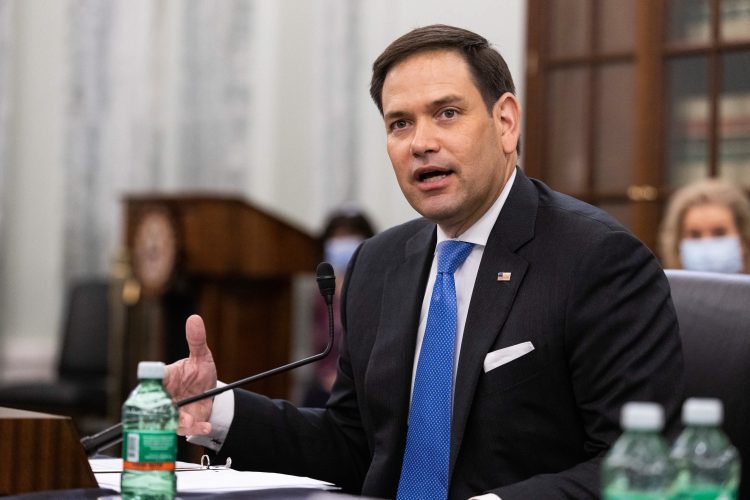
The Secretary of State, Marco Rubioreaffirmed the legality of fuel sales authorized by his Government for the Cuban private sectorwhich he classified as “very small.”
In statements to the press during his participation in the summit of the CARICOMthe Cuban-American politician asserted that these shipments, questioned by opponents of any bilateral approach or concession to Havana, are not for the Government or the military conglomerate GAESA.
In addition, he denied that the Treasury Department’s announcement about the shipment of Venezuelan oil to private companies means a change of direction amid the pressures and the Trump Administration’s oil siege on the island.
“No, it has always been legal to sell to the private sector in Cuba, okay? These would not be sales to the government. They would not be sales to the company GAESA, owned by the military. They would be sales to a very small private sector that exists in Cuba, and that has always been legal,” he asserted.
Rubio said that these sales are based on “the same reason” that his Government has sent humanitarian aid to the victims of Hurricane Melissa through the Catholic Church. However, he stressed that “that alone will not solve Cuba’s dramatic problems,” which he blamed on government “mismanagement” and “a failed economic model,” without mentioning US sanctions.
Warning to private parties
Rubio pointed out that there are already licenses to carry out these operations and now “it would simply expand to the number of people who could do it.”
“Again, I would go to the private sector. The private sector in Cuba is quite small. It exists, but it is small. And certainly, on its own, it does not have the capacity to address the scale and scope of the challenges that they face,” he reiterated, according to statements published by the State Department.
The Republican, who is a staunch critic of Havana, affirmed that Trump’s policy towards Cuba since his first Administration “was designed, in many ways, to place the private sector and Cubans – not affiliated with the government or the military – in a privileged position”, something that in his opinion supports the authorization to sell fuel to them.
However, the head of US diplomacy warned that if Washington discovers that the Cuban private sector “is manipulating and diverting fuel to the regime or to the military company” that benefit would disappear.
“If we discover that they are moving that material in ways that violate the spirit and scope of these permits, those licenses will be canceled,” he said.
“It’s your fault.”
In his statements, in which he also addressed other aspects related to Cuba and the current international scenario – such as a possible military conflict with Iran – Rubio insisted on blaming its authorities and its economic system for the worsening of the crisis on the island.
“It’s their fault,” he said, while ensuring that the Government is “incompetent” in economic matters. “It’s not even an economy. It’s a total dysfunction,” he said.
Without referring to the impact of the historic embargo—which Havana considers the main cause of the island’s precarious situation—nor of the current oil siege, the politician considered that “Cuba has survived largely thanks to subsidies” from countries such as the USSR and Venezuela, and that now without these subsidies the country is going through its worst economic climate.
“They are the ones who have made decisions that have left Cuba vulnerable to the situation it finds itself in now,” he said, referring to the Cuban authorities.
The path of reforms
In this logic, the Secretary of State affirmed that the Government of the island has not allowed private businesses to develop and considered that “if the Cuban economy worked, it would have a much larger private sector.”
In this sense, as he had already done in a recent interview with BloombergRubio once again pointed to economic opening as a way for change in the Caribbean country.
“If (the authorities) want to open the doors and allow the Cuban private sector, independent of the army and the government, to grow, the solution is there,” he said.
Furthermore, although he stressed that Cuba “needs to change drastically,” he also left the door open to a gradual transformation.
“It doesn’t have to change suddenly,” he said, and said that the US would “love” to see Havana implement “drastic” reforms that open “the space for economic and, eventually, political freedom for the Cuban people.”
Instead, “if they decide to hunker down and just move forward, I think they will continue to experience failures and the people of the country will continue to suffer,” he emphasized.