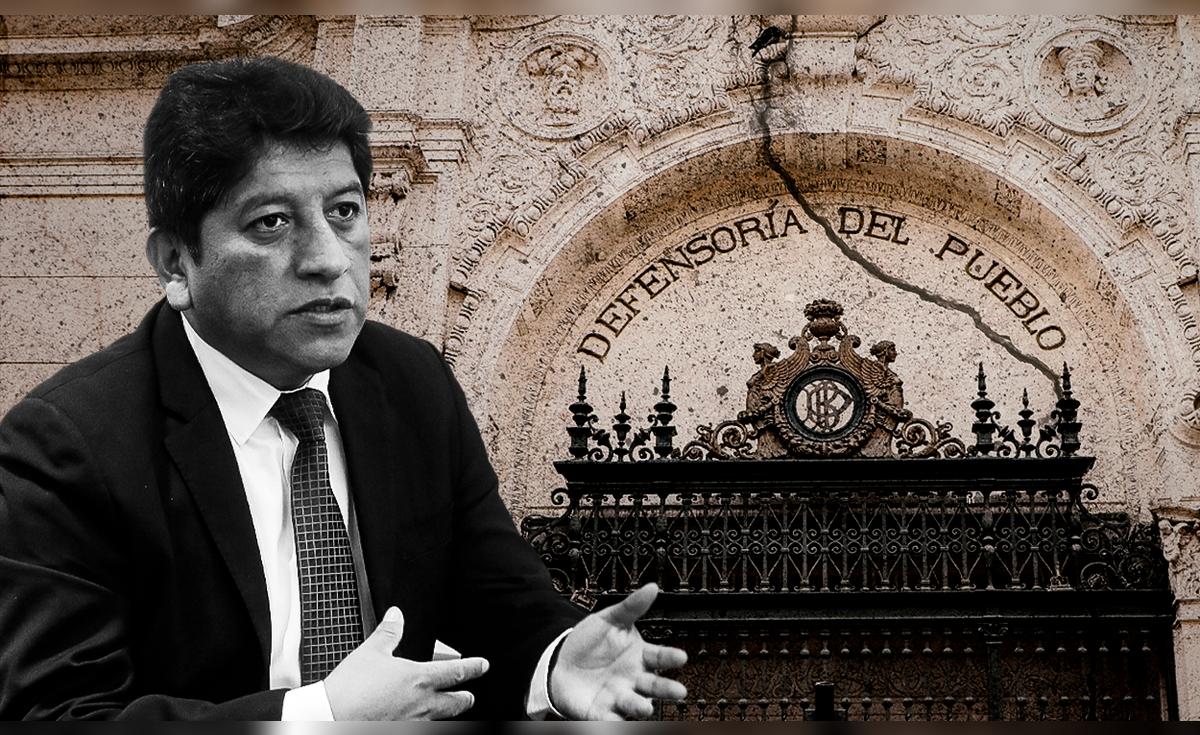
The management of Joshua Gutierrez has deepened the institutional deterioration of the Ombudsman’s Officeaccording to workers, former defenders and international organizations. They point out that his leadership has weakened the autonomy of the body in charge of protecting fundamental rights and supervising the State.
listen to the newsText converted to audio
Artificial intelligence
Various actors agree that the institution is going through an unprecedented internal crisis. The political alignment of the defender and his silence in the face of serious complaints are questioned, which, according to specialists, affects the credibility of the organization and its ability to act impartially.
WE RECOMMEND YOU
BYE LAVA JATO AND WHITE NECKS + ELECTIONS | WITHOUT SCRIPT WITH ROSA MARÍA PALACIOS
The workers’ union maintains that the decisions of the current administration have generated internal tensions, unjustified changes and a reduction in the entity’s supervisory role. For them, the problem is not administrative, but structural: the constitutional mission of the Ombudsman’s Office has been compromised.
At an external level, the management of Joshua Gutierrez also faces questions. He Accreditation Subcommittee of the Global Alliance of National Human Rights Institutions (GANHRI) has initiated observation processes in the face of possible setbacks in independence standards, which places the Peruvian institution under unprecedented supervision in the regional context.
Former defenders, such as Walter Albán, describe this scenario as a threat to democracy. They consider that the lack of autonomy in the Ombudsman’s Office not only affects citizen attention, but also opens space for political interference that weakens the control of power.
The combination of internal tensions, institutional setbacks and international observations paints a complex picture. Different voices agree that the entity is going through one of its most critical moments since its creation and that the decisions of the current management are accelerating its wear and tear.
De la Peña also warns that the management of Joshua Gutierrez has directly affected the public image of the Ombudsman’s Office. He points out that workers perceive a growing distance from citizens, who previously trusted the institution as a space for defense against abuses of power and who today question its lack of pronouncement in critical situations.
The general secretary highlights that this scenario generates widespread demotivation among the entity’s employees. He maintains that the institutional deterioration It is not only reflected in administrative decisions, but also in the loss of the ethical sense that guided the defense work, which puts at risk the continuity of a key institution for the protection of fundamental rights.
Union warns of internal deterioration and loss of independence
Gilmer De la Peña, general secretary of the union, pointed out that the current stage is marked by arbitrary decisions that affect labor stability and the technical structure of the institution. It states that changes have been made without technical support and that specialized profiles have been displaced, which affects the operational capacity of the Ombudsman’s Office.
“The workers consider that this management is destroying the Ombudsman’s Office (…) They have withdrawn all the technical staff and have appointed people who do not meet the requirements for those positions,” he commented.
The leader warns that under the leadership of Joshua Gutierrez There is a tendency to minimize sensitive complaints. According to him, the institution has stopped speaking out on cases of state abuse, violations of rights and emergency situations where historically it intervened firmly.
For the union, this institutional silence is not coincidental. De la Peña assures that there is a political orientation in decision-making, which affects the autonomy of the organization and conditions its public interventions. He points out that this is incompatible with the constitutional mandate of the Ombudsman’s Office.
The leader adds that there have also been internal tensions due to the lack of dialogue with the workers. He assures that the current management has not established coordination spaces or responded to formal requests from the union, which increases staff uncertainty.
“Now there is a closed-door policy. No official receives us (…) We have never had a management like this. Before there was always dialogue and respect,” he stated.
The union secretary emphasizes that the union’s objective is not to confront, but to defend the mission of the institution. For this reason he insists that the administration of Joshua Gutierrez It must correct its decisions, guarantee transparency and recover the supervisory role that has historically characterized the Ombudsman’s Office.
Former defender Walter Albán: “The Ombudsman is experiencing its most serious moment since it was created”
Walter Albán, former ombudsman, maintains that the current administration is going through a critical scenario because it has weakened the principles that support the institution. He points out that the Ombudsman’s Office has lost independence, one of its essential pillars, and affirms that this compromises its legitimacy in the eyes of citizens.
“The Ombudsman’s Office today is not even a shadow of what it was (…) The Ombudsman has become a defender of Congress,” he said.
Albán considers it especially worrying that the institution remains silent in the face of social conflicts and state abuses. He assures that this type of omissions is unprecedented and constitutes a setback in rights protection standards that the country had consolidated over two decades.
The former defender remembers that the Ombudsman’s Office must act without political alignments. However, he warns that under the leadership of Joshua Gutierrez Decisions oriented to favor the interests of the Government and Congress are perceived, which shows a break with institutional autonomy.
He also points out that the international community has begun to observe the Peruvian situation with concern. For Albán, the international review is not a symbolic gesture, but rather an alarm signal about the seriousness of the institutional deterioration that passes through the entity.
Albán adds that the loss of independence has direct consequences on citizens. He explains that a weakened Ombudsman’s Office reduces the country’s ability to respond to abuses, state violence or inaction by authorities, affecting vulnerable populations that depend on its intervention.
It emphasizes that the solution involves recovering autonomy, restoring technical criteria and guaranteeing that the institution once again acts firmly against any violation of rights. He assures that, if not done, the Ombudsman runs the risk of becoming an irrelevant body for Peruvian democracy.
Walter Albán maintains that the damage caused during the management of Joshua Gutierrez It is not limited to the short term. He warns that the political capture of the Ombudsman’s Office It could leave profound consequences on its future functioning, since rebuilding citizen trust and recovering international standards of independence will take several years if a suitable successor is not chosen.
The former defender emphasizes that the institutional deterioration It is not an isolated event, but part of a broader context of democratic weakening. In this framework, it points out that the loss of autonomy of the Ombudsman’s Office contributes to a scenario in which citizens are more exposed to abuses of power, without a strong body that acts as an effective counterweight to the State.