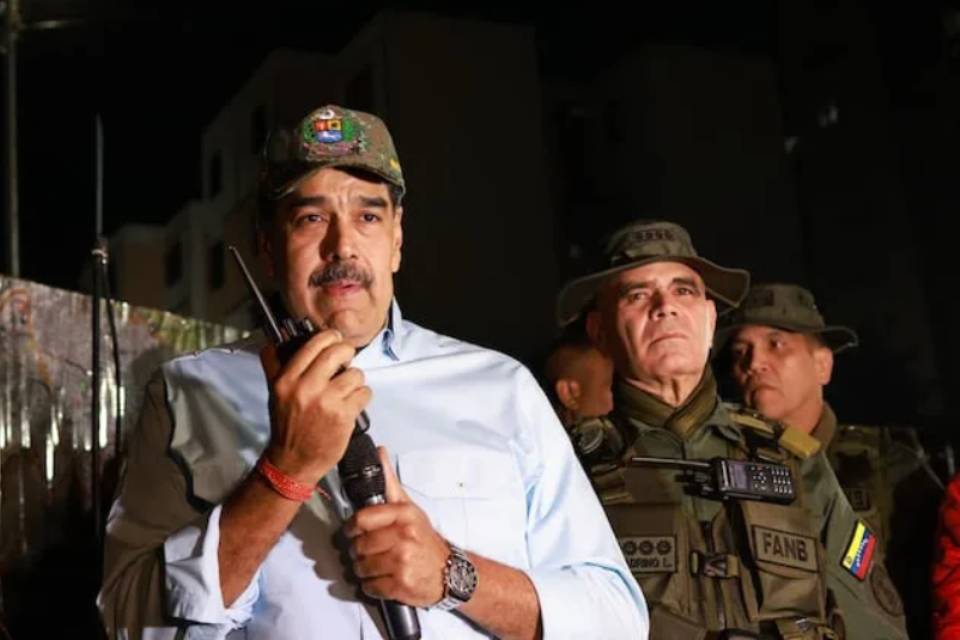
The Venezuelan high command has designed a defense strategy that relies on guerrilla tactics and the “anarchization” of the country if Washington orders an intervention, says Reuters. At the same time, Donald Trump’s administration is studying options ranging from selective airstrikes to operations to take control of oil fields and groups that protect Nicolás Maduro, according to the United States press.
Venezuela has drawn up plans that outline a guerrilla-style response — internally called “prolonged resistance” — and a second clandestine route that seeks to sow urban disorder to make it difficult for a foreign force to take action, according to sources and planning documents. consulted by Reuters. These papers, which have been prepared for several years, contemplate deployments of small units in more than 280 points of the territory to carry out sabotage and harassment actionswhile the so-called “anarchization” would resort to intelligence services and armed militants of the official party to generate chaos in cities like Caracas.
This Monday, Nicolás Maduro affirmed that Chavismo will respond with an “insurrectionary general strike” in case the United States undertakes military action against its government, stating that the workers will paralyze the country’s productive activities “until Chavismo is returned to power.” “From the very moment the order for mobilization and combat operations of the entire people will be decreed (…) and the Venezuelan working class will begin an insurrectionary general strike,” he stated.
a month agoMinister of Culture Ernesto Villegas said in Madrid that “if the United States persists in its intention to enter Venezuela, it will find an unexpected surprise here. This will be worse than another Vietnam for Americanswho are sowing a trail of lies to justify this intervention. Already in 2019Maduro himself said, when Donald Trump governed for the first time in the White House, that “if the United States tries to intervene against us, they will have a Vietnam worse than they could have imagined.”
The limitations of the Armed Forces – low salaries, shortage of supplies and decades-old equipment – largely explain why the administration of Nicolás Maduro has chosen to prepare irregular tactics instead of a conventional defense, say military personnel and analysts cited by Reuters. A critical assessment in these sources admits that, in the face of US military power, Venezuela “would not resist two hours in a conventional war,” and that these measures technically seek increase the political and operational cost of an intervention rather than guarantee a military victory.
In Washington, according to reports examining internal White House deliberations, the debate centers on a range of options ranging from air attacks on military installations and alleged drug trafficking centers to special missions to capture or neutralize high-ranking officials, including President Maduro himself. The New York Times and Washington Post describe how advisors close to the president push for aggressive alternatives—including the seizure of oil fields or surgical strikes against units that protect the president—while the presidency shows reluctance due to the risks to the troops and the legal and political implications.
These proposals include, according to the chronicles, three types of plans: 1) selective air attacks to degrade the military capacity that protects the leadership; 2) special forces operations to capture high value targets; and 3) more complex operations to secure airfields and strategic oil areas. The New York Times warns that, in addition to the tactical risks, there is a legal vacuum that the Department of Justice attempts to fill to technically justify actions beyond those currently waged at sea against suspicious vessels.
The convergence between the Venezuelan strategy of maximizing the cost of an intervention through irregular tactics and the range of US options raises a high risk scenario for civilians and for regional stability. Analysts consulted by the agencies recall that an operation aimed at displacing or capturing leaders involves urban clashes, possible damage to critical infrastructure—including oil fields—and unforeseeable consequences in internal security, with armed groups that could take advantage of violence to expand their control. Washington Post underlinesFurthermore, that the public concentration of forces (for example, the movement of the aircraft carrier USS Gerald R. Ford to the Caribbean) serves a function of psychological pressure in addition to an operational utility.
From Caracas, the administration of Nicolás Maduro has tried to convert the mobilization and display of war material into a deterrent message: to show the capacity for resistance and the possibility that weapons and uncontrolled militias will cause a spiral of violence after an intervention. Critical observers point out that this rhetoric seeks to deter, but at the same time adds a layer of risk by suggesting that, in the event of aggression, the country could plunge into a prolonged phase of fragmentation and violence, with lasting effects on governability.
*Journalism in Venezuela is carried out in a hostile environment for the press with dozens of legal instruments in place to punish the word, especially the laws “against hate”, “against fascism” and “against the blockade.” This content was written taking into consideration the threats and limits that, consequently, have been imposed on the dissemination of information from within the country.
Post Views: 255