In a campaign in which no presidential candidate manages to exceed 10% of voting intention, presidential candidates are tempted to offer gold and silver in the hope of attracting more votes and appearing in the race. But between offers and offers, they could fall into the temptation of giving gifts.
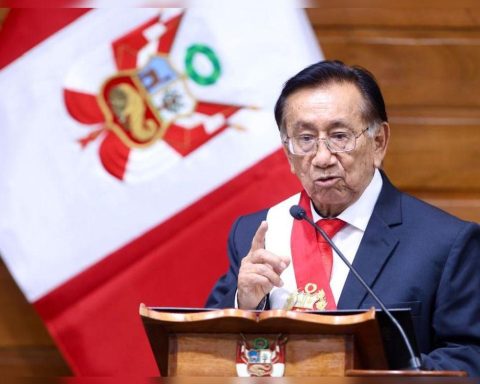
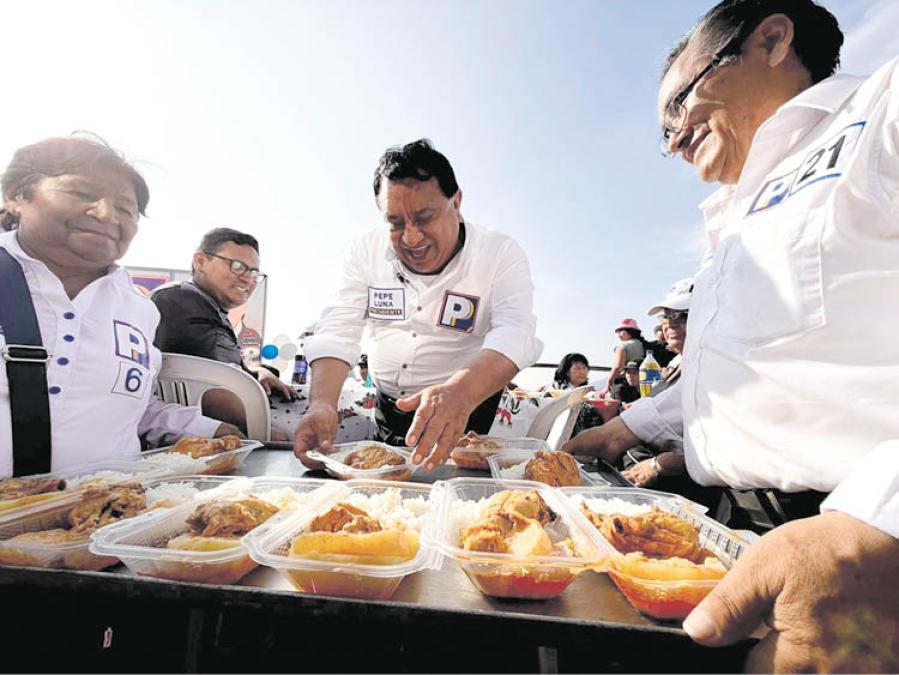
This is the case of the congressman José Luna Gálvezfrom Podemos Perú, who recently visited the AH Buenavista San Germán, in San Martín de Porres, where he brought a chocolate bar and Christmas show, and gave candy lollipops to the children. In his TikTok account, it is indicated that in places like that children play with lizards and that, like him in the past, they drink “contaminated water” and eat “bread alone or with sugar.” In another video, he promises to give “the poor half of the salary of congressmen.”
He also offers that “the yellow stairs will return” to the hills, and he is seen mobilizing stone blocks to build retaining walls. “Retaining walls and stairs have to come like before,” he is heard saying. With the campaign looming, Luna is on the edge of the ledge.
Background and implications
Could a presidential candidate be excluded for giving gifts during the campaign? It already happened during the 2016 presidential race with César Acuña, of Alianza Para el Progreso. On March 9 of that year, just one month before the elections, the National Elections Jury (JNE) unanimously confirmed the exclusion of Acuña.
That ruling was based on the fact that the former governor of La Libertad violated article 42 of the Law of Political Organizations by giving money and gifts during his campaign. According to the resolution, on February 10, 2016, he gave S/10,000 to merchants at the Señor de los Milagros market in Chosica to build a retaining wall, and on February 8, he gave S/5,000 to a citizen with disabilities in Piura, in campaign events.
“From the above, it is evidently seen that the presidential candidate César Acuña Peralta has incurred in the prohibited conduct provided for in article 42 of the Law of Political Organizations (LOP), since the promise of money made in a proselytizing act of the organization that promotes his candidacy turns out to be openly transgressive of the principles of equity, equality and competitiveness that the norm seeks to protect and which is therefore classified as serious, providing for the corresponding sanction of exclusion,” that resolution read.
At that time, Acuña denied any violation and pointed out that the money given was an “act of solidarity” and not proselytism. However, he was still left out of the process.
What does the law say?
Law 28094, Law of Political Organizations, indicates that it is prohibited to deliver or promise to deliver money, gifts, handouts, food, medicine, water, construction materials, household goods or other goods of economic value, as well as establishes that the prohibition is applied directly or through third parties in the campaign.
Gifts are any delivery of money or its equivalent; material goods such as gifts, food, medicines, etc., and promises to deliver something economical or valuable. The ban seeks to prevent vote buying or electoral coercion.
The law contemplates two exceptions: the delivery of goods for individual and immediate consumption given at free proselytizing events, such as water or snacks, and electoral propaganda items such as pens, almanacs or stickers. These goods must not exceed 0.3% of a Tax Tax Unit (UIT) for each unit delivered. According to the ITU’s calculation of 2025, it would be S/16 per object.
If the delivery of prohibited gifts is determined during the campaign, the respective Special Electoral Jury (JEE) may apply a fine of 30 UIT as a sanction. In case of recidivism, the candidate may be excluded. If the gift given exceeds the value of 2 UIT, the exclusion is immediate.
Untouchable candidates
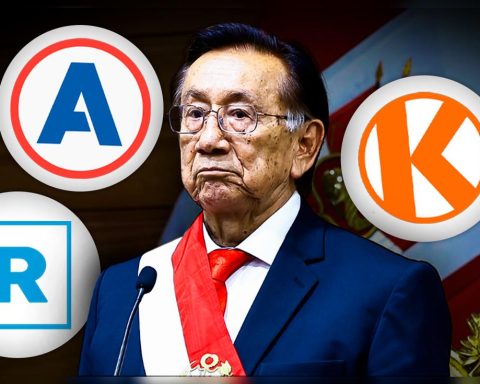
Electoral law specialist José Manuel Villalobos told Perú21 that the law does not sanction the delivery or offering of gifts by presidential candidates. Candidacies are officially registered, at the latest, this Tuesday, December 23. At the moment, only three presidential formulas have been registered, among them that of Avanza País, headed by Congressman José Williams Zapata, and that of APP, led by César Acuña.
“At this moment, when there are no official candidates, the only lock is the moral and ethical issue. You cannot campaign by giving away things; you have to give away proposals,” he said.
In that sense, he said that Luna’s proposals “are populist, but they do not qualify as handouts.”
“You have to take into account the timing of the situation, because for it to qualify as a gift you have to be a candidate,” he explained.
Villalobos recommended to the presidential candidates “not to run clientelist campaigns, to compete through their proposals. Here we are not campaigning to find out who has the most money to give things away. Having a vocation for service does not mean having a vocation for making chocolates.”
In turn, the specialist in electoral issues and former minister José Tello Alfaro agreed that, in this scenario, the pre-candidates are untouchable, despite the fact that their officialization as candidates is a mere procedure because they already won the primaries on December 7.
In dialogue with Perú21, he questioned that the JNE “has not standardized” its criteria because, in the regulations referring to neutrality, electoral propaganda and state advertising, it does sanction candidates when they incur a violation of the norm despite the fact that the registration of candidacies expires only this Tuesday.
“That is a situation that the JNE plenary session should have corrected. If it is a violation of neutrality, you have been a candidate since the primary election, but for the purposes of the gift regulations we are in a different situation,” he said.
Tello said that, with a view to the regional and municipal elections, the electoral body must correct “this contradiction, this legal vacuum.”
However, he emphasized that “this does not exempt the candidates from responsibility, who cannot be giving away things in a clientelistic and negative way, buying votes or support. That does not contribute to democracy.”
“Situations like these are what unnerve every voter, it is part of the Creoleness,” he lamented.