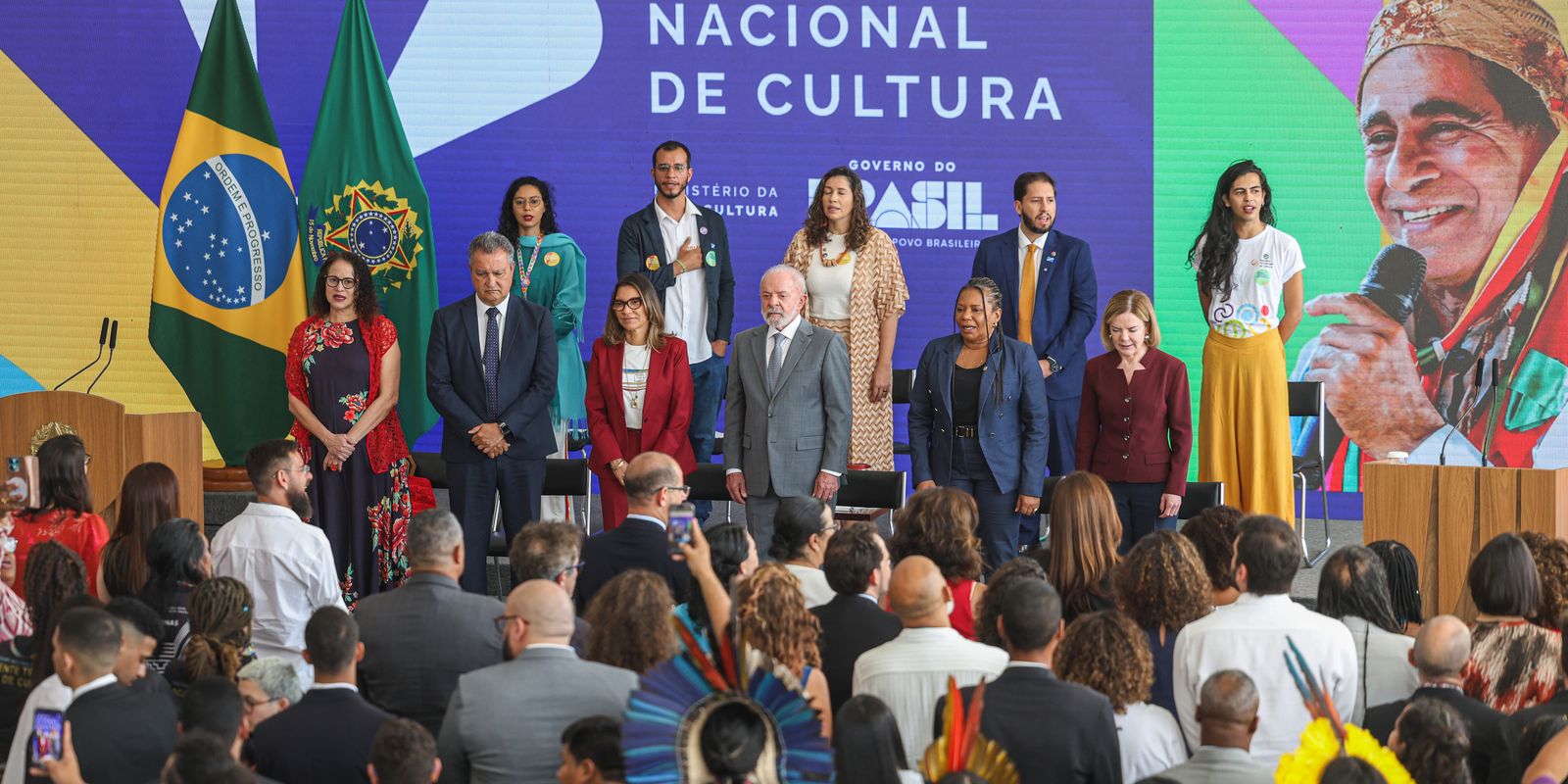
President Luiz Inácio Lula da Silva stated, this Monday (17), that the new National Culture Plan (PNC) wants to create the conditions for communities to explore the cultural potential they have. For him, the country’s culture must be revolutionary, created with social participation and not determined by commercial axes.
A ceremony at Palácio do Planalto marked the sending of the new PNC for analysis by the National Congress. Prepared by the Ministry of Culture (MinC), the plan will guide the country’s cultural policies for the next 10 years.
According to Lula, the plan aims to transform culture into an effectively grassroots, popular movement. “Instead of having those very cramped, very closed things, those domes where everything works correctly, we have a kind of cultural democratic guerrilla in this country, where people need to have the freedom to do things and provoke others to make culture happen,” said Lula.
The event was attended by around 600 territorial agents and representatives of culture committees from all over Brazil, members of the National Program of Culture Committees (PNCC), “which symbolize popular participation and collective commitment to the construction of democratic and accessible cultural policies”.
“I am, in fact, calling on you to be more than cultural agents of the culture committees. You have to be the basis of awareness, of the politicization of a new society that we need to create to definitively break with denialism and fascism”, stated the president.
During the ceremony, Lula also signed the decree that creates the Tripartite Intermanagers Commission, which will monitor the execution of the culture budget and will be the permanent forum for dialogue between the Union, states and municipalities for the implementation of public policies in the sector.
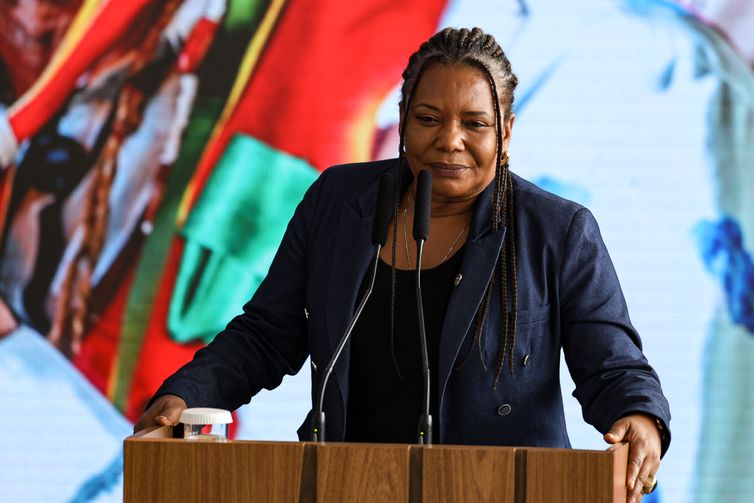
The Minister of Culture, Margareth Menezes, during a ceremony to send the text of the new National Culture Plan to the National Congress. Photo Marcelo Camargo/Agência Brasil
The Minister of Culture, Margareth Menezes, recalled that the model is similar to the Unified Health System (SUS), which also has actions agreed on a federative basis. “It will be our SUS of culture, linking the responsibilities of cities, states and the federal government with the cultural sector. This articulation is very important, it has been necessary for a long time so that we can implement and materialize the strength that Brazilian culture has”, he said.
“We do this with the important support of this network of people here from every corner of the country, territorial agents, culture committees, culture points, participatory councils and federal institutes. Because this is how we bring territories closer to communities in a democratic and inclusive way”, added the minister.
Right to culture
The executive secretary of MinC, Márcio Tavares, said that the plan is made up of eight principles and 21 guidelines. The main one, according to him, deals with the fundamental principle of cultural rights.
“It is in the Constitution and is now organized by the plan, which affirms the right of all people to access and cultural production, to art and the freedom to create and express themselves without any type of censorship, to memory and heritage and to traditional knowledge and practices, participation, accessibility and, for creators, copyright and fair remuneration for their work”, he said.
For Tavares, one of the great advances of this version of the plan is the incorporation of transversal elements that cross all cultural action. Among them, he cites the commitment to the territories and their diverse realities; the elimination of structural barriers that prevent full access to cultural goods; the recognition of indigenous and Afro-Brazilian matrices as foundations of culture; and the responsibility to connect generations in the projection of possible futures.
The plan also has eight strategic axes that bring together the objectives to be achieved in the next decade in the cultural area. They are:
– management and social participation;
– promotion of culture;
– heritage and memory;
– training;
– infrastructure, equipment and cultural spaces;
– creative economy, solidarity economy, work, employment, income and social protection;
– culture, good living and climate action; and
– digital culture and digital rights.
“I highlight here the last two axes that point to the future and that align Brazil with the major global agendas of climate justice and digital sovereignty”, said the executive secretary of the MinC.
Social participation
The territorial agents and cultural committees present at the ceremony are in Brasília for the PNCC meetingwhich started this Sunday (16) and continues until Wednesday (19).
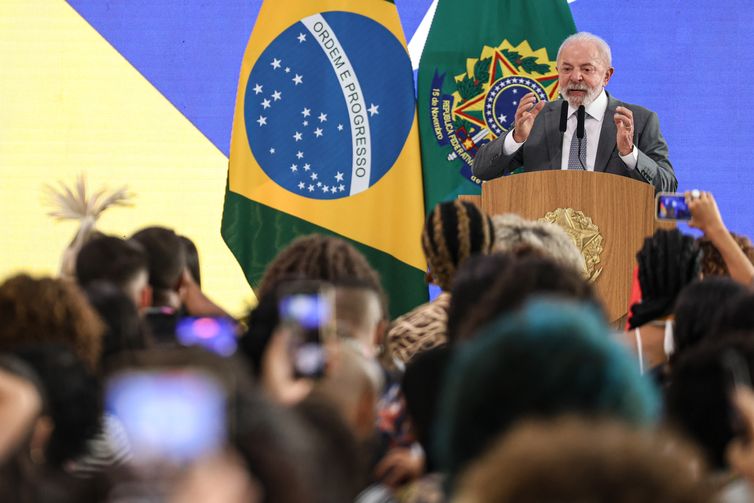
President Luiz Inácio Lula da Silva sends the text of the new National Culture Plan to Congress. Photo Marcelo Camargo/Agência Brasil
Territorial agents are representatives of the diversity of their locations, selected by notices, who will carry out participatory mapping, communication and social mobilization actions, through continued training. They are linked to training courses offered by higher education institutions and, in parallel, carry out cultural action plans in their territories.
The elaboration of the new National Culture Plan was subsidized by the proposals approved during the 4th National Culture Conference (CNC), held by the Ministry of Culture in March 2024. With the theme Democracy and the Right to Culture, the event brought together, in Brasília, 1.2 thousand delegates from across the country, who approved 30 proposals for public policies for the sector.
The representative of civil society at the National Council for Cultural Policy, Shaolin Barreto, highlighted that the plan is a symbol of social participation and collective construction. “We are here at this moment of signing this PL that symbolizes so many other thousands of signatures that this document already carries”, he said, asking for focus and organization in implementing the plan.
“The national council convenes the 4th National Culture Conference after an entire hiatus and putting an end to a moment where they tried to criminalize culture in our country, where they tried to say that culture could not be created in the territories, where they tried to say that our people could not create culture”, he highlighted.
The 4th CNC ended the gap of more than 10 years since the last conference, in December 2013, which evaluated the implementation of the goals of the first PNC.
The pioneering plan was instituted in 2010, by Law No. 12,343after two national conferences, and would be valid until December 2020. However, in 2021 and 2022, the plan underwent two extensions and the text remained in force until December 2024.