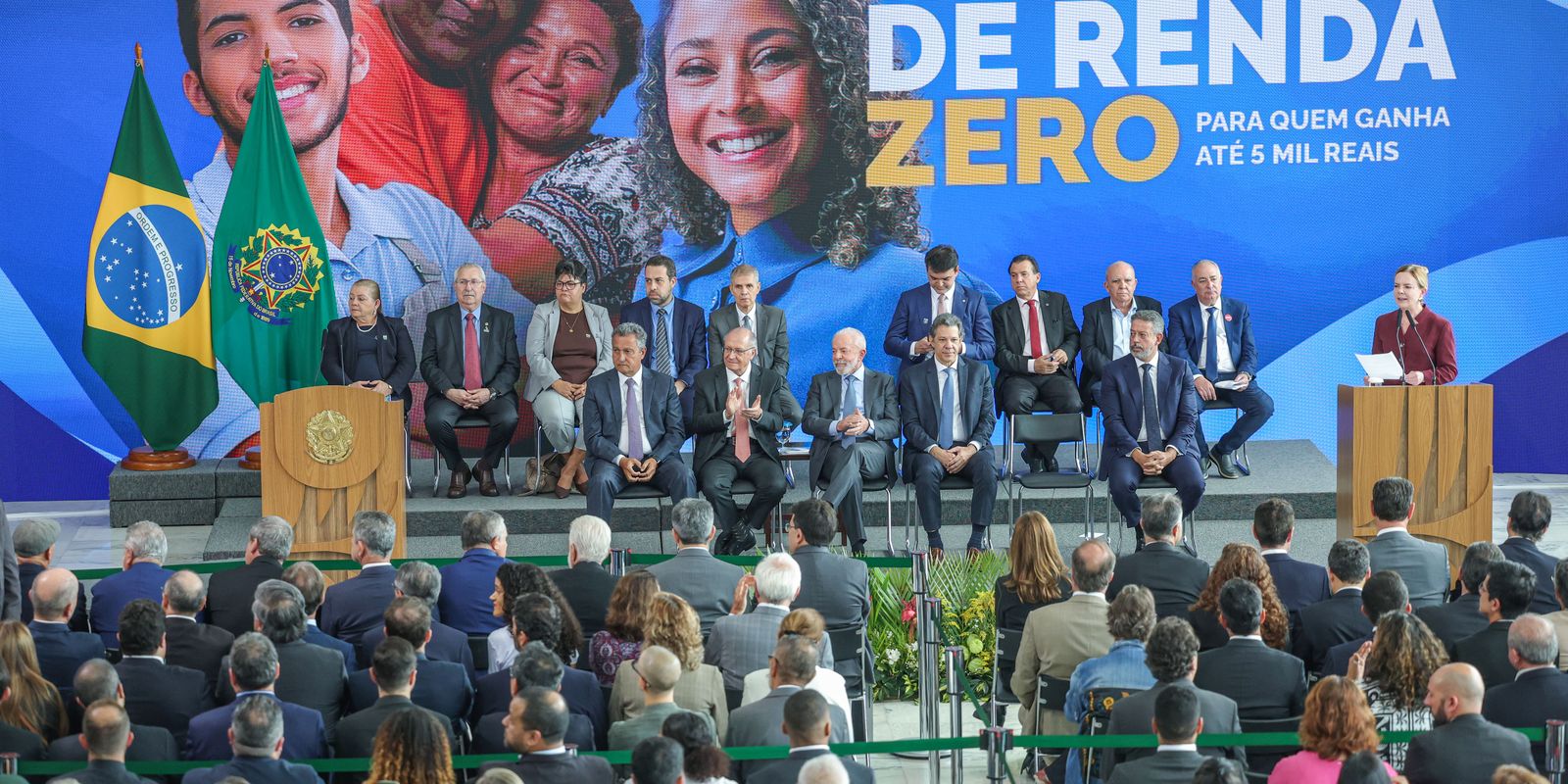
President Luiz Inácio Lula da Silva sanctioned, this Wednesday (26), the exemption from Income Tax (IR) for those earning up to R$5,000 and the increase in taxation for high incomes. One of the main Lula campaign flags in 2022the measure comes into effect from January next year and should benefit more than 15 million Brazilians.
In a speech about social justice and combating inequality, Lula highlighted that there is no “egalitarian society”, but that it is necessary to govern for those who need the State. He reaffirmed that the country’s economic growth is based on the population’s consumption.
“The economy does not grow because of the size of anyone’s bank account, the economy grows because of the consumption that society can have from food,” he said.
“And the rich don’t get poorer. If the poor consume more, the rich will get richer. The rich will sell more meat, more clothes, they will sell more cars. That’s what people need to understand in order to create an economy”, added the president.
Lula repeated a recurring phrase in his speeches – that “a lot of money in the hands of a few means misery, but little money in the hands of many means distribution of wealth”.
“If you take R$10 million and give it to one person, that money will become a bank account and they will live on interest. Take that R$10 million and divide it among a thousand people; that money will become food, clothes, notebooks, it will become something that makes the economy circular and that is what makes the economy grow”, he explained.
THE new lawapproved unanimously by Congress, also establishes tax discounts for people who earn between R$5,000.01 and R$7,350. Currently, the IR exemption only applies to those earning up to two minimum wages.
Of the new beneficiaries, 10 million will stop paying the tax and 5 million will have a reduction in the amount owed.
Experts interviewed by Agência Brasil Lei state that the law has redistributive potentialit will increase family consumption, may reduce debt and will have a positive impact on economic growth.
In practice, the new exemption will have an impact on the Personal Income Tax (IRPF) declaration for 2027, base year 2026.
IR table
There was, however, no correction to the IR table, just the application of exemption and discounts for these new income ranges. A possible correction of the entire table it would cost more than R$100 billion per year, according to government calculations.
So, even with the new law, anyone earning more than R$7,350 will continue to pay 27.5% Income Tax.
Currently, the Income Tax table accumulates an average gap of 154.67% from 1996 to 2024, according to the Inter-Union Department of Statistics and Socioeconomic Studies (Dieese). The last partial correction across all income groups occurred in 2015.
Since 2023, the government has guaranteed the Income Tax exemption for those earning up to two minimum wages, but this only benefits the lower range of the table. In total, the table has five rates: zero, 7.5%, 15%, 22.5% and 27.5%.
Richest
To compensate for the loss of revenue, the text provides for an extra progressive rate of up to 10% for those who receive more than R$600,000 per year (R$50,000 per month), around 140,000 taxpayers. For those who already pay 10% or more, nothing changes.
Today, high-income individual taxpayers collect, on average, an effective income tax rate of 2.5% on their total income, including distribution of profits and dividends. Meanwhile, workers in general pay, on average, 9% to 11% in income tax on their earnings.
Some types of income do not enter this account, such as capital gains, inheritances, donations, income received accumulated, in addition to exempt investments, savings, retirement due to serious illness and compensation. The law also defines limits to prevent the sum of taxes paid by the company and the taxpayer from exceeding percentages set for financial and non-financial companies. If this occurs, there will be a refund in the annual declaration.
The new law also establishes taxation for profits and dividends remitted abroad at a rate of 10%.
Haddad
The Minister of Finance, Fernando Haddad, highlighted that this is a neutral law from a fiscal point of view, as the “upstairs” will pay for the compensation. “When we talk about an adjustment of accounts, everyone shivers and rightly so, because every time an adjustment has been made to the accounts, it has been done on the shoulders of the poorest,” he said.
“This time, we decided to do it differently. This project is neutral from a fiscal point of view. But everything we did to adjust the accounts and which causes some revolt among some people, is that the upstairs was invited to make the adjustment. It wasn’t the downstairs”, added Haddad.
Check out the information in Repórter Brasil Tarde, on TV Brasil